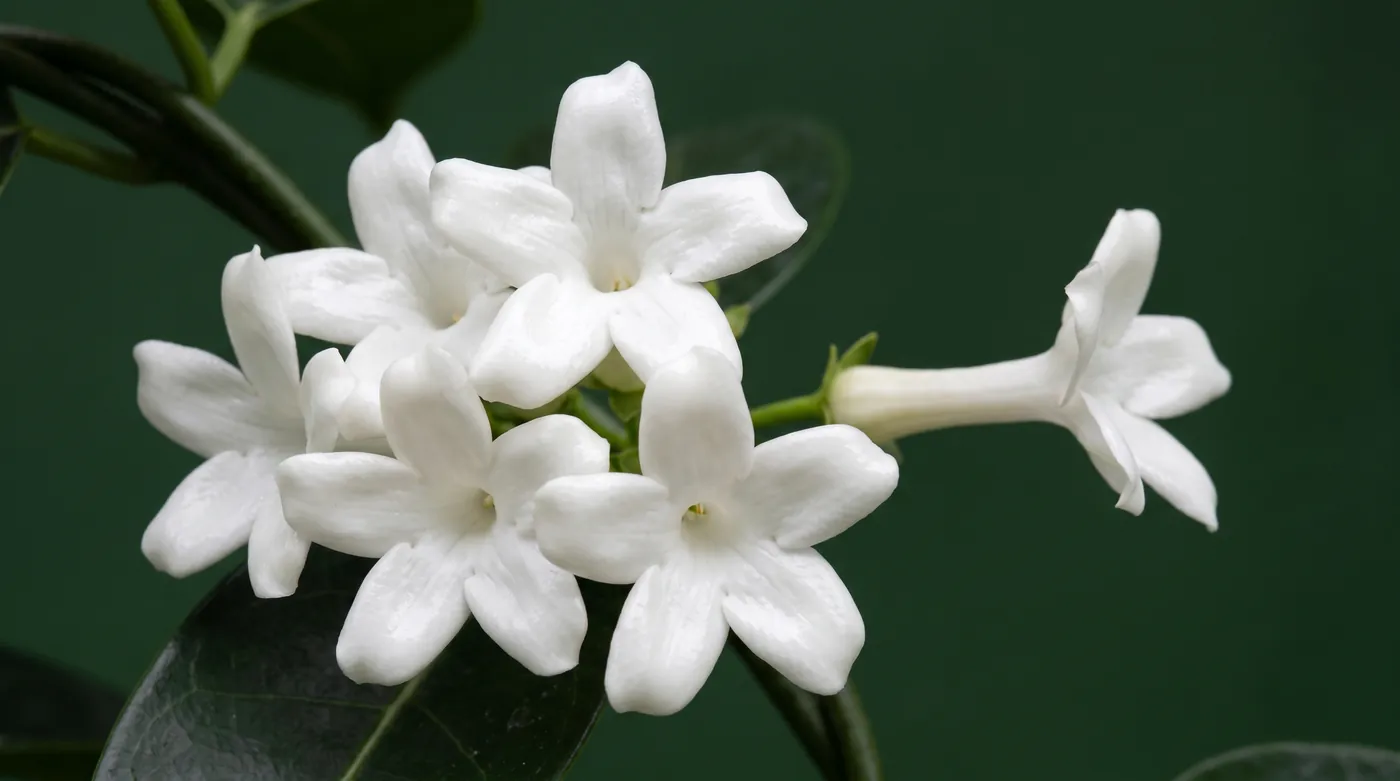
Waxy white star shaped stephanotis flowers on a glossy vine

1 flower in this family

Everything in this guide that belongs to Apocynaceae

Waxy white stephanotis florets with five pointed lobes

Stephanotis

Stephanotis floribunda
3-5 days, longer wired and kept damp

Stephanotis

Milky sap that acts on the heart

Break a stem in this family and it bleeds white, the same as the spurge family does, and the two are worth telling apart because the danger is different. Spurge latex is caustic and burns on contact. This family's latex is not especially irritating to touch, and it is far more dangerous to swallow.

What it carries is cardiac glycosides, compounds that act directly on the muscle of the heart. Oleander is the household example and it is genuinely lethal, in small quantities, from any part of the plant, including dried leaves and the smoke of a fire made from its wood. It has no business anywhere near a food surface.

The same chemistry has been used deliberately for a very long time. African arrow poisons were made from members of this family, and one of those compounds went on to be used to treat failing hearts. It is worth noting that the foxglove, which is in an entirely separate family, arrived at the same class of heart acting compound on its own. Two unrelated lineages found the same weapon.

Floss, monarchs and flowers that smell of meat

The fruit is a pod that splits down one seam and releases seeds each carrying a tuft of fine silk. Milkweed floss is hollow, waxy and extraordinarily buoyant, and when kapok became unobtainable during the Second World War the United States filled military life jackets with millions of pounds of it, collected by schoolchildren.

The monarch butterfly depends on this family completely. Its caterpillars eat nothing but milkweed, and rather than avoiding the cardiac glycosides they store them in their own bodies, so the caterpillar and the adult butterfly are both poisonous to birds. The bold orange and black is an advertisement of exactly that.

At the strange end of the family are the stapelias, low succulents whose starfish shaped flowers are colored and textured like raw meat and smell precisely as bad as that suggests, because their pollinators are blowflies. Frangipani, hoya, mandevilla, desert rose and the periwinkles are all relatives, which is a range from perfume to carrion inside one family.