Thanksgiving is the only one of the big holidays where the flowers are not a gift. They sit on a table that people are eating at, for hours, in a room that gets warm, next to food and candles and a lot of elbows. Every sensible decision about a Thanksgiving arrangement follows from that.
Which is why the most useful thing on this page is not a flower at all. It is a height. A centerpiece that people cannot see over is the single most common mistake of the week, and it is the one that gets quietly moved to the sideboard ten minutes into the meal.
A harvest table, not a bouquet
The other holidays on this site have flowers at their center because of what those flowers mean. Thanksgiving does not, and it is more honest to say so. It is a harvest meal, and the decoration grew out of what a harvest actually produces: gourds, corn, fruit, seed heads, branches, and whatever was still flowering in November.
The cornucopia everyone recognises is much older than the holiday. The horn of plenty comes from Greek myth, the horn of the goat Amalthea that fed the infant Zeus and gave whatever was wished from it, and it had been the standard image of abundance in Western art for centuries before it landed on an American table.
The holiday itself was fixed surprisingly late. Sarah Josepha Hale campaigned for a national day of thanksgiving for the better part of two decades before Lincoln proclaimed one in 1863. Even then the date moved: Franklin Roosevelt shifted it a week earlier in 1939 to lengthen the shopping season, which was unpopular enough to be nicknamed Franksgiving, and Congress settled it on the fourth Thursday in 1941.
What that history leaves you with is freedom. There is no correct Thanksgiving flower and nothing you can get wrong symbolically. The constraints are all practical.
Why the centerpiece has to be low
People sit at this table for a long time and talk across it. An arrangement they cannot see over turns a table for ten into two conversations of five, and the host ends up moving it somewhere else, which is a waste of the thing you bought.
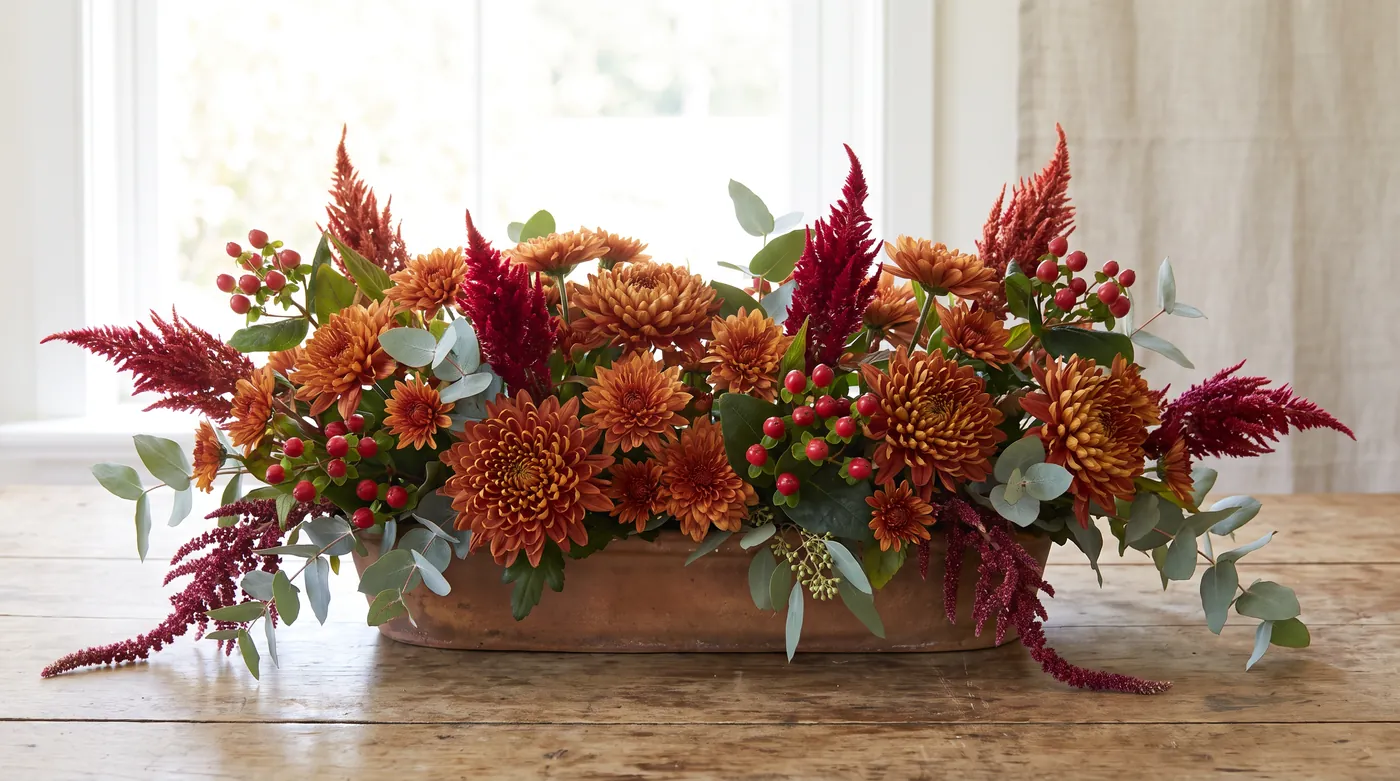
The working rule is that a centerpiece should sit below eye level for someone seated, which in practice means roughly a foot tall at the most. Anything above that has to be so narrow-stemmed that you can see straight through it, which is a different and much harder arrangement to build.
For a long table, a low runner of two or three small arrangements works better than one large one. It fills the length, it leaves room for dishes, and it can be pulled apart and moved when someone needs to put down a turkey.
Two more constraints people forget. Keep scent down, because heavy perfume competes with food and some people find it genuinely unpleasant at a table. And avoid anything that sheds or stains: lily pollen on a linen tablecloth is permanent, and any flower dropping petals into the gravy is a poor guest.
What survives the day
The room is warm, the oven has been on since morning, and the arrangement was probably made a day or two earlier. Warmth shortens flower life faster than anything except a lack of water, so a Thanksgiving piece is built on material that does not care.
That means structure first: berried stems, seed heads, dried and everlasting material, autumn foliage and branches, with a smaller number of flowers doing the color. It is the same principle as a Christmas centerpiece and for exactly the same reason.
The happy accident is that this is the cheapest month of the year for the material you want. Chrysanthemums are at their peak, the everlastings are a dried product and cost the same all year, and much of what makes an autumn arrangement look expensive is foliage.
Bringing flowers to the host
The commonest well-meant mistake of the day is arriving with an armful of wrapped stems. The host is cooking for twelve. You have just handed them a job: find a vase, find scissors, condition the stems, arrange them, and do it now while the gravy needs attention.
Two ways round it. Send them the day before, which is the better answer and means the host can enjoy them while they cook. Or bring something that needs nothing done to it: a hand-tied arrangement already in water, a low finished piece, or a plant.
If you are hosting and someone brings you flowers anyway, the graceful move is a bucket of water in the kitchen and a vase after the meal. Nobody minds.
Timing, and the busiest delivery day nobody expects
Order by the Monday. The Wednesday before Thanksgiving is one of the heaviest delivery days a florist has all year, because everything for Thursday has to arrive then and nothing can be delivered on the day itself. Shops close, and the people who would drive the van are having dinner.
This is a volume week rather than a price week. Nothing spikes the way red roses do in February. What runs out is delivery slots and the florist's time, so ordering early buys you the arrangement you wanted rather than a discount.
It also runs straight into the Christmas season. A good autumn piece built on structure will still look right in early December with the flowers swapped and something evergreen added, which is worth asking your florist about when you order.
What goes in it, and why
Everything here is at its best and its cheapest in November, and all of it copes with a warm room.
Chrysanthemums
The November flower and the backbone of almost every Thanksgiving arrangement. Bronze, rust, deep red and burnt orange, at their peak and their cheapest, and they last for weeks in conditions that finish softer flowers off.
Carnations
The other workhorse. They take heat better than almost anything else in the shop, which is exactly the problem a table centerpiece has, and the modern rust and antique shades suit the season.
Hypericum
Berries on a stem, in reds, burgundies and greens. The reliable way to get berry color into an arrangement without holly dropping all over the tablecloth.
Celosia
The velvety brain-shaped crested form in deep red and orange gives an autumn piece texture that nothing else does, and it dries in place rather than wilting.
Amaranthus
Hanging burgundy ropes that spill over the edge of a low arrangement, which is how you get movement into something that has to stay short.
Sunflowers
The small-headed varieties rather than the giants. Still around from late fields at the start of the month, and nothing else says harvest table as immediately.
Solidago
Goldenrod. Cheap, fine textured and exactly the right yellow, and it fills the gaps that make an arrangement look thin.
Rudbeckia
Black eyed Susan, with the dark cone at the center that ties a bronze and orange arrangement together.
Sedum
Flat dusty pink heads that turn deeper as the season goes on, hold their shape for weeks, and give a low piece a solid horizontal line.
Craspedia
Billy balls. Bright yellow spheres on bare stems that last indefinitely dried, so they can be pulled out and used again in December.
Eucalyptus
The gray-green foliage that stops a rust and orange arrangement looking heavy, and one of the few things that will outlast the flowers around it.
The mistakes that spoil a table
Building it tall. Covered above, and worth the repetition because it is the one everybody makes. If you cannot see the person opposite, it is too tall.
Strong scent. Lilies, stock, tuberose and hyacinths are lovely and they belong somewhere other than a foot from a plate of food.
Lily pollen on linen. If lilies do go on the table, the anthers come out before the arrangement does. Pollen on a cloth is permanent, and brushing at it makes it worse.
Candles too close. Dried and everlasting material is exactly the material that catches, and a low arrangement puts it at flame height. Leave a real gap.
Arriving with unwrapped stems. A gift that creates a task is not quite a gift. Send it the day before.
Common questions
How tall should a Thanksgiving centerpiece be?
Below eye level for someone sitting down, which in practice is about a foot at most. The test is simple: sit at the table and see whether you can look the person opposite in the eye. If not, it is too tall, and it will get moved to the sideboard before the main course.
When should I order?
By the Monday, for Wednesday delivery. The Wednesday before Thanksgiving is one of the busiest delivery days of a florist's year because nothing can be delivered on the Thursday itself. Nothing spikes in price the way Valentine's does, so ordering early buys availability rather than a saving.
What should I bring the host?
Send it the day before rather than carrying it in. Handing over wrapped stems while someone is cooking for twelve gives them a job at the worst possible moment. If you want to arrive with something, make it a finished low arrangement already in water, or a plant.
What lasts through a whole day in a warm room?
Chrysanthemums, carnations and alstroemeria are the dependable three, and berries, seed heads, dried material and foliage are better still because they are indifferent to heat. Build on structure and let a smaller number of flowers carry the color.
Can the same arrangement do Christmas?
Often, and it is worth asking for when you order. An autumn piece built on berries, seed heads and dried material only needs the soft flowers swapped and something evergreen added. Craspedia, celosia and eucalyptus will all still be going in December.
Find a florist near you
Every one of these is easier to get right in person, because a local shop is buying from the same market this page describes and can tell you what actually arrived this week. Our directory lists flower shops in every state, by county and town. Find a florist near you.