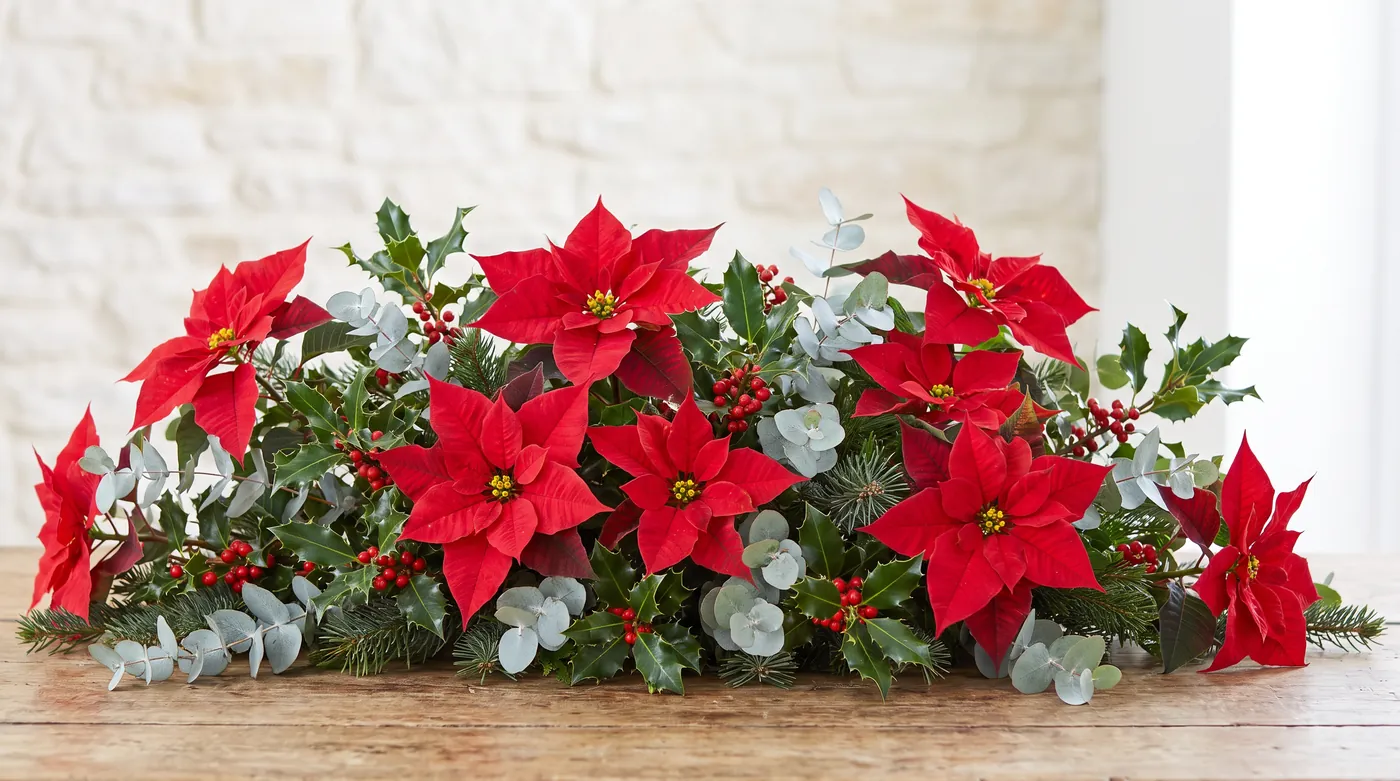
Christmas is the odd one out. The other three holidays are about cut flowers arriving on a date; Christmas is a month-long season, and the thing that sells most of all is a potted plant. The poinsettia is the best selling flowering plant in the United States, and it sells almost entirely in a six week window.
Around it sits everything else the season needs: forced bulbs for scent and drama indoors, evergreens and berries for wreaths and garlands, and arrangements for the table that have to survive a warm room and a long meal.
A Mexican wildflower, an American ambassador and a Californian family
The poinsettia is not a traditional European Christmas plant at all. It is Euphorbia pulcherrima, native to Mexico, where it is the Flor de Nochebuena, the Christmas Eve flower. Franciscan friars in sixteenth century Taxco used it in nativity processions, and the legend attached to it tells of a poor girl with nothing to offer who gathered roadside weeds, which turned scarlet when she laid them at the altar.
It reached the United States through Joel Roberts Poinsett, the first American minister to Mexico, who sent cuttings back to his own greenhouses in South Carolina in 1828. The plant carries his name, and the twelfth of December, the anniversary of his death, is National Poinsettia Day.
What turned it into a mass-market Christmas plant was a single Californian family. The Eckes worked out how to make poinsettias branch into the many-headed shape a shopper expects, kept the technique to themselves for decades, and supplied the overwhelming majority of the American crop. Almost every poinsettia sold today descends from that work.
The greenery is much older than the plant
Holly, ivy and mistletoe were midwinter decoration long before they were Christmas decoration. Bringing evergreens indoors at the darkest point of the year is a very old habit, and the logic is obvious: these are the plants that visibly refuse to die when everything else has.
Christian meanings were layered on afterwards. Holly's spiked leaves and red berries came to be read as the crown of thorns and the blood, which is the reading the carol carries. The hellebore picked up the name Christmas rose from a legend about a shepherd girl with no gift for the Christ child, whose tears were said to have brought white flowers up through the snow. Helleborus niger still flowers in midwinter, which is why the story stuck to that plant and not another.
Forced bulbs are a Victorian contribution. Amaryllis and paperwhite narcissus were brought on early under glass specifically to give a household flowers in December, and both are still doing exactly that job.
What a Christmas arrangement has to survive
The technical problem at Christmas is heat. A centerpiece sits in a warm room, often near a fire or a radiator, sometimes for several days, and warmth shortens flower life faster than anything except a lack of water. That is why florists build December arrangements around structural material: evergreens, berried stems and dried elements that do not care, with a smaller number of flowers doing the work.
Cold is the other one, and it is the poinsettia killer. They are tropical plants, and even a few minutes below about ten degrees celsius damages them permanently. The walk from the shop to a cold car is genuinely enough. Ask for a sleeve, and do not leave one in the car while you do the rest of the shopping.
Timing runs the other way from the other holidays. Poinsettias and wreaths sell from late November, table centerpieces peak between the twentieth and the twenty-fourth, and a week's notice is plenty for almost anything.
What to buy, and why each one works
A December list is a mix of plants, cut stems and structure, because that is how the season is actually put together.
Poinsettias
The plant the season is built on. The colored parts are bracts, which are modified leaves, and the real flowers are the small yellow structures in the center. Buy one where those are still tight and green-yellow rather than shedding pollen, and you are buying a fresh plant.
Amaryllis
One bulb, one thick stem, and three or four enormous trumpets. It gives you more visual impact for the money than anything else in December, and the bulb can be kept for next year.
Paperwhites
Forced narcissus, in flower a few weeks after planting, and heavily scented. The scent divides people sharply, so smell one before you commit to a bowl of them in a small room.
Christmas Cactus
Schlumbergera flowers for weeks in the middle of winter and lives for decades. It is also one of the few festive plants that is safe around cats and dogs.
Hellebores
The Christmas rose. Nodding white and green flowers on a plant that flowers when nothing else does. Cut stems need mature flowers and still sulk, so it is usually the better buy as a plant.
Hypericum
Berries on a stem, in reds and burgundies, and the reliable way to get berry color into an arrangement without holly dropping everywhere.
Holly
The traditional berry, and worth knowing that cut holly drops far more readily indoors than hypericum does. Best in a wreath on a cold door rather than on a warm table.
Eucalyptus
The backbone of most modern Christmas work. Gray-green, scented, lasts for weeks fresh and indefinitely dried.
Roses
Deep reds and creams, used sparingly for focal points. In a warm room they are the part of the arrangement that will go first, so buy them tight.
Anemones
For anyone who wants a Christmas arrangement that does not look like every other Christmas arrangement. The near-black centers against white or deep red are strikingly modern.
Cyclamen
A pot plant that flowers for weeks in a cool room and hates a warm one. The best gift for a hallway or a porch rather than beside a radiator.
The poinsettia poisoning myth, put properly to bed
Poinsettias are not deadly. The belief that they are traces back to a single unverified report from over a century ago, and it has been tested since: the milky sap is an irritant, a pet or a child who chews a leaf may drool, be sick or get a rash, and that is the extent of it. Poison control centers see poinsettia calls every December and they almost never amount to anything.
The genuinely dangerous festive plant is the lily. True lilies and daylilies cause acute kidney failure in cats from a tiny exposure. Amaryllis and mistletoe berries also deserve real caution around animals and small children. If you want a plant you do not have to think about at all, a Christmas cactus is the answer.
Common questions
Are poinsettias poisonous to cats and dogs?
No, not in the way the myth suggests. The sap is an irritant, so an animal that chews one may drool or be sick, but it is not a serious poisoning and the plant has been repeatedly tested. The festive plant that genuinely is dangerous is the lily, which causes kidney failure in cats.
Why does my poinsettia drop its leaves?
Almost always cold or overwatering. They are tropical and even a short spell below about ten degrees celsius damages them permanently, which includes the walk to the car. The other common cause is water sitting in the decorative foil around the pot and rotting the roots. Punch the foil or take the pot out to water it.
When should I buy Christmas flowers?
Poinsettias and wreaths from late November, when the plants are freshest and the choice is widest. Table centerpieces are a different job: they peak between the twentieth and the twenty-fourth, and a week's notice is enough for almost anything. Only very large orders need longer.
What lasts longest through a warm Christmas room?
Structure rather than flowers. Eucalyptus, ruscus, hypericum berries and dried elements will outlast anything soft. Among the flowers, carnations, chrysanthemums and alstroemeria cope with heat far better than roses or lilies do.
Are the red parts of a poinsettia flowers?
No. They are bracts, which are modified leaves. The true flowers are the small yellow structures clustered at the center, and their condition is the best guide to freshness. Tight and green-yellow means a young plant. Shedding pollen, or already gone, means it has been sitting.
Find a florist near you
Every one of these is easier to get right in person, because a local shop is buying from the same market this page describes and can tell you what actually arrived this week. Our directory lists flower shops in every state, by county and town. Find a florist near you.