Mother's Day is the largest week in the florist's year, and it behaves completely differently from Valentine's Day. Instead of one flower spiking in price, everything gets squeezed at once. Delivery slots go first, then the best stock, and the gap between ordering ten days ahead and ordering two days ahead is mostly a gap in quality rather than money.
It is also the holiday where a growing plant sells as well as a bouquet, which is worth knowing if you want the gift to still be there in July.
It began with one white carnation
Mother's Day in the United States has a specific inventor and a specific flower. Anna Jarvis held a memorial for her mother, Ann Reeves Jarvis, at a church in Grafton, West Virginia in May 1908, and handed out white carnations because they had been her mother's favorite. She spent the following years campaigning for national recognition, and Woodrow Wilson proclaimed the holiday in 1914.
The convention that grew out of that service is the reason flowers and this day are joined at all: you wore a white carnation if your mother had died and a colored one if she was living. Everything since, the arrangements and the plants and the delivery vans, descends from one woman's choice of her mother's favorite flower.
There is a sharp ending to the story. Jarvis spent much of the rest of her life fighting the commercialisation of the day she had created, objecting particularly to florists raising prices, and was arrested in 1948 while protesting at a confectioners' convention. She died having tried and failed to have the holiday rescinded.
Why carnations, and why pink specifically
The white carnation came first and still carries remembrance, which is why it appears at memorial services rather than on a kitchen table. Pink took over as the living-mother color, and there is a Christian legend behind that, told as a legend rather than a fact: pink carnations are said to have grown where the Virgin Mary's tears fell.
Carnations have suffered decades of being called cheap, and the reputation belongs to a period of badly dyed stems rather than to the flower. They are one of the longest lasting things a shop sells, they take heat far better than most, and the modern varieties are genuinely beautiful. A florist who talks you into them is not fobbing you off.
What the week actually does to supply
Wedding season is starting at the same moment, so peonies, garden roses and hydrangea are already under pressure before Mother's Day demand lands on top. Nothing about this shows up as a headline price rise. It shows up as your first choice being unavailable on a Saturday.
Order ten days out. You are reserving the florist's time and a delivery window, and Saturday delivery is the crunch point of the entire year. If you can accept a Friday delivery, or a collection rather than a delivery, you will get better flowers for the same money.
The one genuine seasonal windfall is peonies. They are in season through May, moving north with the warmth from late April into June, which is why they are simultaneously the most requested Mother's Day flower and the one that is actually good value that week.
What to send, and why each one works
All of these are in good supply in May, and several of them are at their annual best.
Carnations
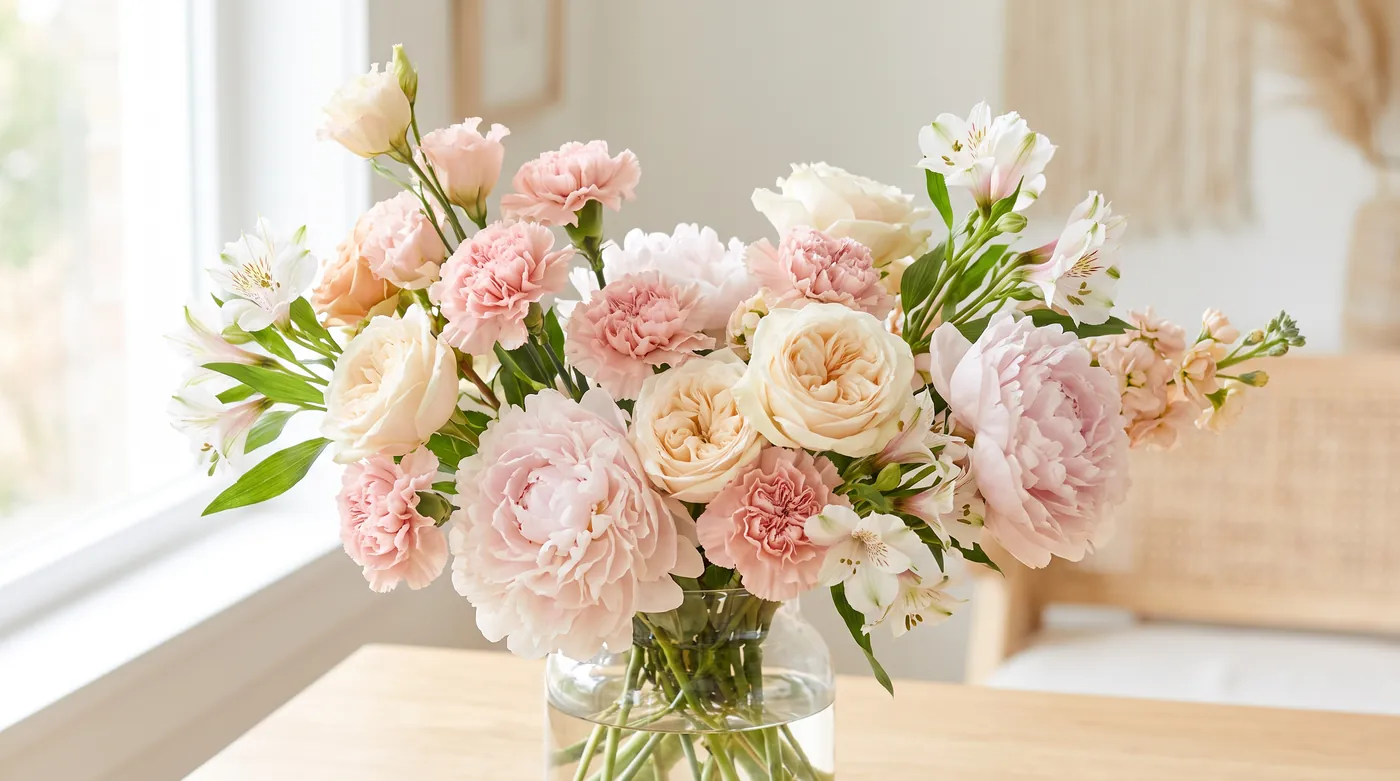
The original Mother's Day flower, and the only one on this list with a claim to the day itself. Pink for a living mother is the convention Anna Jarvis started. They last for weeks.
Peonies
In season, at their peak, and the single most requested flower of the week. Buy them as tight marshmallow-soft buds rather than open heads and you get days more out of them.
Roses
Pink and peach rather than red. In this context the message is gratitude and admiration, which is a completely different reading from the same flower in February.
Lilies
Oriental lilies fill a room with scent and open over a week, so a closed stem keeps giving. Read the safety note below first if there is a cat in the house.
Tulips
Late field tulips are still around in early May and are a different flower from the glasshouse stems sold in January: taller, stronger and cheaper.
Hydrangeas
Enormous heads, and available both as a cut stem and as a plant that can go in the garden afterwards. One of the best value gifts of the week when you count the months rather than the days.
Orchids
A phalaenopsis in a pot flowers for two to three months and then again the following year. The obvious answer for someone who says they do not want cut flowers.
Lilacs
Two or three weeks of the year, and mid May is it. Intensely scented, wilts fast, and worth buying on the day you want it.
Lily of the Valley
May, briefly, and expensive whenever it appears at all. Tiny, extraordinarily scented, and the flower of the month.
Alstroemeria
The workhorse of the week. Two to three weeks of vase life means an arrangement sent on the Saturday is still worth looking at when the month ends.
Gerbera Daisies
Uncomplicated cheerfulness with no second meaning attached, which is exactly right for some relationships and some mothers.
The lily warning, which matters more this week than any other
True lilies, the genus Lilium, and daylilies are fatal to cats. Not an upset stomach: acute kidney failure, from a very small exposure. Pollen groomed off fur is enough, and so is water from the vase. Every part of the plant is dangerous and there is no safe quantity.
Lilies are one of the most sent Mother's Day flowers, so ask before you order. If there is a cat, say so and the florist will build the arrangement without them. Calla lilies and peace lilies are not true lilies and cause mouth irritation rather than kidney damage, which is a real distinction and not a technicality.
Common questions
What is the traditional Mother's Day flower?
The carnation, and specifically the white carnation. Anna Jarvis handed them out at the first Mother's Day service in 1908 because they were her own mother's favorite. The convention that followed was white for a mother who had died and a colored carnation for a living one, which is where pink comes from.
How far ahead should I order for Mother's Day?
Ten days if you want a Saturday or Sunday delivery, which is the busiest delivery window in the florist's year. Ordering late rarely costs more, it just narrows what is available and when it can arrive.
Is it better to send a bouquet or a plant?
It depends whether you want the gift to last the week or the year. An orchid flowers for two to three months and comes back, and a hydrangea can go into the garden afterwards. Cut flowers are the bigger gesture on the day. Plants sell as strongly as bouquets this one week of the year, so a good shop will have both.
Are lilies safe to send?
Not to a house with a cat. True lilies and daylilies cause acute kidney failure in cats from a very small exposure, including pollen groomed off fur. Tell the florist and they will leave them out. In any other household they are one of the best value flowers of the week because the buds open over several days.
Why do florists push carnations when everyone says they are cheap?
Because the reputation comes from a period of badly dyed supermarket stems, not from the flower. Carnations are among the longest lasting things a shop sells, they cope with heat, and the modern varieties are excellent. They are also the flower this holiday was built on.
Find a florist near you
Every one of these is easier to get right in person, because a local shop is buying from the same market this page describes and can tell you what actually arrived this week. Our directory lists flower shops in every state, by county and town. Find a florist near you.