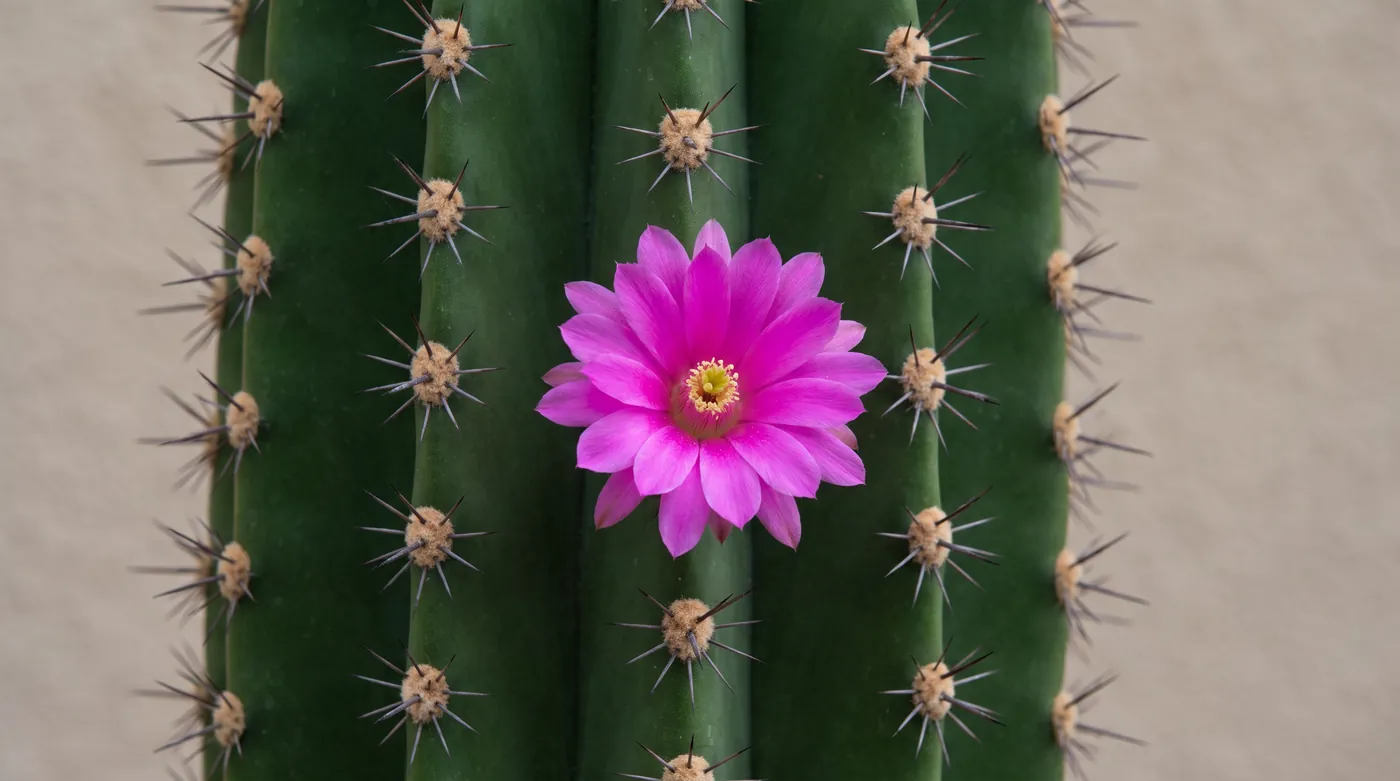
A cactus stem showing spines and a flower emerging from areoles

1 flower in this family

Everything in this guide that belongs to Cactaceae

Magenta Christmas cactus flowers on flat segmented stems

Christmas Cactus

Schlumbergera buckleyi and truncata
4-8 weeks in flower; plant lives decades

Christmas Cactus

The spines are leaves, and the stem is the leaf

If an areole is a shoot, the spines coming out of it are that shoot's leaves, modified past all recognition. The family gave up on leaves as solar panels because a flat leaf loses water faster than anything else a plant owns, and handed the job of photosynthesis to the green stem instead.

The spines kept working, in several directions at once. They deter animals, obviously. Less obviously, a dense white coat of them shades the stem surface from the worst of the sun and traps a still layer of air against it, and in some species they collect dew and drip it down onto the roots. In the chollas the spines are barbed so a whole joint of the plant detaches onto a passing animal and is carried off to root somewhere else.

The ribs are the other clever piece. A ribbed stem is pleated like a concertina, so after rain it can take up a great deal of water and swell outward by flattening the pleats, then shrink again through a drought, over and over, without ever splitting its own skin.
Not all of them live in deserts

The desert is where the family is most obvious, not where all of it lives. A whole branch of the cacti went the other way entirely and moved into wet tropical forest, where they grow perched on tree branches in pockets of leaf litter rather than in soil, with flattened leaf like stems and few spines or none.

They are still cacti in every technical sense, areoles and all, and they still run the water saving chemistry the family is built on, because a plant sitting on a branch in the canopy has no more access to reliable water than one in sand does. The problem is the same; only the address changed.

One more oddity is worth knowing. The family is American from end to end with a single exception: one genus of these forest cacti also occurs naturally in Africa, Madagascar and Sri Lanka, and how it got there, whether by birds or by people, is still argued about.