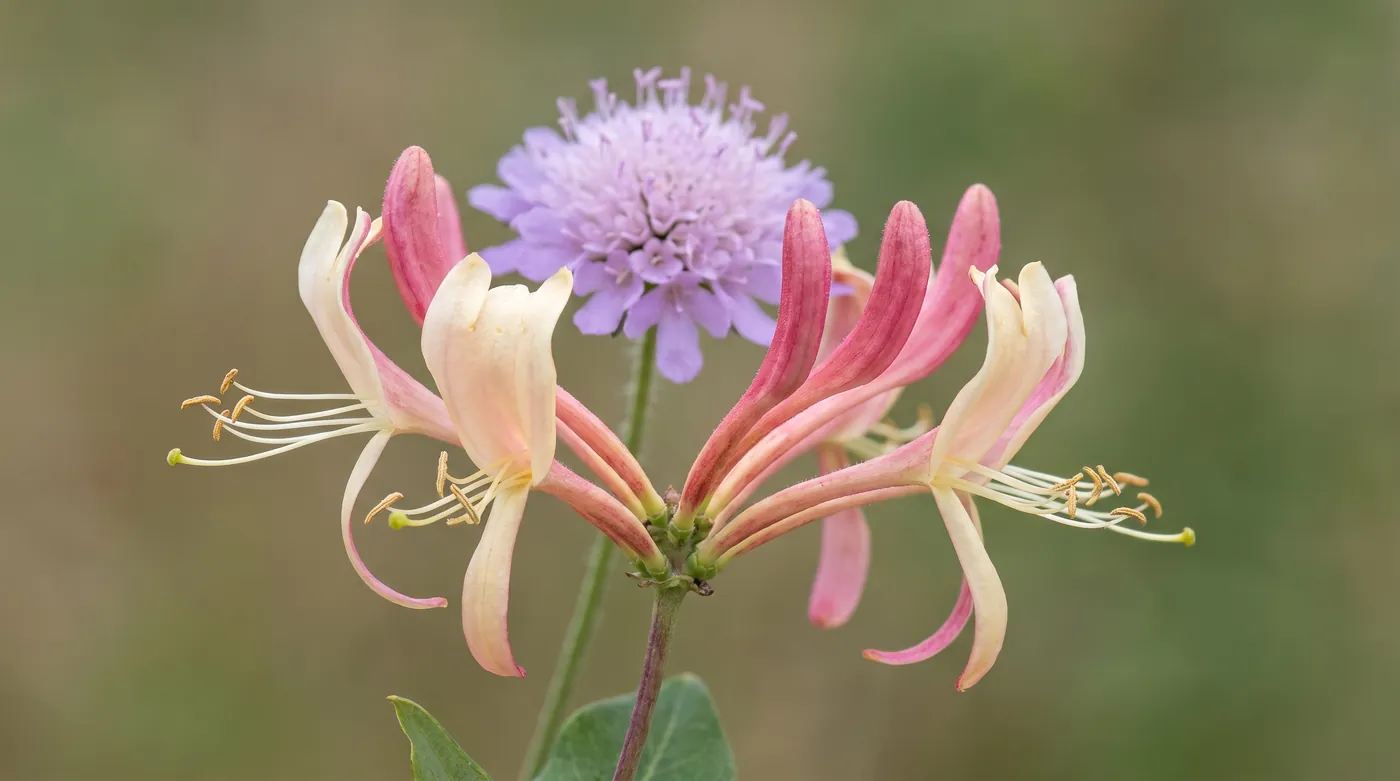
Honeysuckle tubes with projecting stamens, and a scabious

2 flowers in this family

Everything in this guide that belongs to Caprifoliaceae

Cream and pink honeysuckle trumpets on a twining vine

Honeysuckle

Lonicera periclymenum
1-3 days

Honeysuckle
Lavender scabiosa pincushion flowers on wiry stems

Scabiosa

Scabiosa caucasica and atropurpurea
5-8 days

Scabiosa

Honeysuckle is a scent, not a vase flower

Cut honeysuckle lasts one to three days, and that is not poor handling. It is a climber built to flower in place on a living vine, and the cut stem cannot keep up with what the flowers demand.

Sell it for what it does rather than how long it does it. The scent is the strongest in the family and it is at its peak in the evening, because honeysuckle is pollinated by night-flying moths and directs its effort accordingly. A cut stem in a warm room in the evening will scent the whole space, which is worth more than a week of standing still.

Scabiosa is the practical member, five to eight days and a far more cooperative flower, with the pincushion head that gives it its other name. Its seed pods are better still: papery domes that dry perfectly and hold their shape indefinitely, and they are worth cutting deliberately rather than treating as what is left over.

Relatives you already know

Valerian is the best known member outside gardening, its root used as a sedative for centuries and still sold for sleep. The smell of the dried root is genuinely unpleasant and is often compared to old socks, which cats find fascinating in much the way they respond to catnip.

Teasel is here too, the dried head with its stiff hooked bracts, and it was once a genuine piece of industrial equipment. Teasel heads were mounted in frames and used to raise the nap on woolen cloth, a job no machine did better for a long time.

Elder and viburnum sit close by and were traditionally placed in this family before being moved out in the same reshuffle that moved others in. The name Caprifoliaceae means goat leaf, from an old Latin name for honeysuckle, and nobody is entirely sure what goats had to do with it.