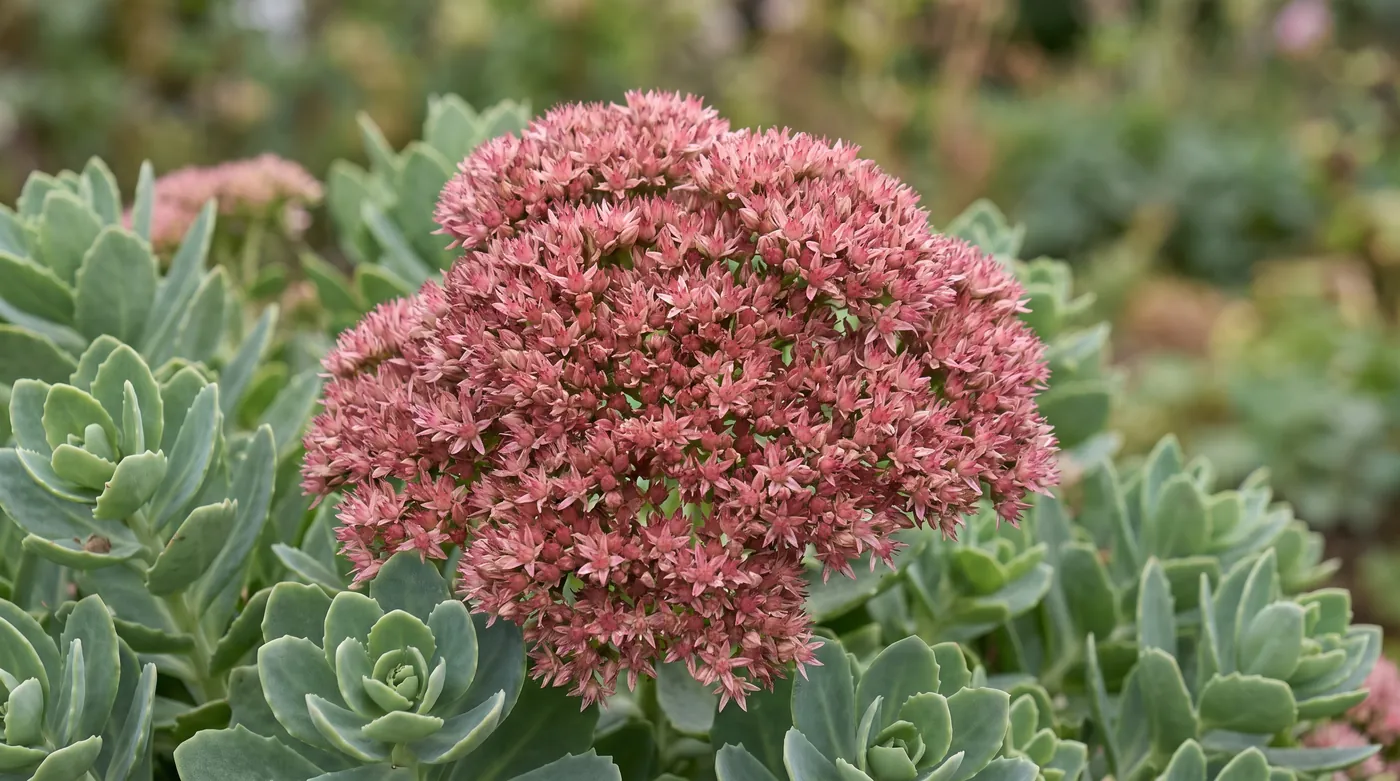
A flat sedum head above thick succulent rosettes

1 flower in this family

Everything in this guide that belongs to Crassulaceae

Flat dusky pink sedum flower heads above fleshy grey-green leaves

Sedum

Hylotelephium spectabile, formerly Sedum
10-21 days

Sedum

A whole plant from one leaf

Break a leaf off almost any member of this family, lay it on the surface of some gritty compost and leave it alone, and in a few weeks it will have grown roots and a miniature plant from the broken end. No hormone, no cut surface treatment and no propagator. Very few plant families will do this so reliably from a bare leaf.

It makes sense for something living on a cliff or a roof, where the likeliest event in a plant's life is a piece being knocked off and landing nearby. The family treats an accident as a method.

Some members industrialized it. There are kalanchoes that produce rows of ready made plantlets along the notches of every leaf edge, each already carrying roots before it detaches, so the parent is permanently fringed with its own offspring and drops them by the hundred. They are charming on a windowsill and a serious weed in warm countries.

Relatives, and one more poison for the heart

The familiar members are jade plant, echeveria, aeonium, the houseleeks and the kalanchoes, and between them they cover most of the succulents sold as houseplants that are not cacti. The family also sits in the same order as the peonies, which is not a resemblance anybody would guess from looking.

One warning is worth carrying. Several kalanchoes, particularly the plantlet makers, contain compounds that act on the heart muscle in the same way the milkweed family's do, and they have killed grazing cattle in Australia and southern Africa in large numbers. They are a genuine risk to a dog or a cat that chews one.

That makes at least three separate plant families that arrived at heart acting compounds independently, which says less about the plants than about how few good ways there are to poison an animal.