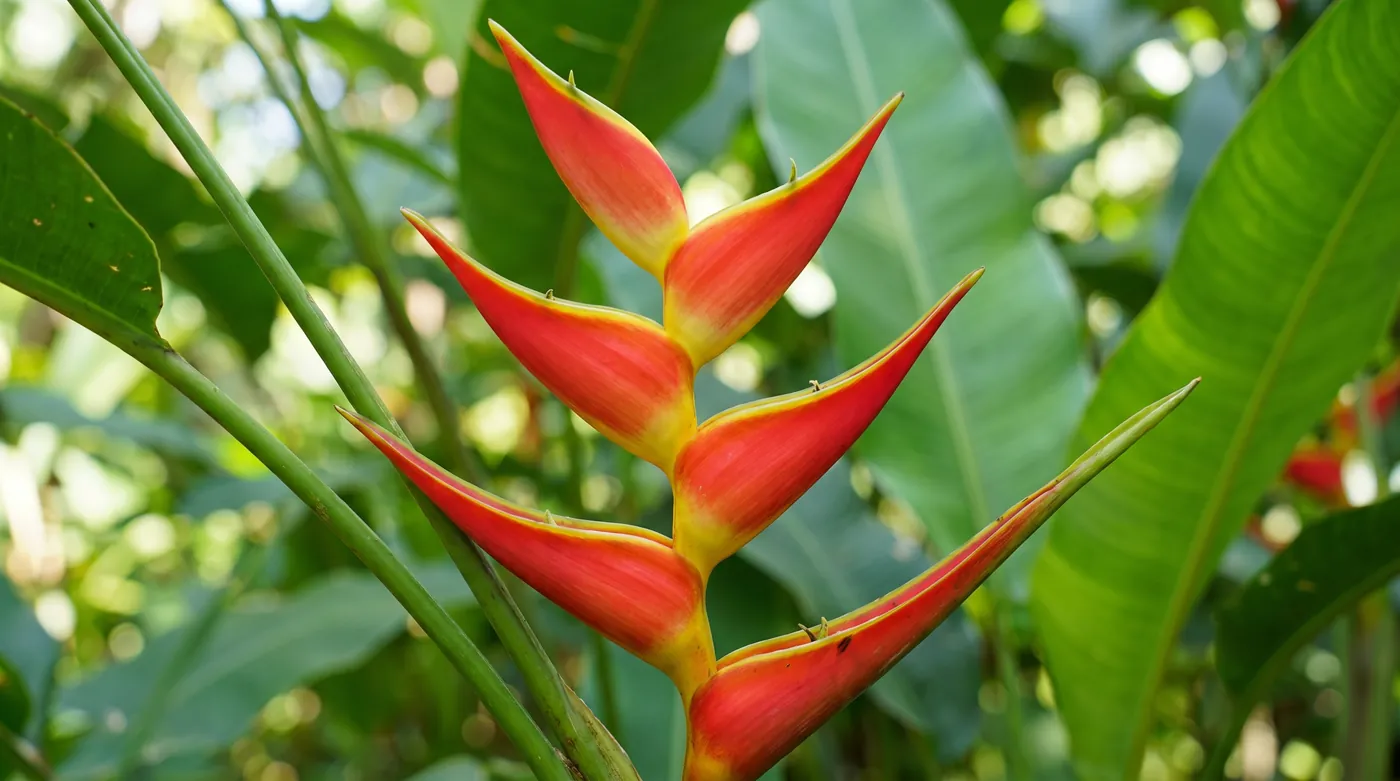
A scarlet heliconia with boat shaped bracts in a zigzag

1 flower in this family

Everything in this guide that belongs to Heliconiaceae

Bright red and yellow heliconia lobster claw bracts

Heliconia

Heliconia spp.
10-21 days

Heliconia

Built for one bird

Heliconias are pollinated by hummingbirds and almost nothing else, and the relationship is tight enough to have shaped both sides. The true flowers sit down inside the bracts as narrow curved tubes holding a great deal of nectar, reachable only by a bill of the right length and the right curve.

Hermit hummingbirds, with long strongly decurved bills, work the species with strongly curved flowers. Straighter billed species work the straighter ones. The fit is exact enough that a bird visiting the wrong species gets very little for the trouble.

The clearest case is in the Caribbean, where male and female purple throated caribs have noticeably different bills: the female's is longer and more curved than the male's. The two sexes feed at two different heliconia species, each matching the shape of its own bill. They are the same bird, living off different plants, and the flowers are a large part of why they stopped looking alike.

Bats that build tents from the leaves

The leaves get used too, and by something that has to modify them first. Several small tropical bats are tent makers: they land on the underside of a large leaf and bite through the side veins in a line either side of the midrib, so that the two halves of the leaf collapse downward into an inverted V.

The bat then roosts inside its own tent, hanging from the intact midrib, sheltered from rain and hidden from anything looking down. A group will share one. Heliconia leaves, being big, broad and held out flat, are among the preferred materials, and in parts of Central America you can find the folded leaves and know what made them.

A tent lasts a few weeks before the leaf gives out, so the bats build constantly. It is one of the very few examples of a mammal other than a human making a shelter out of a plant by cutting it to shape.