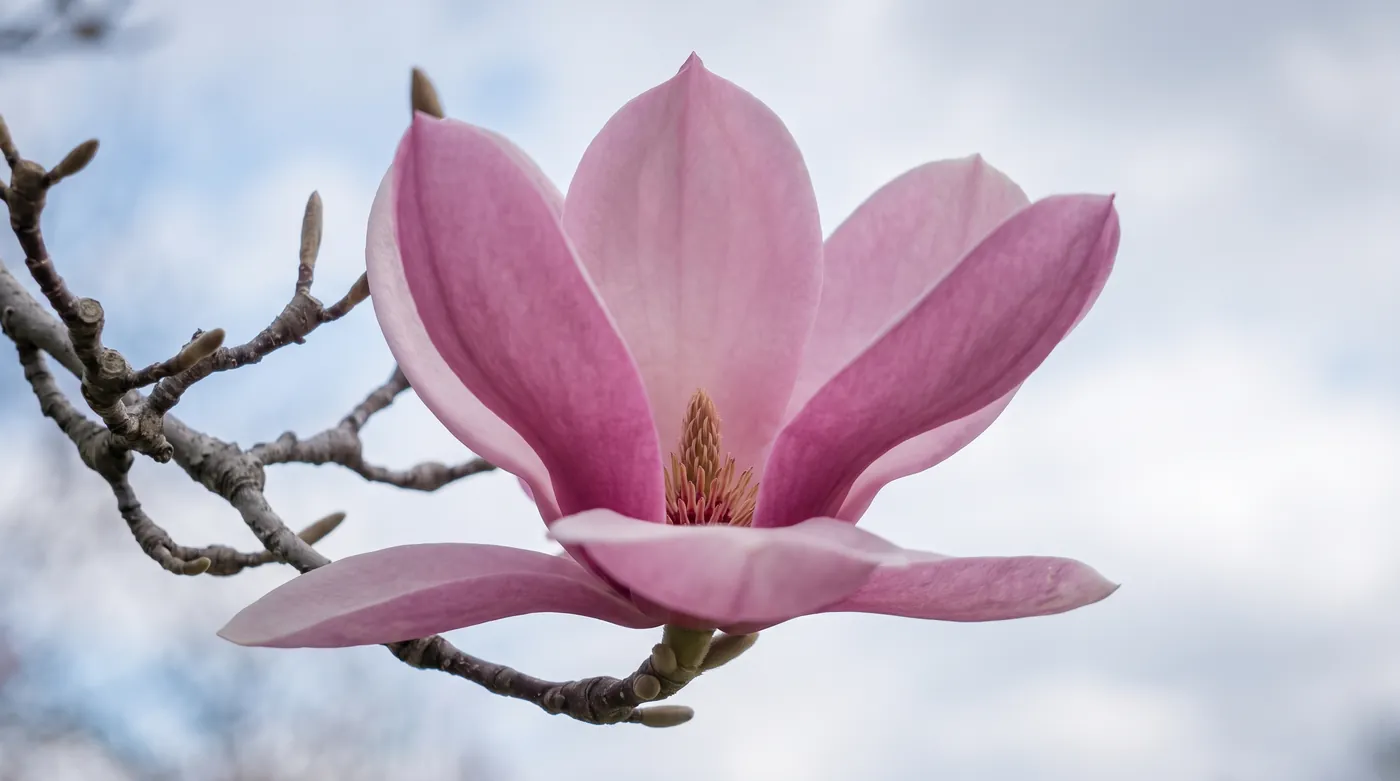
A magnolia flower on a bare branch showing its central column

1 flower in this family

Everything in this guide that belongs to Magnoliaceae

Large pink and white magnolia flowers on bare branches

Magnolia

Magnolia spp.
4-8 days

Magnolia

Two days, in a fixed order

A magnolia flower will not fertilize itself, and it prevents it with timing rather than chemistry. On the first day the carpels are receptive and the stamens are still shut. Only on the second day, once the carpels have gone past receptivity, do the stamens shed. A single flower is therefore female first and male afterward, and never both at once.

The flower is also open on the first day and closes again overnight, which is not decorative. Anything that came in for the first day is shut inside until the second, by which time the stamens are shedding and the visitor leaves loaded. Since the flower it came from is now past taking pollen, the load has to be carried to a different flower to be worth anything, which is precisely the point.

The thick tepals and the heavy build make sense in that light. This is a flower that is handled roughly by insects with chewing mouthparts and shut around them for a night, and it is constructed to take it.

The tallest member is a tulip tree

The family has only one other genus, and it is not a shrub. The tulip tree is one of the largest hardwoods in eastern North America, straight trunked and well over a hundred feet, and it carries genuinely tulip shaped flowers in green and orange high in its own canopy where they are almost impossible to see from the ground. People live under them for years without knowing the tree flowers.

It is a serious timber tree, sold as yellow poplar although it is no kind of poplar, and it is one of the heaviest nectar producers in the American forest, giving a dark strong honey. Its leaf is unmistakable: it looks as though the tip has been cut off square with scissors.

The family's split between eastern Asia and the Americas, with the whole of Europe empty in between, is the same broken pattern several old northern families show, and it is the mark of a group that was continuous before the climate cooled.