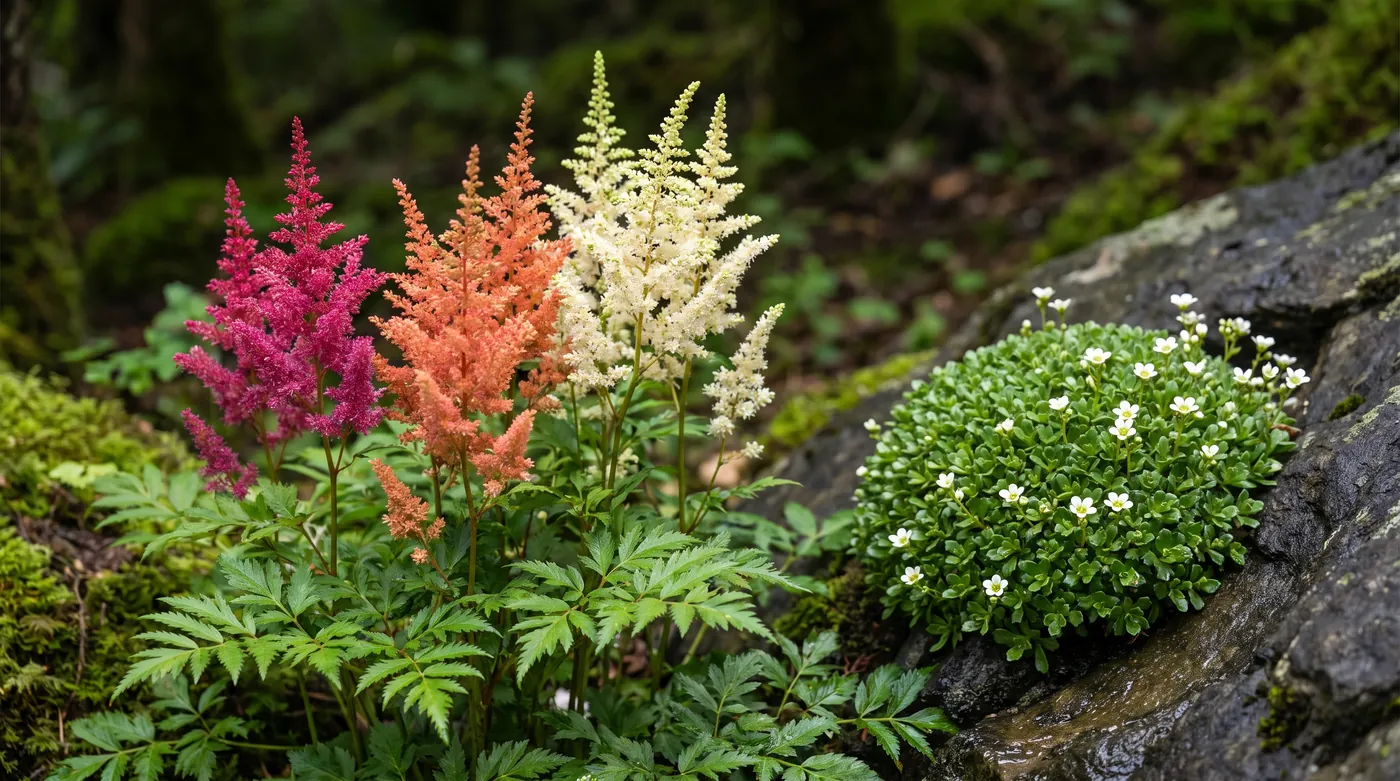
Astilbe plumes with alpine saxifrage growing from rock

1 flower in this family

Everything in this guide that belongs to Saxifragaceae

Soft pink and white astilbe plumes

Astilbe

Astilbe x arendsii
4-8 days

Astilbe

Further north than almost anything else

Purple saxifrage is one of the northernmost flowering plants on the planet. It has been recorded above eighty three degrees north in northern Greenland, on ground that is bare gravel for most of the year, and it is typically the first thing to flower anywhere it grows, often coming into bloom within days of the snow going and sometimes through it.

The shape is doing the work. These plants grow as dense low cushions, which trap still air among the leaves and can hold the inside of the cushion several degrees warmer than the air a hand's width above it. In a place where the growing season is a few weeks, a few degrees is the difference between setting seed and not.

Some arctic members do not risk seed at all. Instead of flowers they produce small bulbils on the stem, ready made miniature plants that drop off and root, so reproduction does not depend on a pollinator arriving, on the weather holding, or on there being enough summer left to ripen anything.

A wildflower turned into a foliage industry

The fastest change in this family has happened in gardens rather than in the wild. Coral bells were, until fairly recently, a modest American woodland plant grown for thin spires of small flowers. Breeders then started crossing a handful of species and selecting for leaf color instead, and inside about thirty years the genus went from a few green-leaved kinds to hundreds of named cultivars in amber, lime, peach, near black and silver.

It is now grown almost entirely as a foliage plant, with the flowers treated as incidental and sometimes removed. Very few ornamental genera have been redirected that completely that recently.

For the wider neighborhood, this family sits in the same order as the peonies and the stonecrops, both of which look nothing like it, along with the currants and gooseberries and the witch hazels. It is one of the more mixed groups in the classification, and one of the older ones.