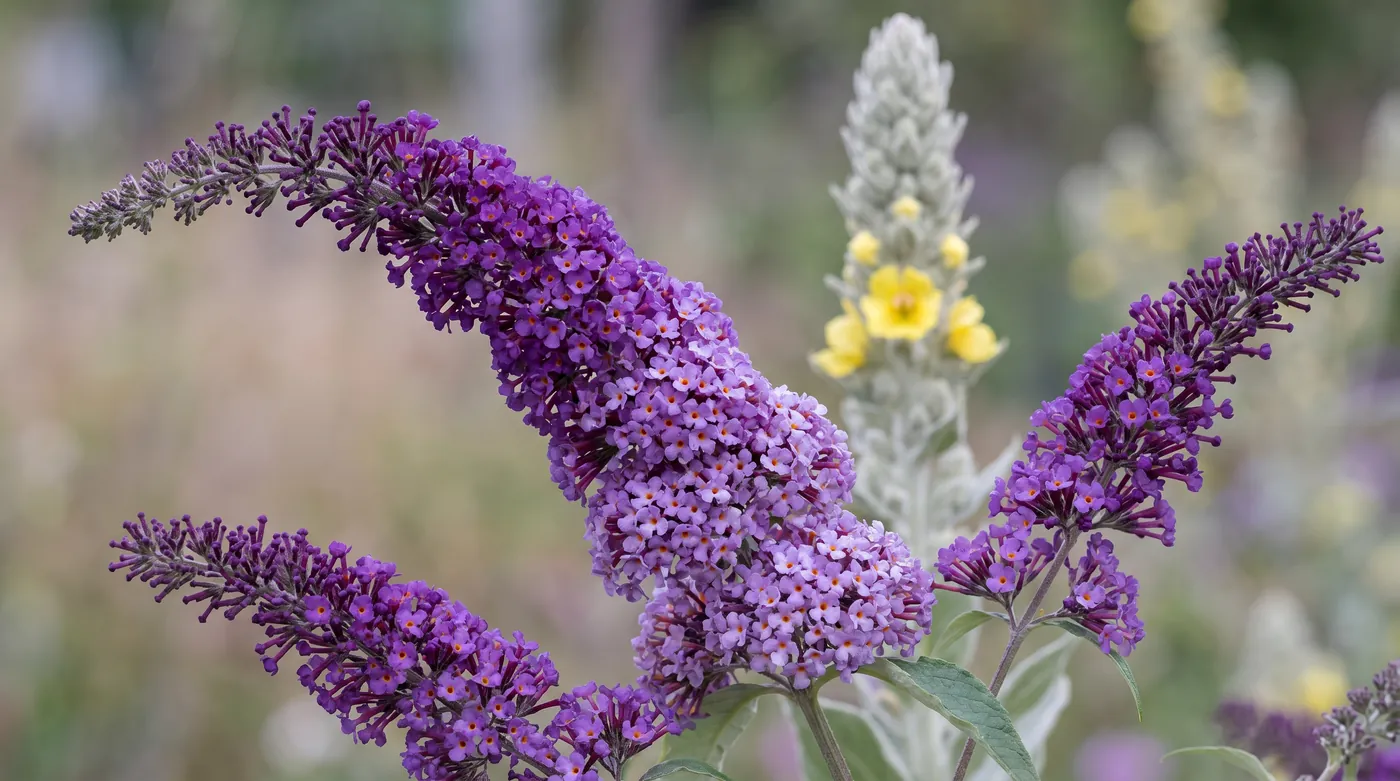
Buddleia cones of tiny orange eyed flowers, with mullein behind

1 flower in this family

Everything in this guide that belongs to Scrophulariaceae

Long purple buddleia flower cones with orange centres

Buddleia

Buddleja davidii
3-6 days

Buddleia

Named after a disease, and pollinated by wasps

Figwort is not a decorative plant. The flowers are small, dull, and colored a brownish maroon that reads as almost no color at all, and the whole plant smells faintly unpleasant.

That combination is a specification, not a failure. Figwort is one of very few plants in the northern hemisphere pollinated principally by wasps, which are unimpressed by bright petals and quite interested in a dull brown cup of accessible nectar that smells slightly of meat. A figwort in flower in July will have wasps on it and very little else.

The name is medical. The plant produces knobbly swellings on its roots, and those were taken to resemble the swollen neck glands of scrofula, a tubercular condition once common enough to be called the king's evil. Under the doctrine that a plant advertises its use through its appearance, that made it the treatment, and both the English name and the scientific one still carry the diagnosis.

Torches, and a shrub with no fixed address

Mullein is the other survivor worth knowing: a tall biennial that spends its first year as a flat rosette of thick, pale, densely felted leaves and its second sending up a single stiff spike of yellow flowers, often taller than a person, on waste ground and roadsides.

The spike had a practical afterlife. Dried and dipped in tallow or fat it burns steadily as a torch, and it was used that way widely enough to collect names in several languages meaning candle or taper. The felted leaves were used as lamp wicks, as padding inside shoes, and as an improvised dressing.

The shrub this page is here for has had the least settled classification of anything in the family. It has been placed in a family of its own, then with the strychnine relatives, and now here, and the current position rests on molecular evidence rather than on anything you could see by looking at it. In a family this heavily rearranged, that is entirely in keeping.