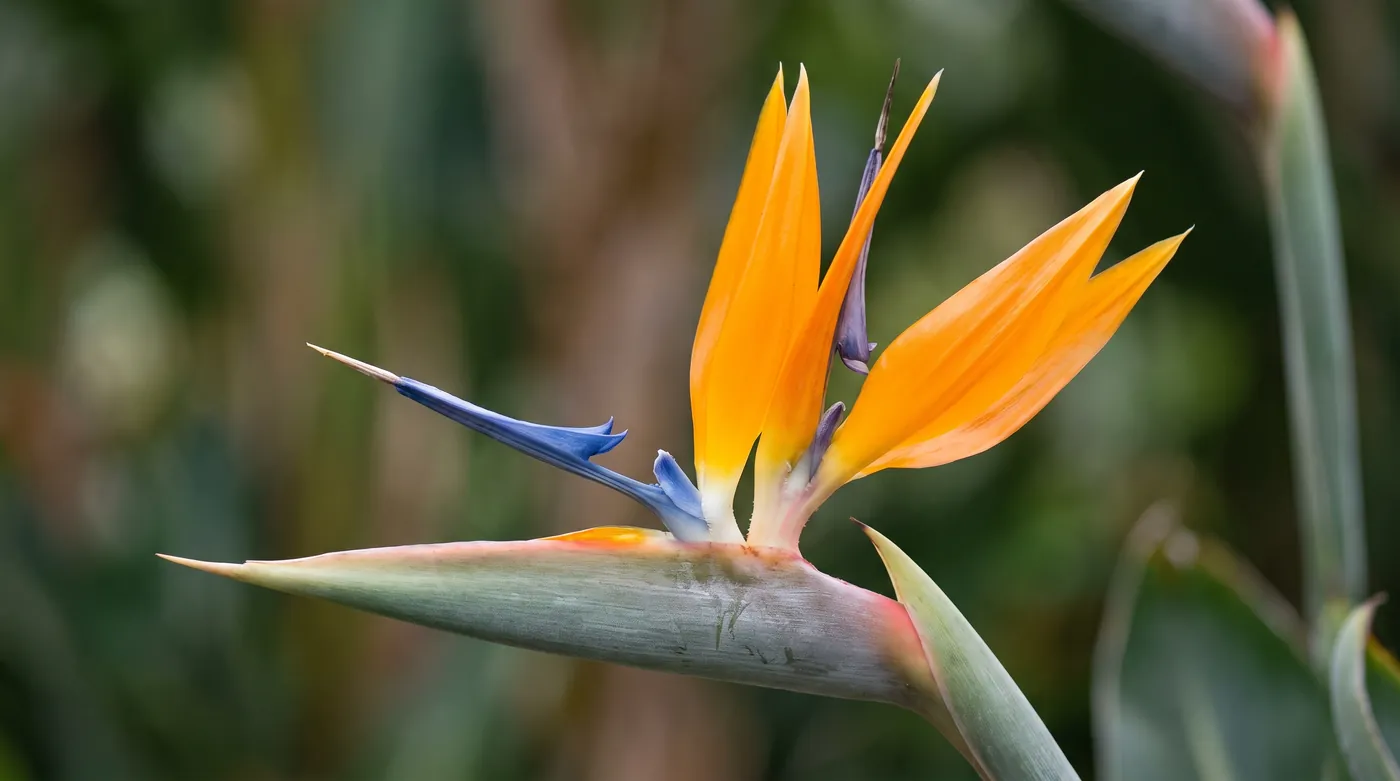
A bird of paradise showing orange sepals and the blue arrow

1 flower in this family

Everything in this guide that belongs to Strelitziaceae

Orange and blue bird of paradise flower against green leaves

Birds of Paradise

Strelitzia reginae
7-14 days, sometimes longer

Birds of Paradise

The blue arrow is a machine

The arrow is the working part. Two of the three inner petals are fused along their edges into a narrow closed trough, and the pollen bearing anthers and the style are shut inside it, hidden and protected. Nothing can reach them by pushing at the flower from outside.

It opens by weight. A bird landing on the arrow to reach the nectar below presses the two halves apart along the seam, the anthers are exposed underneath its feet, and pollen is smeared onto the feet and legs. When the bird lifts off, the trough springs shut again and is ready for the next one, and a single flower can be worked over and over.

Pollen on the feet is unusual. Most bird pollinated flowers put it on the forehead or the bill, where the bird cannot easily preen it away. This family instead built a perch and turned the act of standing on it into the mechanism, which is why the arrow is stiff enough to hold a bird and why it sits exactly where it does.
Bananas, gingers, and a pigment borrowed from animals

The order this family belongs to is a good one to know, because its members share that habit of wrapping flowers in a colored bract. Bananas are in it, and so are the gingers, the cannas, the prayer plants and the heliconias. Anything with waxy paddle leaves and flowers emerging from a boat is likely to be somewhere in this group.

The family's oddest discovery is chemical. Bird of paradise seeds are black with a shock of brilliant orange fiber attached, and when that orange was analyzed it turned out to be bilirubin, the pigment that colors a healing bruise and, in excess, causes jaundice. It had been considered an animal pigment, produced when the body breaks down old blood. Finding a plant making it was genuinely unexpected, and it has since been looked for and found elsewhere.