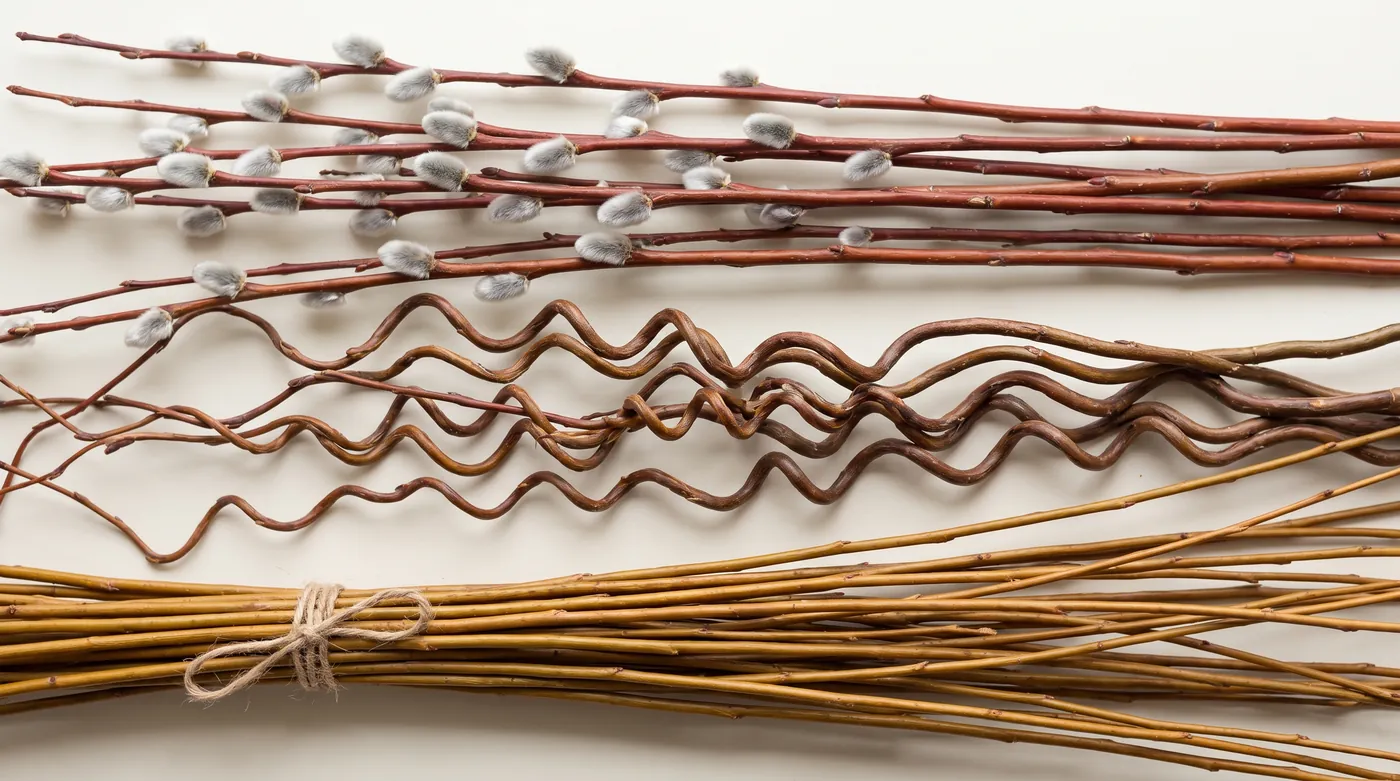
Silver catkin stems, contorted willow and a bundle of withies

2 flowers in this genus

Everything in this guide that belongs to Salix

Twisted corkscrew curly willow branches

Curly Willow

Salix matsudana 'Tortuosa'
Indefinite dry; weeks in water before rooting

Curly Willow
Silver furry catkins along slender willow branches

Pussy Willow

Salix discolor
Years dry; 1-2 weeks in water

Pussy Willow

An industry built on cutting it back

The reason willow has been grown deliberately for thousands of years is not its timber. It is that cutting a willow hard makes it respond with a dense crop of long, straight, flexible one year rods, and it will do that indefinitely without being harmed. Cut it to the ground each winter and it will still be producing a century later.

Those rods are withies, and basketry ran on them across Europe and Asia for as long as there have been baskets, along with hurdles, fish traps, eel pots, coracles and fencing. Whole landscapes were managed for it, and some still are.

The color comes from the variety and from the processing rather than from dye. Cut and dried with the bark on gives brown. Stripped after being stood in water until the sap rises gives white. Boiled in its bark before stripping gives buff, where the tannin in the bark stains the wood underneath. A basket in three colors is one species handled three ways.
The smallest tree in the world

The genus reaches further north than almost any woody plant, and what it looks like when it gets there is nothing like a tree. The dwarf arctic and alpine willows are a few centimeters high, creeping flat over rock and gravel with leaves the size of a fingernail, and one of them is regularly described as the smallest tree on earth.

It is a tree in the sense that counts botanically: a woody perennial with a genuine trunk and branches, and if you dig one up you find a gnarled woody stem that may be older than the person holding it. They grow a fraction of a millimeter a year, and individual plants of a few inches across have been aged at well over a century.

Lying flat is the whole strategy. Anything standing more than a hand's width above the ground in that climate is outside the thin band of still warmer air near the surface, and is scoured by wind and ice. The same genus that supplies eighty foot trees beside a river solves the arctic by refusing to stand up.