About Curly Willow
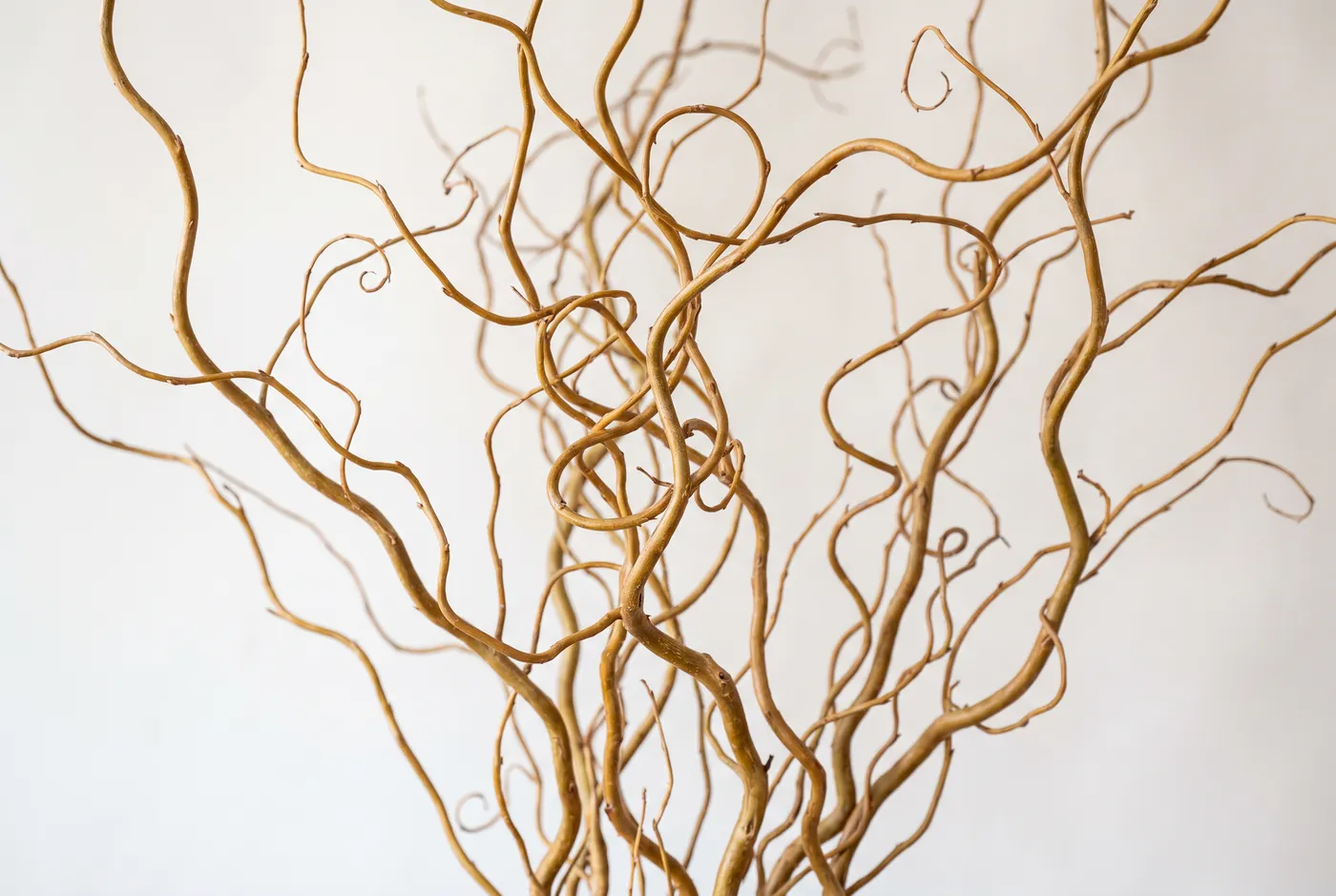
Curly willow is branches and nothing else: bare stems that twist and spiral in on themselves, sold for structure rather than for flowers. Florists use it to build the frame of a large arrangement, to line the inside of a glass vase, or on its own in a tall container where it does the whole job.
It lasts effectively forever dry, it roots readily in water, and a stem left in a vase for a few weeks will often produce roots and can then be planted. It is one of very few things in a flower shop that can turn into a tree.
Primary Meanings
- Flexibility: The obvious association with willow
- Resilience: It regrows from almost any cutting
- Growth: From how readily it roots
- Individuality: No two branches twist the same way
Curly Willow Colors and Their Meanings
Golden Brown
The natural stem colour
Red-Stemmed Willow
Winter colour on some cultivars
Bleached White
Commercially bleached for pale schemes
Dyed Willow
Painted in colours for events
Popular Curly Willow Types
Salix matsudana 'Tortuosa'
The classic corkscrew willow
Scarlet Curls
Red-stemmed, twisted, strong winter colour
Golden Curls
Yellow-toned stems
Bleached Willow
Commercially treated to near-white
Care Instructions
No Water Needed
It lasts indefinitely dry.
Water Means Roots
Left in water it roots within weeks.
Plant the Rooted Stems
Rooted cuttings grow into trees.
Watch for Leaves
In water it will also leaf out.
Best Occasions for Curly Willow
- Large Arrangements: Structure and height without flowers
- Weddings: Arch and installation frameworks
- Modern Design: One material, used sculpturally
- Permanent Displays: It lasts indefinitely dry
Interesting Curly Willow Facts
- The twisting is genetic, not trained or manipulated
- Cut stems root readily in water and can be planted out as trees
- It lasts indefinitely when kept dry
- Willow bark contains salicin, the origin of aspirin
- Bleached and dyed versions are common; the natural colour is golden brown
How to Buy Good Curly Willow
Buy on shape rather than freshness, because a dry branch is perfectly usable and will last forever. Look for stems with genuine tight twisting along their whole length rather than only at the tips, and check for breaks at the curl points, which is where they snap. Flexibility tells you how recently it was cut: a pliable branch can still be bent into shape, while a brittle one is fixed as it is. Length determines price, so decide the scale first.
Season, Availability and What Drives the Price
Cut mainly in winter when the branches are bare, and stocked year-round because it keeps indefinitely. It is inexpensive for the scale it provides and is priced by length. Demand rises with wedding installation work and around Christmas, when it is used as an armature for lights and decorations. Bleached and dyed versions cost more than natural.
What to Use Instead
Pussy willow gives the same branch structure with silver catkins for a few weeks in late winter. Forsythia adds yellow flowers to a similar framework. Birch and dogwood give straight stems where curly willow gives movement, and red dogwood brings winter color. Manzanita is the expensive alternative for large installations. For twisting movement at low cost, curly willow is the standard answer.
Safety Around Pets and Skin
Willow is not listed as toxic to cats or dogs by the ASPCA. It contains salicin, chemically related to aspirin, so a pet chewing significant quantities of bark could in principle experience salicylate effects, and cats metabolise salicylates poorly. In practice cut branches present minimal risk. The realistic hazard is mechanical: long branches in an unstable vase, and sharp broken ends.
Florist Tips for Curly Willow
Leave it in water and grow a tree
Curly willow roots readily. A stem left in a vase for a few weeks will often produce roots, and those cuttings grow into full trees if planted. It is the cheapest tree you will ever buy.
Keep it dry if you want it to stay bare
In water it roots and leafs out, which changes the look completely. If you want the clean bare structure, use an empty vase.
Bend it while it is fresh
A recently cut branch is pliable and can be persuaded into a shape. Once dry it is fixed and will snap rather than bend.
Common Questions About Curly Willow
Can I grow curly willow from a cut branch?
Yes, very easily. Stand it in water and it will usually root within a few weeks, then it can be planted outside and will grow into a tree. Willow roots more readily than almost any plant.
How long does curly willow last?
Indefinitely if kept dry. In water it lasts weeks before it starts rooting and producing leaves, which some people want and others do not.
Is the twisting natural?
Yes, it is genetic. Salix matsudana 'Tortuosa' grows that way on its own; the branches are not trained, wired or manipulated.