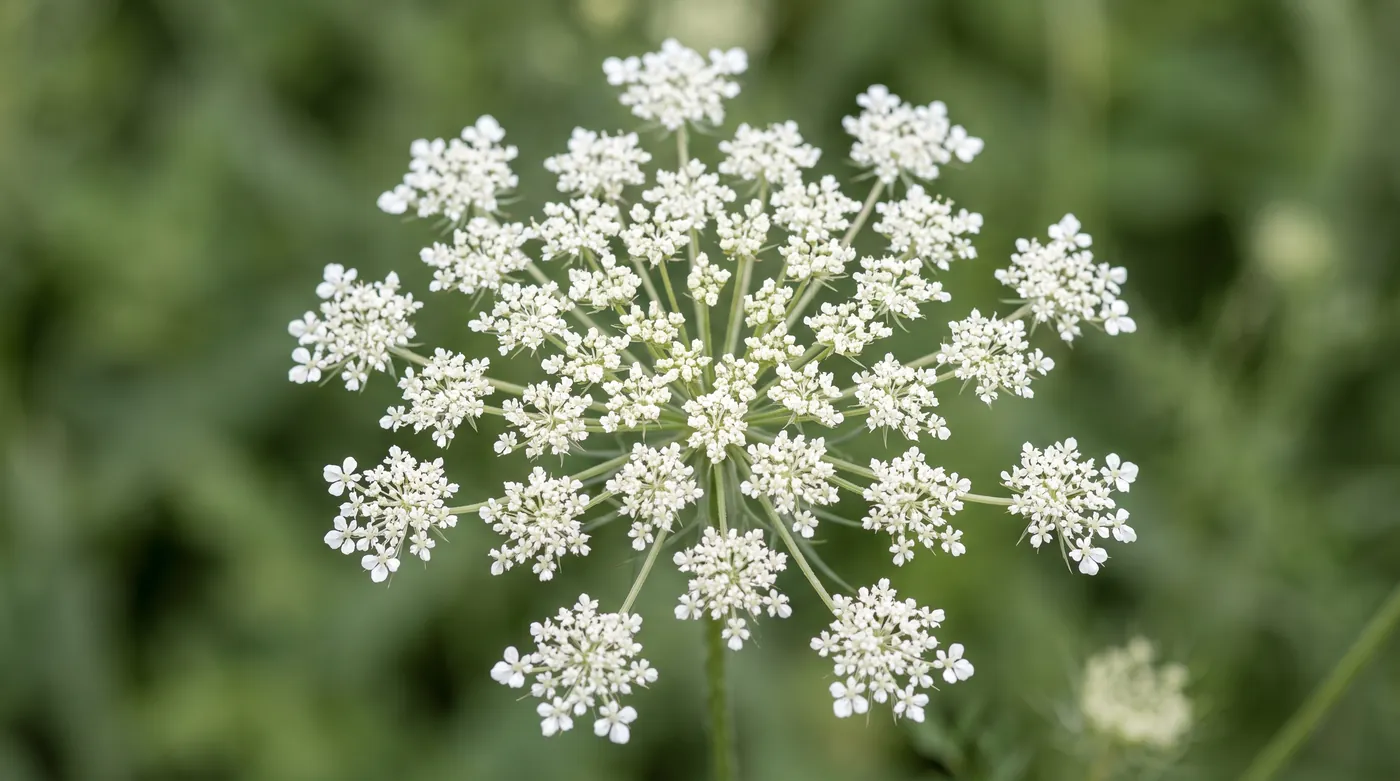
The flat lacy umbel of Queen Anne's lace from above

2 flowers in this family

Everything in this guide that belongs to Apiaceae

Steel blue eryngium sea holly with spiky collars

Eryngium

Eryngium planum and relatives
10-14 days fresh, years dried

Eryngium
Flat white umbels of Queen Anne's lace on fine stems

Queen Anne's Lace

Ammi majus and Daucus carota
5-10 days

Queen Anne's Lace

Eryngium breaks the rule and proves it

Sea holly looks nothing like the rest of the family. It reads as a thistle: a stiff spiny cone in metallic blue, surrounded by a collar of spiky bracts. There is no lacy plate anywhere in sight, and most people assume it belongs with the daisies.

It does not. It is an umbellifer whose umbel has been compressed until the stalks vanish and the flowers are packed onto a cone instead of spread across a plate. Take one apart and the individual flowers are textbook Apiaceae, five tiny petals and all. The family has simply folded the plate into a cone.

It is also the best keeper here by a wide margin, ten days to a fortnight fresh and effectively forever dried, holding that metallic blue with no treatment at all. Most of the family is soft and short lived, so eryngium is worth knowing as the exception in both directions.

Relatives you already know

Carrot, parsnip, celery, celeriac, fennel, parsley, dill, coriander, cumin, caraway, anise and lovage are all in this family. It is one of the most important flavor families in cooking, and the reason is that its members are unusually rich in aromatic oils.

Queen Anne's lace is literally the wild carrot, the same species as the one in the ground. Pull one up and it smells exactly like a carrot, which is the single most reliable field test. The old story is that the dark floret at the center of some heads is a drop of Queen Anne's blood where she pricked her finger making the lace.

The botanical explanation is less romantic and more interesting: that dark spot mimics an insect already feeding, and a head with one attracts more visitors than a head without. The flower is advertising a crowd it does not have.