About Eryngium
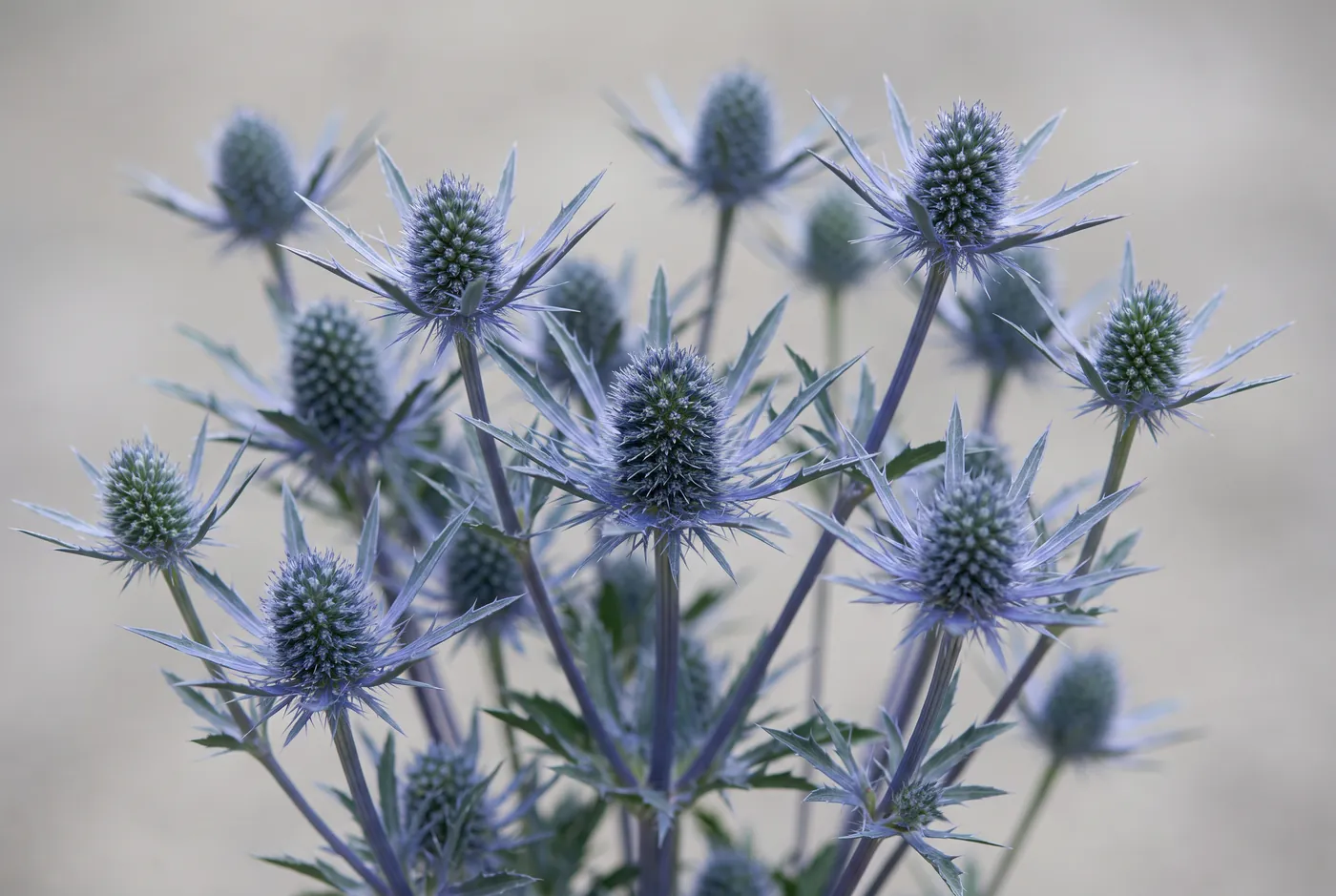
Eryngium is a small cone of tightly packed flowers sitting inside a spiky collar of bracts, and the whole thing, stem included, turns a hard metallic blue. It looks like something cast in steel, and it is one of the very few plants where the colour genuinely runs down into the stem rather than stopping at the flower.
It is called sea holly because several species grow on coastal sand, and it is a relative of carrots and Queen Anne's lace rather than of true holly. It dries perfectly and keeps its colour, which is why it appears in dried work as often as fresh.
Primary Meanings
- Independence: From its tough, self-sufficient growth
- Attraction: The Victorian meaning, from the striking colour
- Severity: From the spines
- Admiration: The common modern gifting association
Eryngium Colors and Their Meanings
Steel Blue Eryngium
The classic metallic blue
Silver Eryngium
Miss Willmott's Ghost, near-white
Violet Eryngium
Deeper cultivars
Green Eryngium
Immature heads before colouring
Popular Eryngium Types
Eryngium planum
The commercial cut standard; small blue heads
Eryngium alpinum
Larger, softer, feathery collars
Miss Willmott's Ghost
Eryngium giganteum; silvery white and large
Blue Glitter
Bred for intense colour and long stems
Care Instructions
Handle With Care
The bracts are genuinely sharp.
Shallow Water
Stiff stems need little and rot in depth.
Dries Perfectly
It keeps its blue for years.
Untroubled
Heat and dry air barely affect it.
Best Occasions for Eryngium
- Modern Bouquets: Texture and a rare true blue
- Weddings: The something blue, in a form that lasts
- Dried Work: Colour holds indefinitely
- Masculine Arrangements: Its hardness suits where flowers would not
Interesting Eryngium Facts
- The blue runs down into the stem, which is very unusual
- It is related to carrots and Queen Anne's lace, not to holly
- Miss Willmott's Ghost is named after a gardener who scattered its seed in others' gardens
- It dries with no loss of colour
- Several species grow wild on coastal sand dunes
How to Buy Good Eryngium
Buy stems where the blue has fully developed and run down into the stem itself, because green-stemmed eryngium was cut early and the colour will not deepen after cutting. The spiky collars should be intact and rigid with no browning at the points. Handle the bunch carefully in the shop; the bracts are sharp enough to draw blood and people routinely underestimate them. Check the small central cone is tight rather than shedding.
Season, Availability and What Drives the Price
Mid to late summer for the field crop, which is when the colour is strongest and the price lowest. Dried eryngium is available year-round and is genuinely as good as fresh for most purposes, since it keeps its colour completely. Wedding demand for something blue keeps summer prices firm. It is moderately priced and, given it lasts for years dried, one of the better-value stems in the shop.
What to Use Instead
Echinops, the globe thistle, gives a rounder blue sphere and behaves the same way. Craspedia offers the same hard texture in yellow. Statice provides colour that never fades in a softer form. For blue specifically, delphinium and nigella give it in flowers rather than in structure. Nothing else has metallic blue running into the stem, which is the whole appeal.
Safety Around Pets and Skin
Eryngium is not listed as toxic to cats or dogs. The hazard is entirely mechanical: the bracts are stiff and genuinely sharp, sharp enough to injure a mouth or a paw and certainly sharp enough to catch a hand. It is not a stem to leave where a pet investigates things by chewing, and it is worth warning anyone arranging it for the first time.
Florist Tips for Eryngium
It is sharper than it looks
The bracts will draw blood. Handle it by the stem, wear gloves when stripping a bunch, and keep it away from anywhere small children reach into.
Buy it fully blue
The colour develops on the plant, not in the vase. A green-stemmed stem stays green. Look for blue running right down the stem.
Dried is as good as fresh
Eryngium holds its colour completely when dried, so a bunch bought in August still looks the same the following summer. Take it out of the water and leave it.
Common Questions About Eryngium
Is sea holly related to holly?
No. Despite the name and the spines, eryngium is in the carrot family, alongside Queen Anne's lace and fennel. The name comes from several species growing wild on coastal sand dunes.
Is the blue colour natural?
Yes, entirely. Eryngium develops a genuine metallic blue that runs down into the stem as the plant matures, which is extremely unusual. Very cheap blue flowers elsewhere in a shop are often dyed, but this is not one of them.
Can you dry eryngium?
Yes, and it is one of the best. It keeps its blue with essentially no fading and holds its shape indefinitely. Simply take it out of water and stand it somewhere dry.