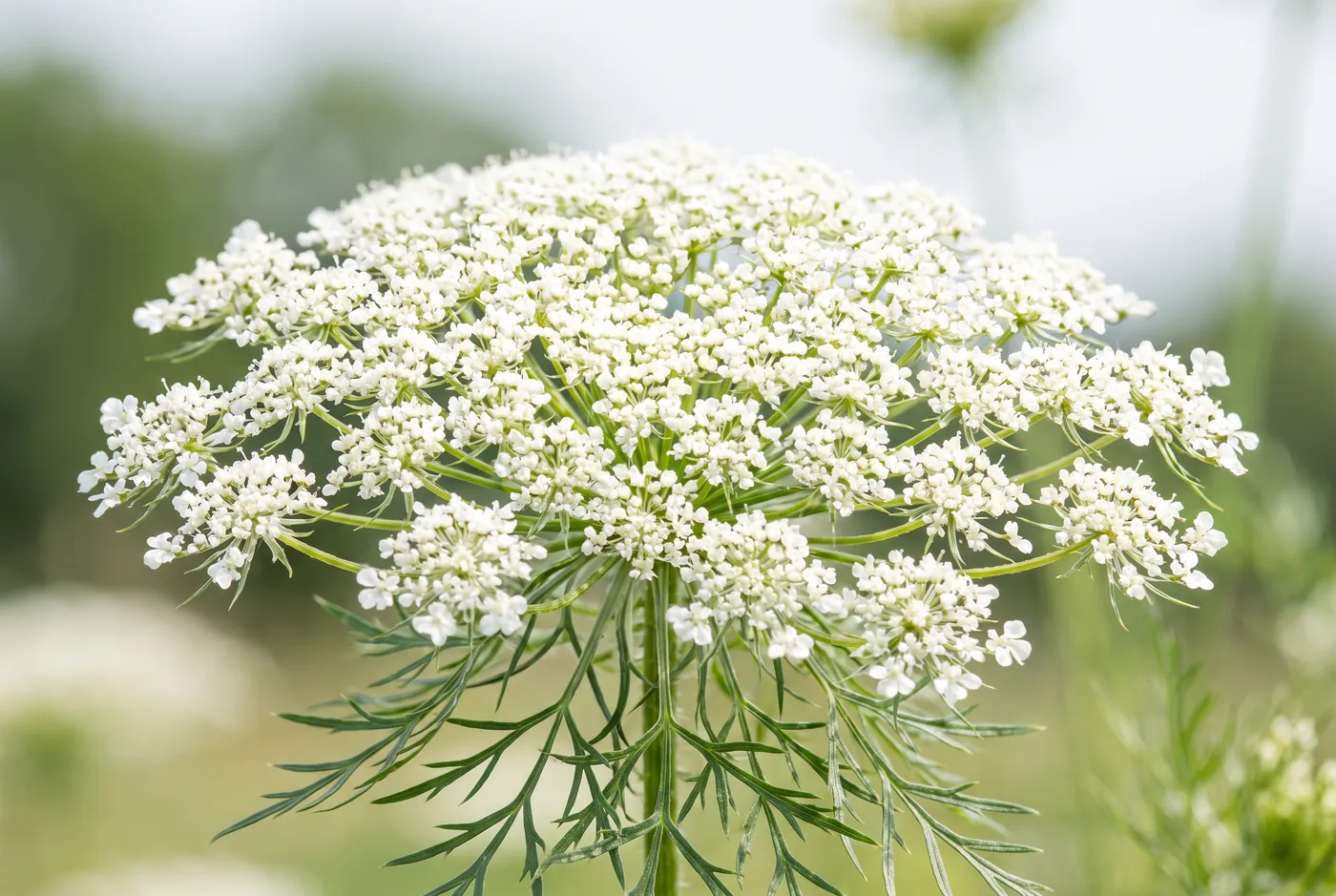
About Queen Anne's Lace
Queen Anne's lace is a flat white umbel made of hundreds of tiny flowers, held on a fine stem above ferny foliage, giving the airy meadow haze that loose modern bouquets are built around. Two plants are sold under the name: the wild Daucus carota, and Ammi majus, grown commercially and sold as false Queen Anne's lace. If you bought it from a florist, it was almost certainly ammi.
The wild plant has a small dark red floret at the centre of the umbel, said to be a drop of Queen Anne's blood from a pricked finger. Ammi does not. It is the quickest way to tell them apart.
Primary Meanings
- Sanctuary: The traditional meaning, from the umbel's shelter
- Delicacy: From the fine lace-like structure
- Complexity: Hundreds of flowers forming one head
- Haven: The Victorian association
Queen Anne's Lace Colors and Their Meanings
White Queen Anne's Lace
The classic; both species
Cream Ammi
Ammi visnaga, denser and greener
Dark Centre
The single red floret on true Daucus
Chocolate Lace
Dara; a deep burgundy cultivated Daucus
Popular Queen Anne's Lace Types
Ammi majus
False Queen Anne's lace; the commercial cut flower
Ammi visnaga
Denser, greener, stiffer umbels
Daucus carota
True Queen Anne's lace, wild carrot
Dara
A cultivated Daucus in deep burgundy and pink
Care Instructions
Clean Water
Hollow stems foul water quickly.
Strip Foliage
The ferny leaves rot fast.
Cut Mature
Buy umbels fully open; buds rarely develop.
Wash Your Hands
The sap causes sun-triggered skin burns.
Best Occasions for Queen Anne's Lace
- Summer Weddings: The meadow look, and its main commercial use
- Cottage Bouquets: With cosmos, zinnias and nigella
- Rustic Arrangements: The wild-gathered aesthetic
- Dried Work: The seed heads dry into small nests
Interesting Queen Anne's Lace Facts
- Most florist Queen Anne's lace is Ammi majus, not the true wild plant
- True Daucus carota has one tiny dark red floret at the centre; ammi has none
- Daucus carota is wild carrot and the ancestor of the cultivated one
- The sap causes phytophotodermatitis, burns triggered by sunlight
- Its dangerous lookalikes include hemlock, which has killed people who confused them
How to Buy Good Queen Anne's Lace
Buy umbels that are fully open and flat, because unopened heads often fail to develop after cutting. The individual florets should be bright white rather than dull or browning, and the stem firm and hollow-crisp rather than soft. Strip and discard the ferny foliage, which rots fast and fouls the water. Look at the centre of the umbel: a single dark red floret means you have true Daucus rather than ammi, which is worth knowing but does not change the price.
Season, Availability and What Drives the Price
Early to midsummer for the commercial ammi crop, with the wild plant flowering roadside through the same period. It is inexpensive and largely a local grower's flower, though ammi is farmed at scale in Europe and reaches wholesalers reliably. Wedding demand for the loose meadow style is what firms up the summer price. Dara, the burgundy cultivated form, costs noticeably more than plain white.
What to Use Instead
Baby's breath gives volume in a denser, less structured way. Nigella provides similar airiness with blue flowers and better pods. Orlaya is the refined alternative, smaller and whiter, and is increasingly grown for cutting. Achillea 'The Pearl' gives flat white heads that last far longer. For the specific flat lace umbel, ammi and orlaya are effectively the only options.
Safety Around Pets and Skin
This one needs care on two fronts. **The sap causes phytophotodermatitis**: get it on your skin, then expose that skin to sunlight, and you get blistering burns that can leave marks for months. Wear gloves and long sleeves when cutting quantities in sunshine. **And the family contains lethal lookalikes.** Poison hemlock and water hemlock resemble Queen Anne's lace closely enough that people have died foraging. Never gather white umbels from the wild unless you can identify them with certainty. The plants are also mildly toxic to pets.
Florist Tips for Queen Anne's Lace
Check the centre for the red dot
One tiny dark red floret in the middle of the umbel means true Queen Anne's lace, Daucus carota. No dot means ammi, which is what most florists sell. It is the fastest identification there is.
Gloves, and not in bright sun
The sap plus sunlight causes serious blistering burns. This is a genuine hazard for anyone cutting it in quantity on a summer day, not a theoretical one.
Never forage white umbels
Hemlock looks similar and is lethal. This family has killed foragers. Buy it or grow it from known seed.
Common Questions About Queen Anne's Lace
Is ammi the same as Queen Anne's lace?
Not botanically, but they are sold interchangeably. True Queen Anne's lace is Daucus carota, the wild carrot. Ammi majus is a different plant grown commercially and sold as false Queen Anne's lace. Almost all florist stock is ammi.
What is the tiny dark flower in the middle?
A single dark red or purple floret at the centre of the umbel, found on true Daucus carota. Folklore says it is a drop of Queen Anne's blood from a pricked finger. Ammi does not have it, which makes it a reliable way to tell the two apart.
Is Queen Anne's lace dangerous?
The sap causes phytophotodermatitis, blistering burns triggered by sunlight on exposed skin, so wear gloves. More seriously, poison hemlock and water hemlock look similar and are lethal. Never gather white umbels from the wild without certain identification.