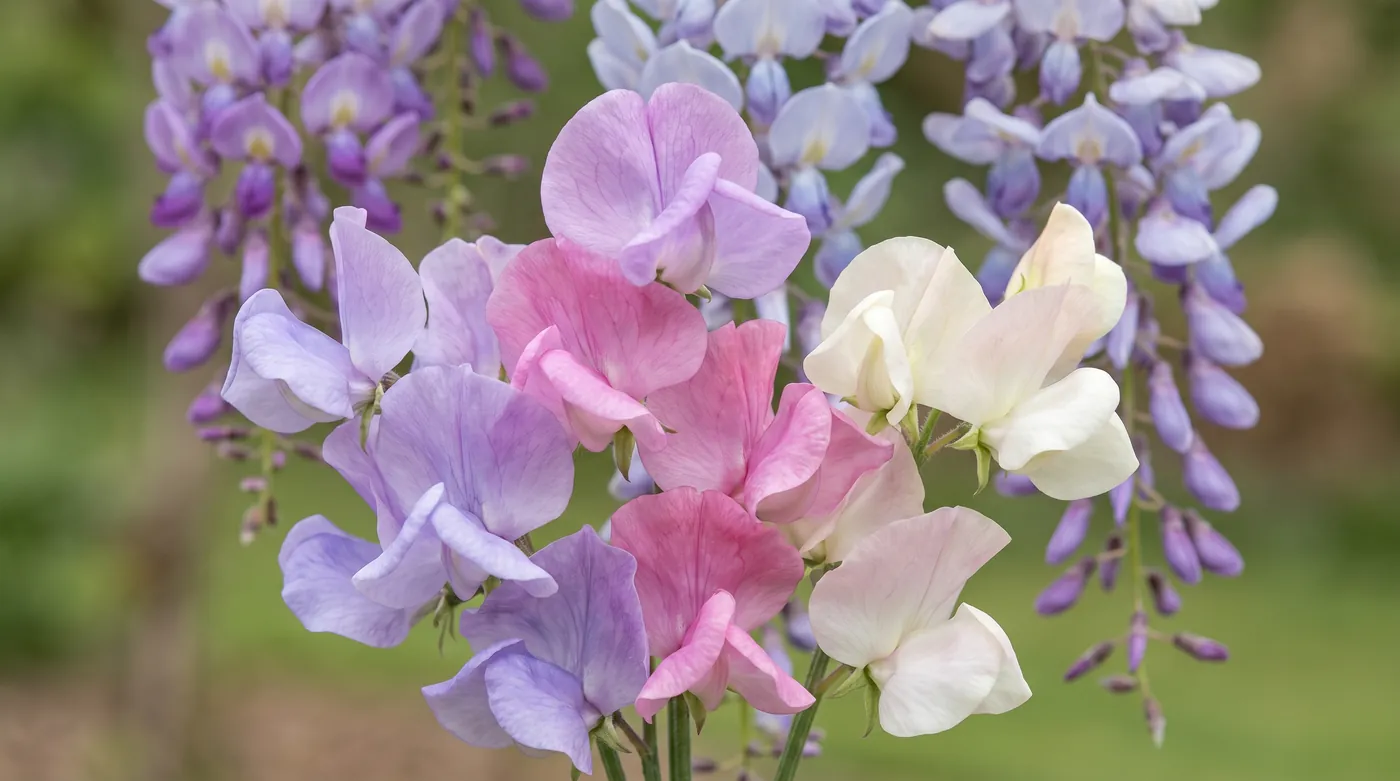
Sweet peas showing the pea flower shape, with wisteria behind

2 flowers in this family

Everything in this guide that belongs to Fabaceae

Pastel sweet pea blooms on slender stems

Sweet Peas

Lathyrus odoratus
3-5 days

Sweet Peas
Long hanging racemes of purple wisteria flowers

Wisteria

Wisteria floribunda and sinensis
2-4 days

Wisteria

Nitrogen, and why farmers care

The reason this family matters beyond the garden is a partnership with bacteria. Rhizobia living in nodules on the roots take nitrogen straight out of the air and convert it into a form the plant can use, and the plant feeds them sugars in return.

Almost nothing else does this at scale. It is why clover is sown into pasture, why beans were rotated with cereals for centuries before anybody knew why it worked, and why legumes are so high in protein: they have a nitrogen supply other plants have to compete for in the soil.

For a gardener the practical version is that peas and beans leave the ground better than they found it, and sweet peas can be grown on poor soil that would starve a comparable annual.

Relatives you already know

Peas, beans, lentils, chickpeas, peanuts, soybeans, alfalfa, clover, carob, tamarind and licorice are all in this family. So is the acacia, the mimosa sold in late winter, laburnum, lupins, broom and gorse. In terms of what people actually eat it is second only to the grasses.

It is also a family with a real toxic streak, and the two facts sit closer together than is comfortable. Laburnum seeds are seriously poisonous, wisteria seeds and pods will make somebody very ill, and even sweet pea seeds are toxic if eaten in quantity, causing a condition called lathyrism that has appeared in famine populations living on the related grass pea.

Nothing in a bouquet is a hazard by being looked at, but wisteria pods look like edible bean pods and are worth mentioning to anybody with children or a curious dog.