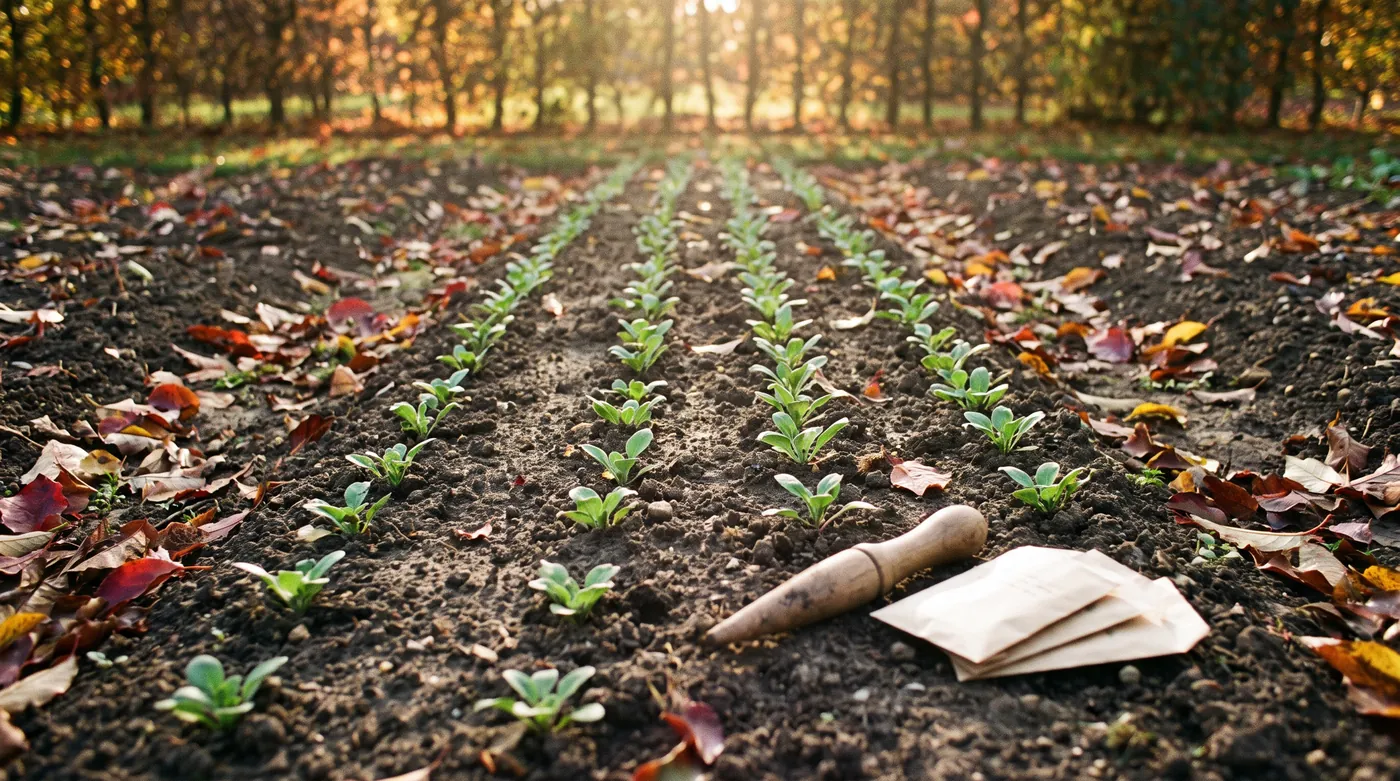
Rows of small hardy annual seedlings in a bare autumn garden bed

What hardy actually means here

A hardy annual is one whose seedlings survive frost. It germinates in the cool, sits through winter as a small tough plant, and starts growing hard the moment the ground warms, weeks before a spring sown seed has even germinated.

The result is a plant with a much bigger root system before it ever thinks about flowering, and that shows up in three ways:

  • Earlier flowers, often by three or four weeks, which lands them in the gap between the spring bulbs finishing and the summer annuals starting.
  • Longer, stronger stems, which for cutting is the whole point. Spring sown sweet peas are short. Fall sown ones are not.
  • More flowers per plant, and a plant that stands up to a dry spell instead of stalling in it.

How and when

Timing is the part people get wrong. Sow too early and the plants get large and soft before winter, then rot or get flattened. Sow too late and they do not make enough root to be worth it. The target is small, sturdy and well rooted going into the cold, which in most places means roughly six weeks before your first hard frost.

Two ways to do it. In the ground, straight into a prepared bed, which is simplest and works where winters are not severe. Or in module trays kept somewhere cold but sheltered, a cold frame or an unheated greenhouse or just against a wall, which gives you far more control and is the safer option if your winter is genuinely hard.

Either way, keep them on the dry side. The thing that kills fall sown seedlings is almost never cold. It is sitting wet in cold, which rots them at the base, so drainage matters more than protection.
What it feels like in May

The honest sell for this is the timing rather than the size. There is a period in late spring when the bulbs are finished and the summer annuals are still small, and a garden with nothing to cut in it. Fall sown hardy annuals land exactly there, and they arrive as full sized plants rather than as something you are waiting on.

It costs a couple of hours in October and a packet of seed. It is the best return on effort in the whole growing year.

More from the blog

Greenhouses on a high plateau in the Colombian Andes at dawn

Why So Many American Flowers Are Grown in Colombia

28 July 2026

A large share of the flowers sold in the United States are grown near Bogota. The reasons are altitude, the equator, and a 1960s policy decision.

Read it
Rows of trolleys stacked with cut flowers in a vast auction warehouse

How Flowers Get Here: The Clock Auction Most of Them Pass Through

21 July 2026

A huge share of the world's cut flowers move through Dutch auction halls that run backwards, in seconds, before dawn.

Read it
Striped and flamed tulips arranged in a dark vase in old master style

Tulip Mania: Most of What You Have Heard Did Not Happen

14 July 2026

The Dutch tulip bubble is the standard cautionary tale about speculation. Historians have spent decades taking most of it apart.

Read it