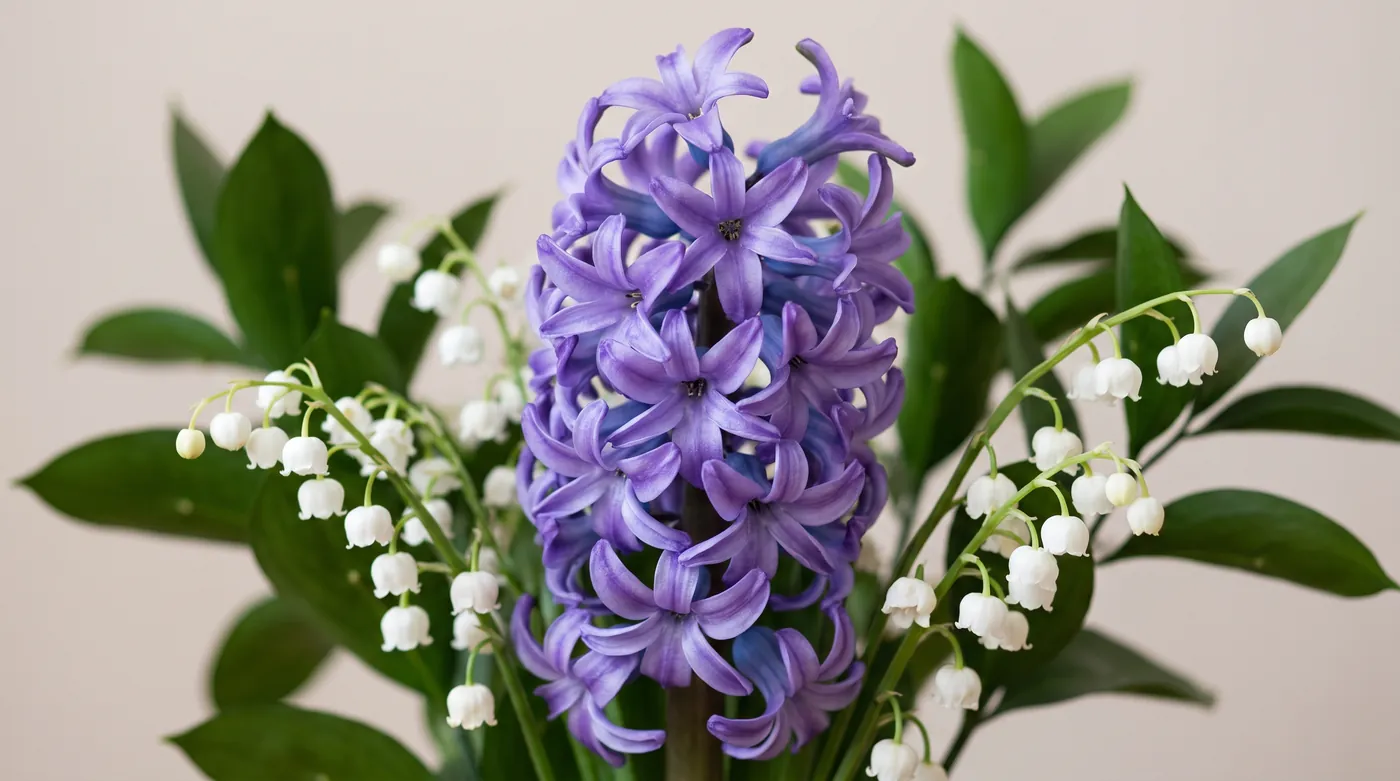
A hyacinth spike with lily of the valley and ruscus

6 flowers in this family

Everything in this guide that belongs to Asparagaceae

Dense hyacinth spikes in blue, pink and white

Hyacinths

Hyacinthus orientalis
5-10 days

Hyacinths
White bell-shaped lily of the valley on arching stems

Lily of the Valley

Convallaria majalis
4-7 days

Lily of the Valley
Dense cobalt blue muscari spikes

Muscari

Muscari armeniacum
5-10 days

Muscari
Long arching stems of glossy dark green Italian ruscus

Ruscus

Ruscus hypoglossum and aculeatus
21-30 days

Ruscus
Arching Solomon's seal stems with hanging white bell flowers

Solomon's Seal

Polygonatum multiflorum
7-12 days

Solomon's Seal
Waxy white tuberose florets opening along a tall spike

Tuberose

Agave amica, formerly Polianthes tuberosa
7-14 days

Tuberose

What the members share in the vase

Two things run through the ornamental side: many grow from bulbs or rhizomes, and a lot of them are strongly scented. Hyacinth, lily of the valley and tuberose are three of the most powerful scents in the whole flower trade, and none of them is subtle.

That has a practical edge. A single hyacinth stem will carry a room, and tuberose is strong enough that some venues will not take it. Scent sells, but it is worth asking before it goes into a hospital order or a small dining room, because the customer who loves it and the customer who cannot sit near it are about equally common.

Hyacinths bring a second quirk. The cut base bleeds a slimy sap that fouls water quickly and irritates skin on repeated handling, and the stem is really a fleshy stalk rather than a woody one. Rinse the base, use shallow clean water, and expect to change it more than once.

Relatives you already know

Asparagus itself, obviously, and the spear on the plate is exactly the young shoot that would have unfurled into the ferny growth if left. The asparagus fern in a florist's bucket is a relative sold for the foliage rather than the crop.

The agaves are here too, which brings tequila and mezcal into the same family as lily of the valley, along with sisal rope and the yuccas and dracaenas sold as houseplants. Tuberose has recently been moved into Agave itself and is now Agave amica, having spent two centuries as Polianthes tuberosa. Suppliers are still catching up with that one.

The English bluebell is a member, and so is the Spanish bluebell that keeps hybridizing with it. Lily of the valley is worth one clear warning regardless of family: it is seriously poisonous, the water it has stood in is poisonous too, and it should be kept well away from children and animals.