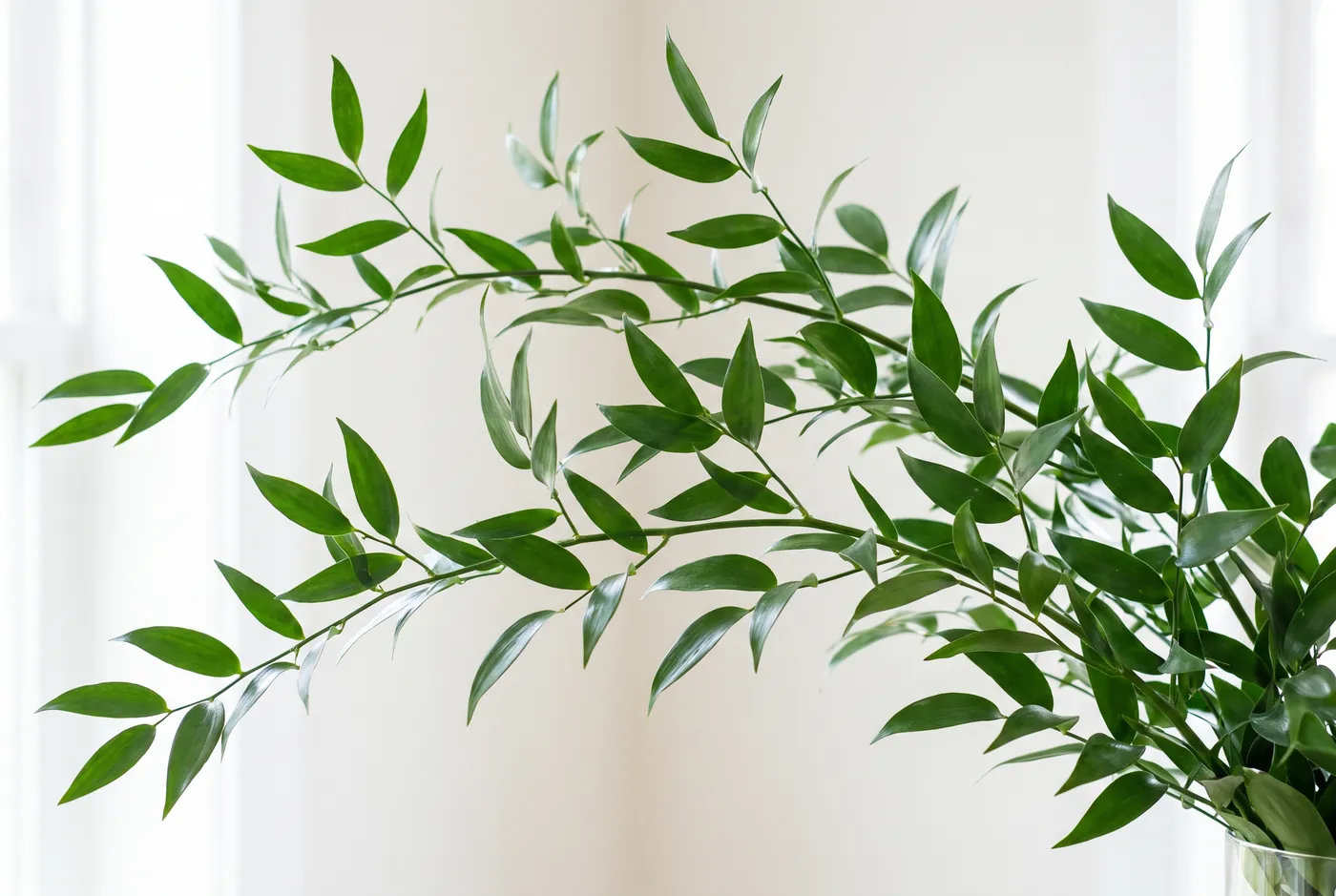
About Ruscus
Ruscus is the dark glossy greenery that lines the edge of arrangements, trails from bouquets and fills gaps in almost every wedding installation. It is close to indestructible: three weeks in water is routine, it holds out of water for days, and it barely reacts to heat.
The flat green blades are not leaves. They are cladodes, flattened stems doing the job of leaves, which is why tiny flowers appear directly in the middle of each one. It is a relative of asparagus, and the wild European species is butcher's broom, once used to scrub chopping blocks.
Primary Meanings
- Endurance: From its exceptional vase life
- Protection: Butcher's broom was hung to guard stores
- Constancy: It stays green in all conditions
- Support: Its role in arrangements, holding everything else up
Ruscus Colors and Their Meanings
Deep Green Ruscus
The standard, and the point of it
Mid Green Ruscus
Israeli ruscus, broader and lighter
Variegated Ruscus
Cream-edged, occasionally available
Popular Ruscus Types
Italian Ruscus
Long fine arching stems, the trailing standard
Israeli Ruscus
Broader flatter blades, stiffer and more upright
Butcher's Broom
Ruscus aculeatus; the spiny wild European species
Soft Ruscus
A finer, more pliable form for bouquet work
Care Instructions
Deep Water
It drinks steadily for weeks.
Recut Occasionally
Long vase life means the end seals over.
Tolerates Anything
Heat and dry air barely affect it.
Reuse It
It commonly outlasts two sets of flowers.
Best Occasions for Ruscus
- Weddings: Garlands, arches and bouquet trails
- Everyday Bouquets: The workhorse edge greenery
- Church and Event Work: Survives long days without water
- Garlands: Its length and toughness suit long runs
Interesting Ruscus Facts
- The flat green blades are cladodes, flattened stems rather than true leaves
- Tiny flowers appear in the middle of each blade, which gives it away
- It is a relative of asparagus
- Butcher's broom was bundled and used to scrub butchers' blocks
- It routinely outlasts every flower it is arranged with
How to Buy Good Ruscus
Look for even deep color with no yellowing at the tips of the blades, which is where age shows first. Stems should be firm and springy rather than brittle. Italian ruscus is bought for length, so measure what you need before ordering, because a garland eats far more than people expect. Check the cut ends are clean and pale. It is cheap enough that there is no reason to accept tired stock.
Season, Availability and What Drives the Price
Cut as foliage year-round, mostly from Italy, Israel and Central America, and the price is among the steadiest in the trade. Demand climbs sharply through wedding season because garland work consumes it by the metre. It is one of the least expensive things a florist buys relative to how much work it does, which is exactly why it is in almost everything.
What to Use Instead
Eucalyptus gives gray-green color and scent where ruscus gives dark green structure. Olive branches trail similarly with a softer, more silvered look. Salal, sometimes sold as lemon leaf, does the same edging job with broader leaves. Leatherleaf fern is the old-fashioned alternative and reads as dated. For sheer durability nothing beats ruscus, which is why it survives every change in fashion.
Safety Around Pets and Skin
Ruscus is not listed as toxic to cats or dogs by the ASPCA and is generally treated as safe. The berries of the wild butcher's broom are mildly irritant if eaten, and that species carries sharp spines, but the florist types sold as Italian and Israeli ruscus are spineless and rarely carry berries. It is a safe choice for a house with animals.
Florist Tips for Ruscus
It will outlast two bunches of flowers
Do not throw ruscus away with a dead bouquet. Rinse it, recut it and use it again with the next lot. Three weeks is normal and four is achievable.
Buy Italian for trailing, Israeli for structure
Italian ruscus has long fine arching stems for garlands and bouquet trails. Israeli is stiffer and broader, better where you need something to hold its shape.
The flowers in the middle are the giveaway
If you spot a tiny flower sitting in the center of a green blade, that blade is a flattened stem rather than a leaf. It is the easiest way to identify ruscus.
Common Questions About Ruscus
How long does ruscus last?
Three to four weeks in water, and several days out of it. It is the most durable greenery in general trade, which is why it is used for event work where arrangements have to survive a long day without attention.
Are the green parts leaves?
No. They are cladodes, flattened stems that do the job of leaves. You can tell because the tiny flowers emerge from the middle of each blade, which no true leaf would do.
What is the difference between Italian and Israeli ruscus?
Italian ruscus has long, fine, arching stems with small blades and is used for trailing and garlands. Israeli ruscus has broader, flatter blades on stiffer upright stems and is used where structure is needed.