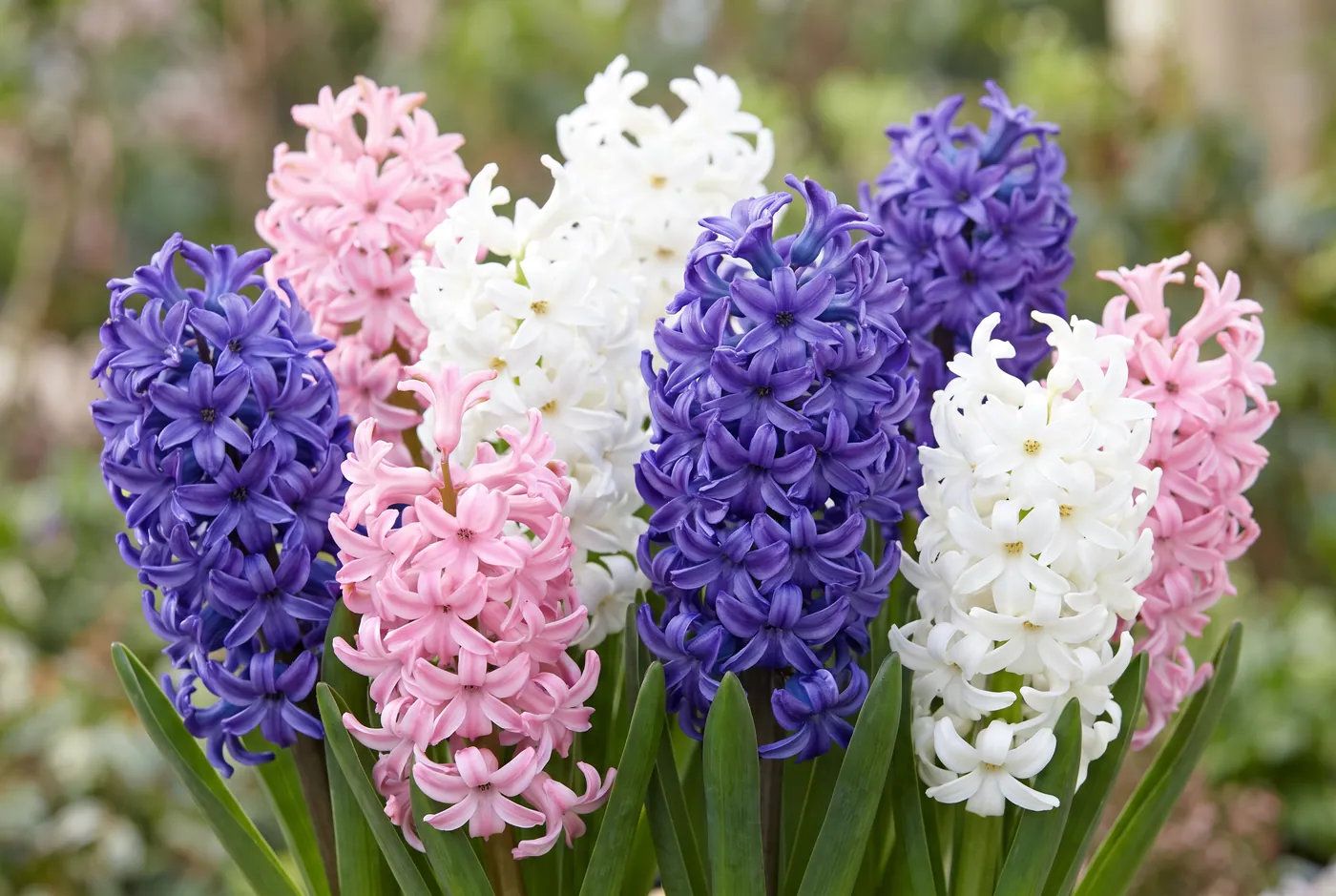
About Hyacinths
Nothing else sold in late winter smells like a hyacinth. A single dense spike of waxy starry florets will scent an entire floor of a house, which is either the reason to buy one or the reason to keep it in another room. They arrive in January when almost nothing is happening, and they are cheap.
They are sold three ways: as forced bulbs in a pot, as cut stems, and prepared in glass forcing vases with the bulb suspended above water. All three work, and the last is worth doing once just to watch the roots.
Primary Meanings
- Sincerity: The classic meaning across the Victorian language of flowers
- Playfulness: Associated particularly with the blue forms
- Sorrow: From the Greek myth of Hyacinthus, killed by a discus
- Rebirth: One of the first bulbs to flower after winter
Hyacinths Colors and Their Meanings
Blue Hyacinth
Constancy; the traditional colour
White Hyacinth
Purity, and the most strongly scented
Pink Hyacinth
Playfulness and warmth
Purple Hyacinth
Sorrow and apology, from the myth
Yellow Hyacinth
Jealousy in the old language; simply cheerful now
Popular Hyacinths Types
Dutch Hyacinth
The dense fat spike everyone pictures
Multiflora
Several looser spikes per bulb, more natural looking
Roman Hyacinth
Slender and delicate, an older garden form
Grape Hyacinth
Muscari, a different genus entirely, small and blue
Care Instructions
Wear Gloves
The sap causes itching for many people. Wash after handling.
Shallow Water
Thick fleshy stems rot quickly in depth.
Cool Room
Warmth makes them flop and shortens them sharply.
Keep the Bulb Base
Cut stems last longer with the white base left on.
Best Occasions for Hyacinths
- Early Spring: January to March, when little else is available
- Easter: A traditional Easter flower alongside daffodils
- Apologies: Purple hyacinth carries the meaning specifically
- Home Scent: One pot perfumes a whole floor
Interesting Hyacinths Facts
- The scent is strong enough that a single bulb can perfume a large room
- The sap contains calcium oxalate crystals and causes itching in many people
- Grape hyacinth is Muscari, an unrelated genus despite the name
- Bulbs are prepared with a cold treatment to force flowering out of season
- The Greek myth has the flower springing from the blood of Apollo's dying friend
How to Buy Good Hyacinths
Buy them with the florets still mostly closed and just showing color, because they open fast and a fully open hyacinth has a few days left at most. The spike should feel dense and heavy for its size; a loose one with gaps between the florets will look sparse when it opens. For cut stems, check the white fleshy base is intact and not brown, because that is where they rot first. For potted bulbs, look for a short sturdy spike rather than a tall pale one, which means it was forced too warm and will flop within days.
Season, Availability and What Drives the Price
Hyacinths are among the earliest flowers of the year, appearing from December and running through to April. They are forced: bulbs are given an artificial cold winter so they flower ahead of schedule, which is why they arrive in the dead season. They are cheap throughout, and cheapest as potted bulbs rather than cut stems. There is no real price spike because demand is spread rather than concentrated on one day, and the supply from Dutch growers is enormous.
What to Use Instead
For the scent, paperwhite narcissus is the other powerfully perfumed forced bulb of the same season, and stock takes over in early spring. Freesia gives a lighter, cleaner fragrance and lasts longer. For the look without the smell, muscari is the small blue relative and lasts well in a low vase. If you like the idea but find the scent overwhelming, which many people do, choose fewer stems rather than a different flower: one hyacinth is genuinely plenty.
Safety Around Pets and Skin
Hyacinth bulbs are toxic to cats and dogs, and the bulb is far worse than the flower. They contain calcium oxalate crystals and other irritants that cause intense mouth irritation, drooling, vomiting and diarrhoea. The same crystals cause a well-known itching and rash in people who handle bulbs bare-handed, sometimes called hyacinth itch, which is a real occupational issue for growers. Wear gloves when handling bulbs and keep them away from pets entirely.
Florist Tips for Hyacinths
Leave the white base on a cut stem
Hyacinths cut with the pale fleshy base intact last noticeably longer than ones trimmed back to green. Do not tidy that part off.
Wash your hands after handling bulbs
The sap causes a persistent itch in a lot of people. It is not an allergy so much as a mechanical irritation from the crystals in the sap.
One is enough in a small room
People routinely buy three and find the scent overpowering. Start with one and add another if you want more.
Common Questions About Hyacinths
Why do my hands itch after handling hyacinths?
The bulbs and stems contain calcium oxalate crystals, which cause a mechanical irritation of the skin. It is common enough to have its own name, hyacinth itch, and it is a known problem for bulb growers. Wear gloves and wash afterwards.
Why did my potted hyacinth flop over?
Too warm. Hyacinths forced or kept in a heated room grow tall and weak and fall over under the weight of the spike. Keep them in the coolest room you have and they stay compact and upright for much longer.
Is grape hyacinth the same plant?
No. Grape hyacinth is Muscari, a different genus. It is much smaller, deep blue, and looks like a tiny cluster of grapes. The scent is far milder and it flowers slightly later.