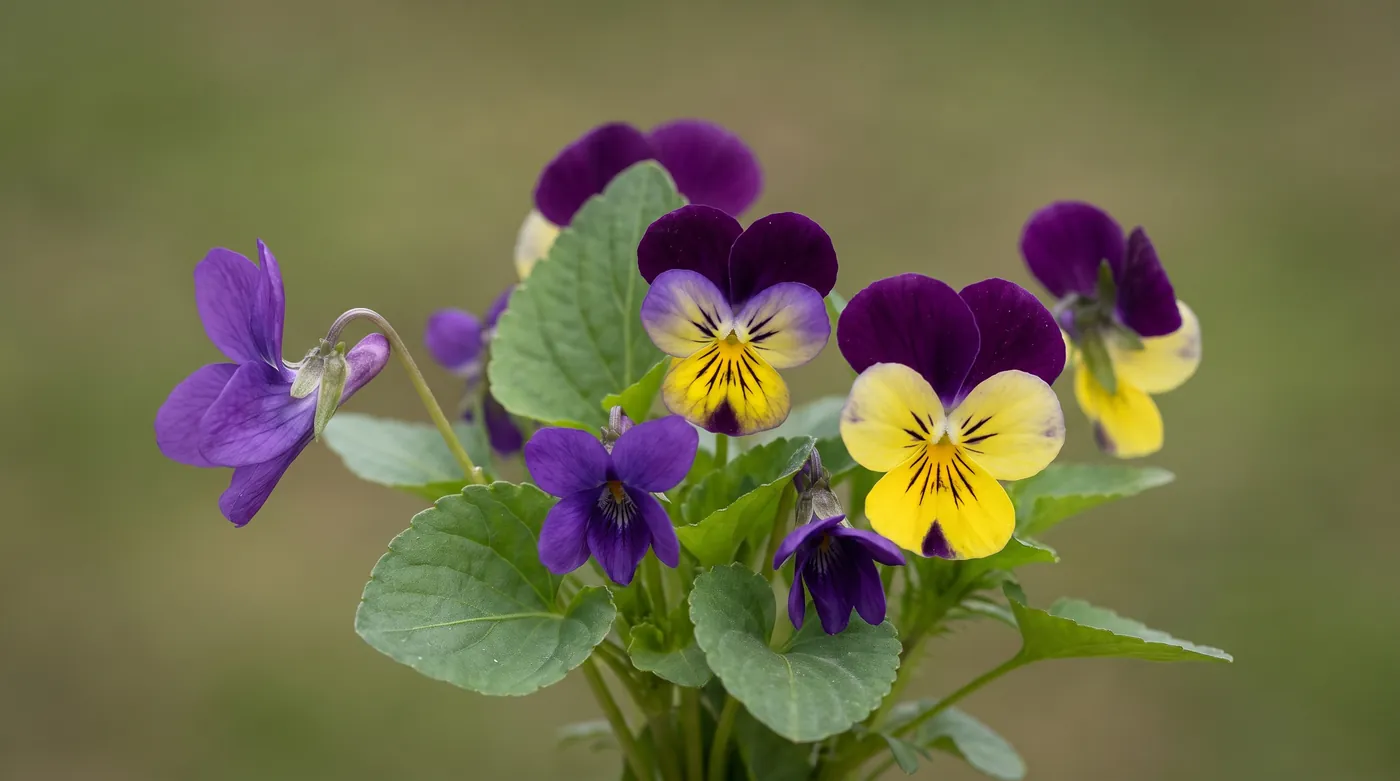
Five petals and a spur
A violet flower is not symmetrical the way a buttercup is. Turn one to face you and it has a left and a right rather than a rotation: two petals standing up, two out to the sides and one hanging below, larger than the rest, doing the work of a landing platform.
That lower petal runs backward into a hollow spur behind the flower, and the spur holds nectar. Two of the five stamens push small appendages into it, so an insect after the nectar has to force its head past the reproductive parts to reach the reward. The markings radiating out from the throat of a pansy are not decoration either. They are nectar guides, lines pointing at the entrance, and under ultraviolet light they are far more pronounced than they look to us.
Pansies are Viola x wittrockiana, a garden hybrid with no wild equivalent, bred up in the nineteenth century from a handful of European species. The name comes from the French pensee, a thought, which is why Ophelia hands out pansies for thoughts.