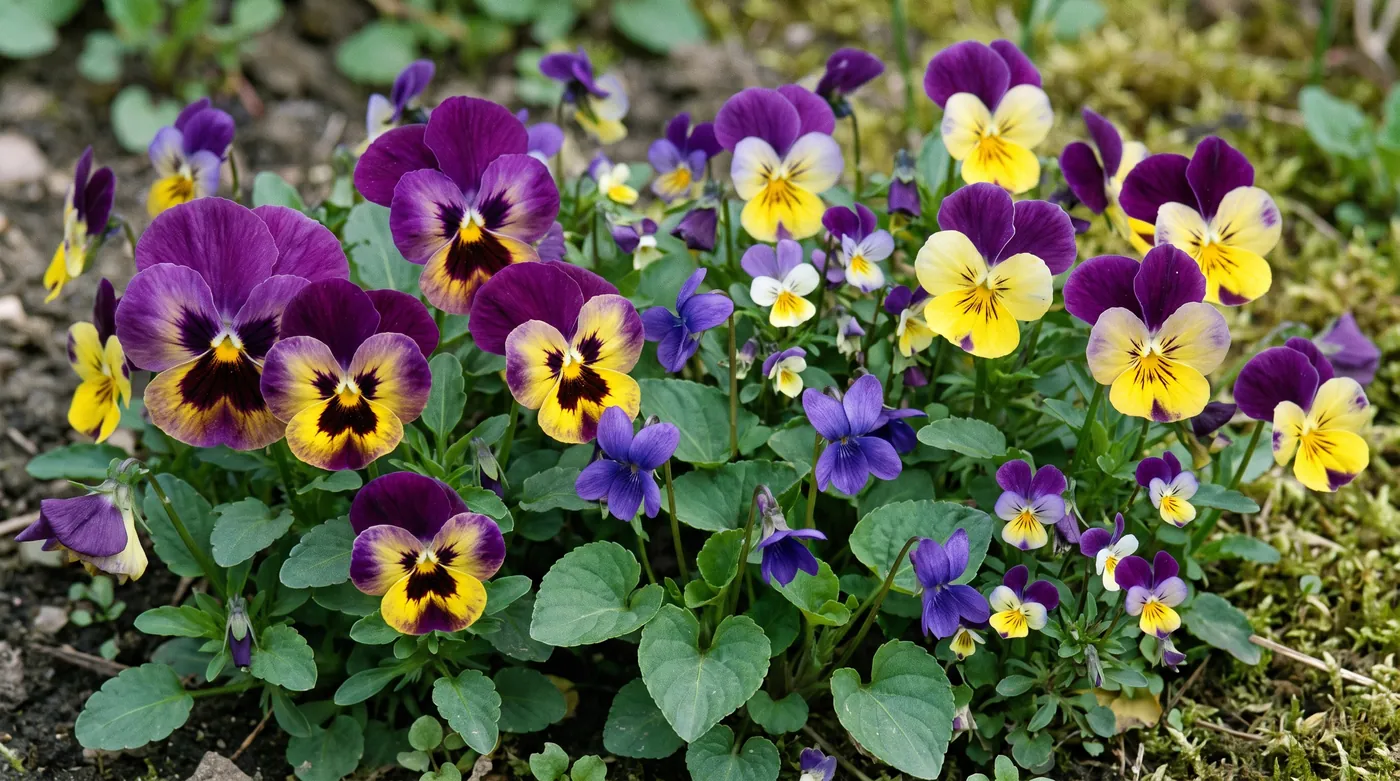
Large faced pansies beside small violets and violas

2 flowers in this genus

Everything in this guide that belongs to Viola

Purple and yellow pansies with dark face markings

Pansies

Viola x wittrockiana
2-4 days cut; months as a plant

Pansies
Deep purple sweet violets with heart-shaped leaves

Violets

Viola odorata
3-5 days

Violets

The face was an accident

The garden pansy is one of the few ornamental plants whose invention can be dated and more or less credited. It came out of England in the early nineteenth century, from a small number of people crossing wild European violas at the same time, and it took about twenty years to go from a scattering of small wildflowers to something recognizable as a modern pansy.

The blotch arrived partway through as a chance seedling. Before it, the flowers carried only fine radiating lines; the dark solid mark that reads as a face turned up unbidden in somebody's seedling bed around 1830 and was immediately bred for, because it is what made the flower a curiosity rather than a wildflower.

It is worth knowing what those lines and blotches actually are, since they predate the breeding. They are nectar guides, converging on the throat of the flower where the reward is, and under ultraviolet light they are far stronger than they appear to us. The face was a pollination signal long before it was a selling point.

Proteins tied in a circle

The genuinely extraordinary thing about this genus was not discovered until recently. Violas produce a family of small proteins whose backbone is joined head to tail into a closed loop, with the whole structure pinned together internally by additional bonds.

Having no loose ends makes them almost indestructible by the standards of proteins. They survive boiling, they survive the digestive enzymes that break ordinary proteins apart, and they hold their shape in conditions that would destroy almost anything comparable. The plant makes them as a defense against insects and disease.

That stability is why they are of interest well outside botany. Most protein based drugs cannot be swallowed, because the gut destroys them before they do anything, and a naturally occurring scaffold that survives the same journey is a promising thing to hang a drug on. The work is a long way from finished, and it started with somebody noticing that a tea made from a viola still worked after being boiled.