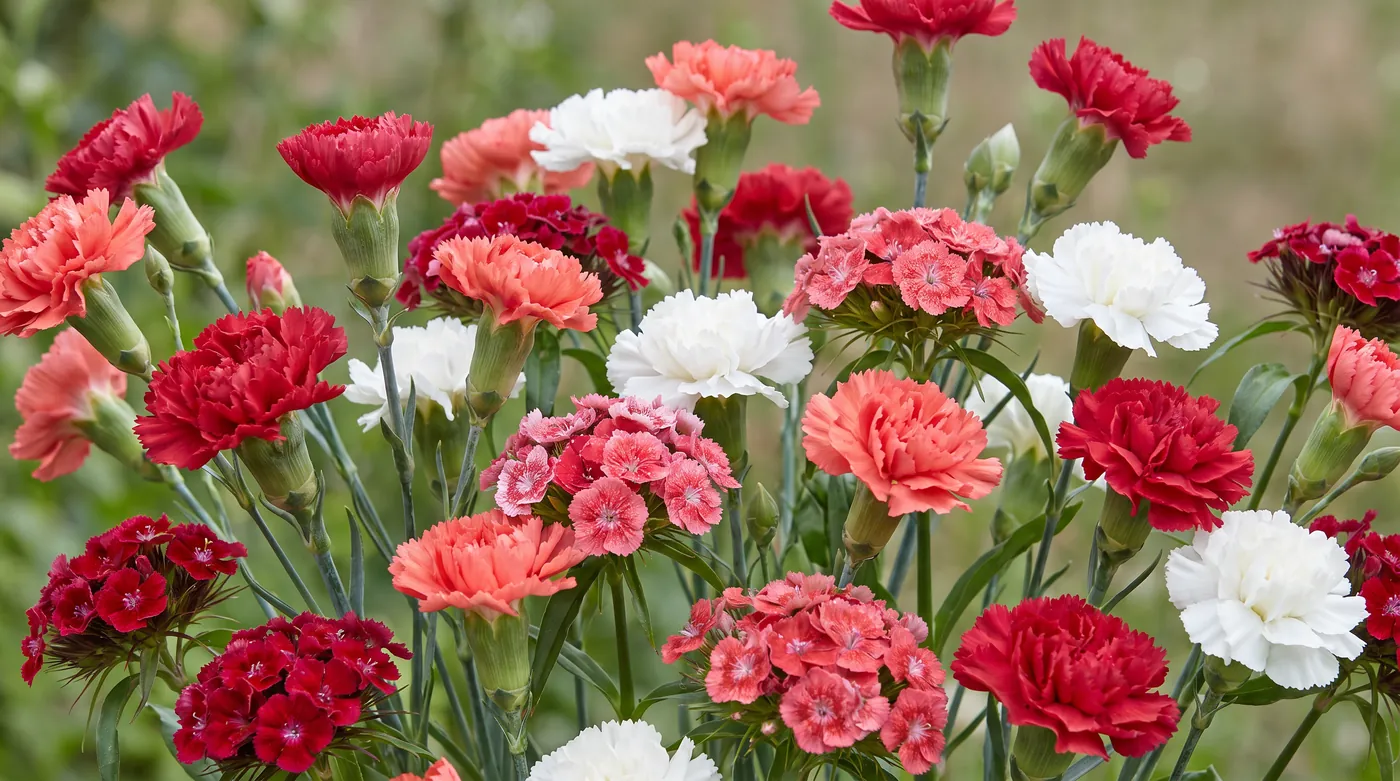
Carnations beside flat heads of sweet william

2 flowers in this genus

Everything in this guide that belongs to Dianthus

Carnations

Carnations

Dianthus caryophyllus
14-21 days

Carnations
Dense flat heads of crimson and white sweet William flowers

Sweet William

Dianthus barbatus
7-14 days

Sweet William

Clove, and the compound behind it

The old cottage pinks and the original carnation species share a scent that is unmistakable and that has nothing floral about it: warm, spicy and recognizably clove. That is not a poetic comparison. The plants make the same aromatic compound cloves do, which is why the description keeps arriving independently in every language that has a word for both.

It mattered historically. Before the spice trade made cloves affordable in northern Europe, flowers from this genus were used to spice wine and ale as a cheap local substitute for the imported article, and several of their old names refer to that rather than to anything ornamental.

Modern breeding has largely spent it. Selecting hard for stem length, color range, bloom size and vase life pulled the scent out of most commercial lines, and it is now a thing to check for rather than to assume. The plants that kept it are mostly the older garden types and a handful of varieties grown deliberately for it.

One tube, and what happens under pressure

Every flower in this genus sits in a narrow rigid tube formed by its fused sepals, and it is a tighter piece of engineering than it looks. The petals are packed inside that tube with their bases clamped, which is what holds the head together and why a dianthus flower does not shed petals one at a time the way a rose does.

Push it too far and it fails in a specific way. If a bud develops faster or fuller than the tube can accommodate, usually after a warm spell or in a heavily doubled variety, the tube splits down one side and the flower spills out lopsided. It cannot recover, and growers of large headed carnations routinely slip a small band around the calyx before it opens to stop it happening at all.

The same construction is why the stems have such obvious swollen joints. Those nodes are where the leaves attach in opposite pairs, they are the strongest points on an otherwise thin stem, and they are also where it snaps when it snaps.