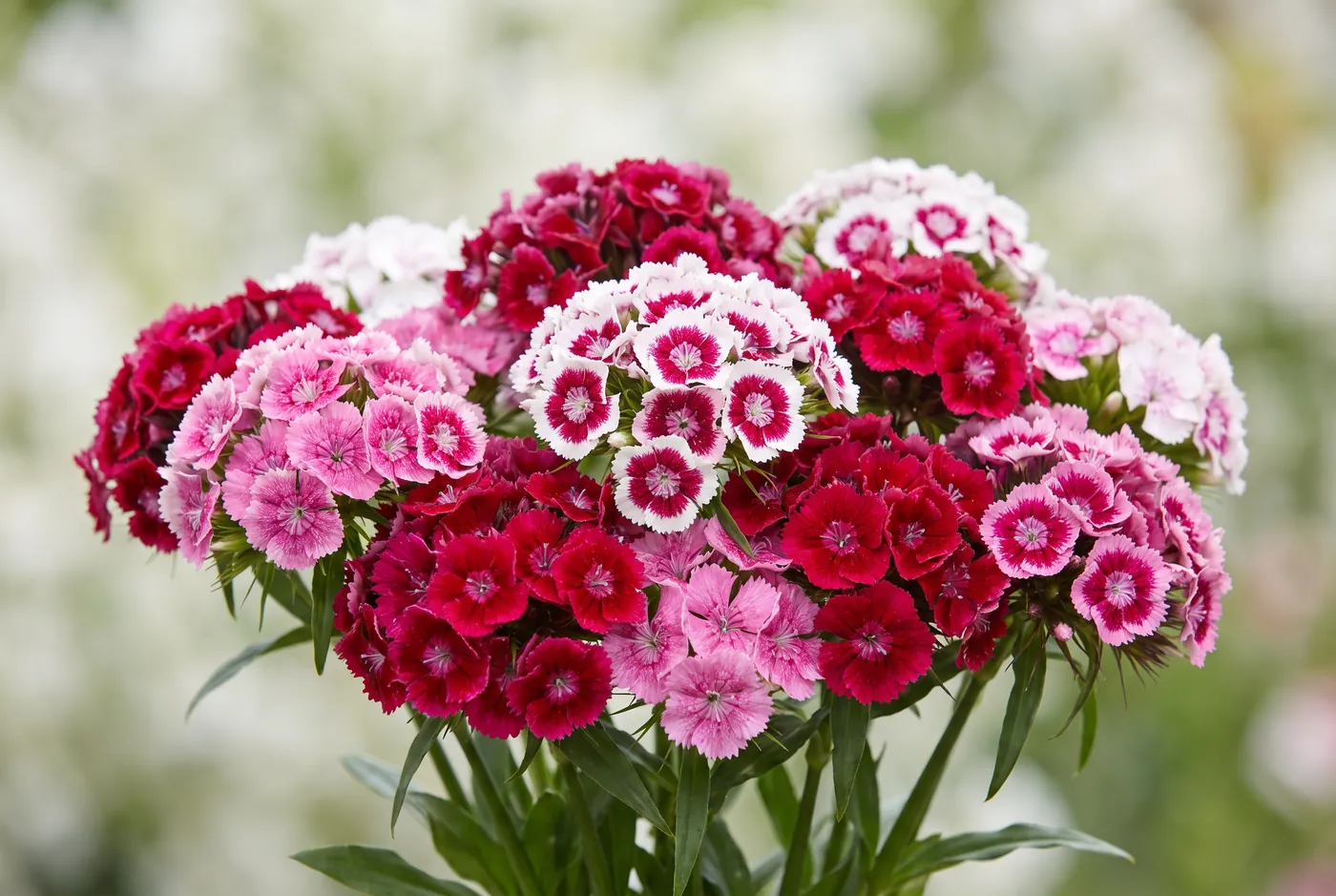
About Sweet William
Sweet William is a flat, densely packed head of small fringed flowers in crimson, pink, white and bicolours, on a stiff stem with narrow leaves. It carries the same clove scent as its relatives the carnation and the pink, though usually lighter, and it lasts remarkably well cut.
It had a moment in 2011 when it appeared in Kate Middleton's wedding bouquet, chosen for the obvious reason. Sales of it went up sharply and have never entirely settled back.
Primary Meanings
- Gallantry: The traditional meaning
- Finesse: The Victorian association
- A Smile: Commonly given to cheer someone
- Masculine Admiration: From the name and its wedding use
Sweet William Colors and Their Meanings
Crimson Sweet William
The classic and strongest colour
Pink Sweet William
Affection; widely grown
White Sweet William
Purity; used in bridal work
Bicolour Sweet William
Eyed and edged forms, the traditional look
Near-Black Sweet William
Sooty; deep maroon and much sought after
Popular Sweet William Types
Dianthus barbatus
The species; the classic biennial
Sooty
Near-black flowers on dark stems
Green Trick
A dianthus grown for green mossy balls, no petals at all
Amazon Series
Bred for cutting; long stems, first-year flowering
Care Instructions
Clean Water
Change every couple of days.
Strip Foliage
Leaves below the water rot fast.
Pick Off Spent Florets
The head keeps opening for a week.
Cool Room
It holds well but heat shortens it.
Best Occasions for Sweet William
- Early Summer Bouquets: Its natural season
- Weddings: Boosted by the 2011 royal bouquet
- Cottage Arrangements: With larkspur, ammi and cosmos
- Father's Day: The name makes it a common choice
Interesting Sweet William Facts
- It is a dianthus, related to carnations and pinks
- It appeared in Kate Middleton's 2011 wedding bouquet
- The traditional plant is biennial, flowering in its second year
- Green Trick, a dianthus with no petals at all, is a close relative
- Each flat head is dozens of small individual flowers opening in sequence
How to Buy Good Sweet William
Look for heads where roughly half the small florets are open and the rest still in bud, since they open in sequence over a week or more. The open florets should be crisp with no browning at the edges. Stems are stiff and should feel rigid; softness at the base means bad water. Smell it, because scent varies a great deal between varieties and some modern cutting strains have almost none, which is a fair reason to choose one bunch over another.
Season, Availability and What Drives the Price
Late spring into early summer is the main crop, and that is when it is cheapest and best. Some year-round supply exists from greenhouse growers. It is inexpensive and, for a flower that lasts up to a fortnight, one of the better-value things in a summer bunch. Wedding demand has been noticeably higher since 2011, particularly for the white and near-black varieties.
What to Use Instead
Carnations are the obvious relative, longer lasting and available all year. Phlox gives a similar domed head with a sweeter scent. Yarrow provides a flat plate in muted colours. Green Trick dianthus, the mossy green ball, is the same genus doing something entirely different and is worth knowing about. For a flat head of small clove-scented flowers in early summer, sweet William is the standard.
Safety Around Pets and Skin
Dianthus, including sweet William, is mildly toxic to cats and dogs. It causes vomiting, diarrhoea and mild dermatitis, and it is on the ASPCA list. It is not dangerous the way lilies are, but it appears in a great many mixed bunches, so it is one of the more likely things a pet will actually encounter.
Florist Tips for Sweet William
Smell before you buy
Scent varies hugely between varieties. Some modern cutting strains have been bred for stem length and colour and have almost no clove note left. If the scent is why you want it, check.
Pick off spent florets
Each head opens over a week or more. Removing the browned florets keeps it looking fresh while the rest come through.
Green Trick is the same genus
If you have ever wondered what the bright green mossy balls in modern bouquets are, they are a dianthus with no petals at all, closely related to this.
Common Questions About Sweet William
Is sweet William a carnation?
Same genus, different species. Sweet William is Dianthus barbatus; carnations are Dianthus caryophyllus. They share the clove scent and the fringed petals, but sweet William carries many small flowers in a flat head rather than one large bloom.
Why is it called sweet William?
Nobody is certain. Theories point at William Shakespeare, at William the Conqueror and at several saints, none convincingly. The name is at least four hundred years old and its origin is genuinely unknown.
Is sweet William safe for pets?
Mildly toxic. Dianthus species cause vomiting, diarrhoea and skin irritation in cats and dogs and are on the ASPCA list. Not dangerous, but worth keeping out of reach.