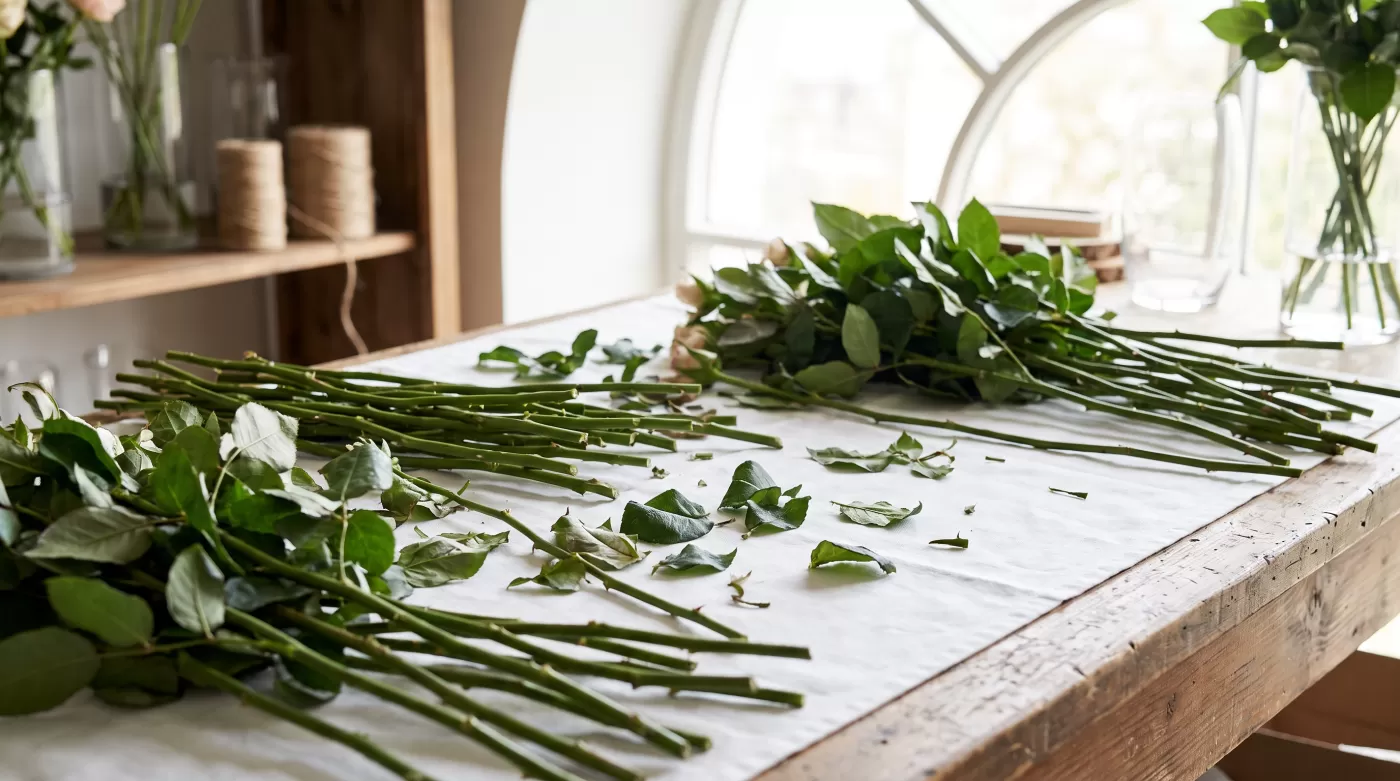
Close-up view of fresh rose stems on a clean florist work table, some stems fully leafed, others with leaves stripped away showing bare green stems, scattered rose leaves on the white surface, profess

Leaves Drink More Than Blooms Do

A stem is a hydraulic system with limited capacity, and foliage makes a lot of demands on it. Leaves transpire, which means they release water vapor, and they do it at a higher rate than petals. The more leaf surface area you leave on a stem, the faster that stem dries out, and a flower in a vase does not have roots to pull replacement water fast enough.

This matters most in the first few days after cutting, when the stem ends are still adjusting and not taking up water efficiently. A rose with full foliage will wilt in a vase that would keep a stripped rose crisp, not because the water is bad but because the leaves are demanding more than the cut stem can deliver.

Commercial growers leave the foliage on because it continues photosynthesis during pack-out and transit, which keeps the stems fed. Florists take it off because once the flower is in a vase, the cost of that foliage outweighs the benefit.

What Gets Kept and Why

Florists do not strip everything. The foliage that stays on serves a purpose, and there is a pattern to what gets kept:

  • Leaves near the bloom that frame the flower or fill space in a hand-tied bunch without drooping into the water
  • Foliage that is part of the stem's structure, like the collars on some lilies or the small leaves tight against a rose head
  • Decorative leaves on stems sold specifically for their foliage, like eucalyptus or ruscus, where the leaf is the product

What gets removed is anything that will sit in water, anything yellowing or damaged, and most of what sits in the middle section of the stem where it adds transpiration load without adding to the look of the arrangement.

More from the blog

Bunches of long-stemmed roses arranged vertically in clear plastic sleeves on a wholesale flower market table, sorted by height with visible grade labels showing different centimeter measurements, pro

Why Flower Stems Are Graded by the Centimeter

12 August 2026

The wholesale flower trade sorts stems into grades by length, and a few centimeters can double the price. Here's what actually drives that difference.

Read it
Rows of small hardy annual seedlings in a bare autumn garden bed

Sow Hardy Annuals in Fall and They Flower Weeks Earlier

4 August 2026

Fall sown hardy annuals come through winter as small plants and flower earlier, taller and heavier than the same seed sown in spring.

Read it
Greenhouses on a high plateau in the Colombian Andes at dawn

Why So Many American Flowers Are Grown in Colombia

28 July 2026

A large share of the flowers sold in the United States are grown near Bogota. The reasons are altitude, the equator, and a 1960s policy decision.

Read it