About Asters
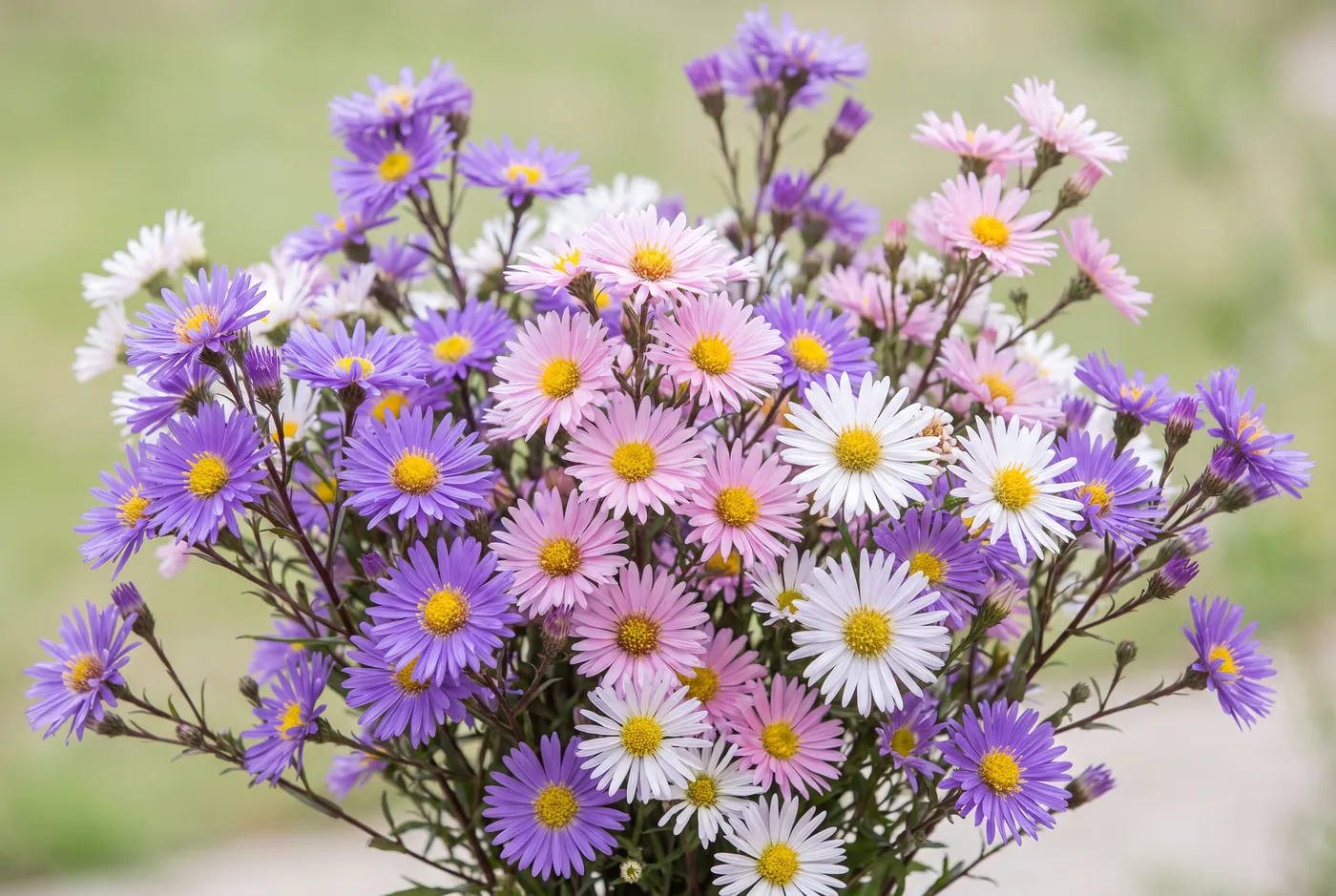
Asters are what fills a vase when summer flowers have finished and nothing else has started. Masses of small daisy-like blooms on branching stems, in purples, pinks and whites with a yellow eye, and they arrive exactly when arrangements start needing help. In Britain they are called Michaelmas daisies, after the late-September feast they flower for.
They are the birth flower for September. They are also cheap, generous and slightly awkward to keep, because the foliage is the first thing to spoil and it takes the water with it.
Primary Meanings
- Patience: The classic meaning, from its late flowering
- Love and Daintiness: The Victorian association
- Wisdom: Linked to the Greek goddess Astraea and the stars
- Remembrance: Traditionally laid on graves in parts of Europe
Asters Colors and Their Meanings
Purple Asters
Wisdom and royalty; the most common shade
Pink Asters
Sensitivity and gentle love
White Asters
Innocence and new beginnings
Blue Asters
Calm; among the truer blues available in autumn
Red Asters
Devotion, less common in the trade
Popular Asters Types
China Aster
The florist type, single-stemmed with a large bloom
Michaelmas Daisy
Branching sprays of small flowers, the classic autumn look
Matsumoto
The commercial cut variety, tough and long lasting
New England Aster
Tall native American species, deep purple
Care Instructions
Strip the Foliage
The leaves rot fast. Remove everything below the water.
Change Water Often
Every other day at minimum, they foul it quickly.
Recut
Trim on an angle and re-trim mid-week.
Pick Off Spent Blooms
Branching sprays keep going if you remove the finished ones.
Best Occasions for Asters
- September Birthdays: The birth flower for the month
- Autumn Arrangements: Peak season and the reason they exist commercially
- Sympathy: A traditional remembrance flower across Europe
- 20th Anniversary: The traditional flower for the milestone
Interesting Asters Facts
- Aster means star in Greek, after the shape of the flower
- It is the birth flower for September and the 20th anniversary flower
- Michaelmas daisy refers to flowering around 29 September
- Botanists moved most North American asters out of the genus Aster entirely in the 1990s
- They are one of the last significant nectar sources for late bees
How to Buy Good Asters
Look at the centers. An aster with a fluffy, powdery yellow eye is already mature and on its way out; you want centers that are still tight and flat. Because they come as branching sprays, judge the whole stem rather than one bloom: a good spray has open flowers, buds showing color and green tight buds all at once, which is what gives you a fortnight rather than a week. The foliage tells you the age faster than the flowers do, so reject anything with yellowing or black-spotted leaves.
Season, Availability and What Drives the Price
Asters run from August into October and that is when they are cheap, plentiful and at their best. They exist commercially precisely because they fill the gap after summer flowers finish, so autumn is not just the best time to buy them, it is close to the only time worth doing so. Greenhouse stems appear at other times of year and are noticeably weaker for the price. Around late September and early October they are one of the best-value flowers in the shop.
What to Use Instead
Chrysanthemums cover the same autumn season and last far longer, though they read as more formal. Daisies give the same simple open face in spring and summer. For the loose, meadow-like spray effect specifically, solidago and September-flowering rudbeckia both work, and rudbeckia brings the same yellow eye at a larger scale. Small-flowered spray chrysanthemums are the closest year-round substitute, and are what most florists will suggest when asters are out of season.
Safety Around Pets and Skin
Asters are not toxic to cats or dogs and are not on the ASPCA hazard list. They are a safe choice for a house with animals. A pet eating a large quantity may have a mild stomach upset, as with any plant material, but there is no specific toxin. Worth noting because they are frequently confused with chrysanthemums, which ARE toxic to cats and dogs and look similar in a mixed autumn bunch.
Florist Tips for Asters
The leaves are the problem, not the flowers
Aster foliage breaks down fast and fouls the water, which then blocks the stems. Strip everything below the waterline and change the water every couple of days and you will get twice the life out of them.
Buy sprays, not single stems
A branching spray with flowers at three different stages keeps producing for a fortnight. A stem where everything is open at once finishes together.
Do not confuse them with chrysanthemums around pets
They look alike in an autumn bunch. Asters are safe; chrysanthemums are toxic to cats and dogs. If you are not certain which you have, treat the bunch as toxic.
Common Questions About Asters
What is a Michaelmas daisy?
The same plant. It is the British name for the autumn-flowering asters, after Michaelmas on 29 September, which is roughly when they peak. Confusingly, botanists reclassified most North American asters into other genera in the 1990s, so the labels in a garden center may not match the name on the bucket.
Are asters safe for cats?
Yes, asters are not toxic. Be careful with identification though: chrysanthemums look similar in a mixed autumn bouquet and those ARE toxic to cats and dogs.
Why do my asters die so quickly?
Almost always the foliage. Aster leaves rot fast in water and the bacteria blocks the stems within days. Strip every leaf that would sit below the waterline, change the water frequently, and recut the stems midweek.