About Banksia
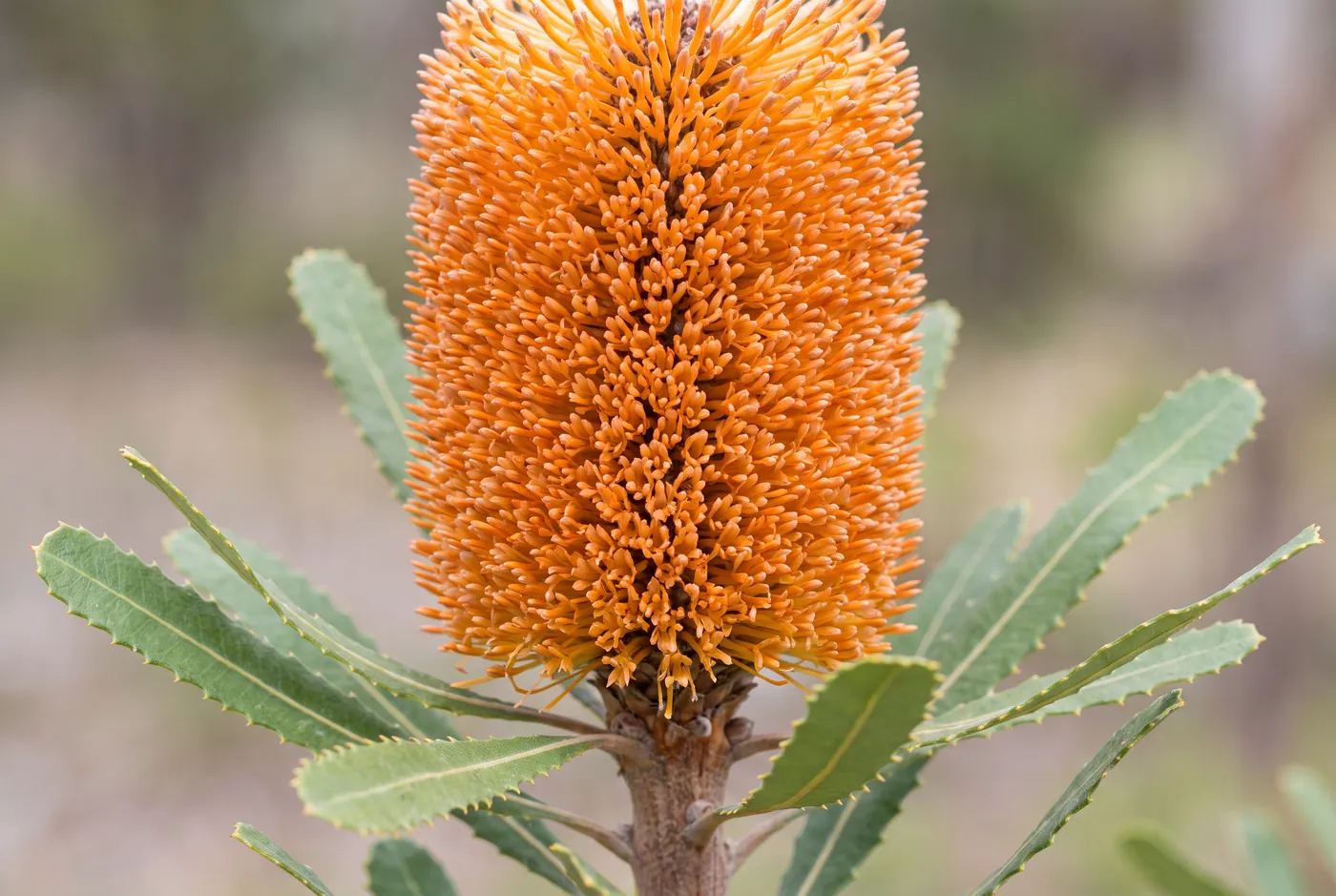
A banksia flower is a dense cylindrical brush, sometimes the size of a forearm, built from hundreds or even thousands of individual flowers packed around a woody core. In orange, yellow, red and burgundy, with stiff serrated leaves below, it looks less like a flower than a piece of industrial design.
It is in the same family as protea, it comes from Australia, and it dries into a permanent object rather than dying. Many species also need bushfire to release their seed, which tells you something about how tough the whole plant is.
Primary Meanings
- Resilience: It regenerates after fire
- Endurance: From its woody, weather-proof structure
- Uniqueness: Nothing else looks like it
- Strength: The common gifting association
Banksia Colors and Their Meanings
Orange Banksia
The classic; ashbyi and similar
Yellow Banksia
Warmth; the most common commercially
Burgundy Banksia
Depth; the darkest species
Silver-Green Banksia
Unopened spikes, used deliberately
Popular Banksia Types
Banksia coccinea
Scarlet banksia, the showiest and most expensive
Banksia hookeriana
Orange, the commercial cut standard
Banksia menziesii
Firewood banksia, pink and grey tones
Banksia baxteri
Bird's nest banksia, wide open spikes
Care Instructions
Split the Stem
Very woody; split or crush the cut end.
Clean Water
Change it regularly; stems are sensitive to bacteria.
Strip Lower Leaves
Leaf blackening is the usual failure, as with protea.
Dries Permanently
It becomes a lasting object rather than dying.
Best Occasions for Banksia
- Modern Arrangements: One stem carries a whole design
- Textural Weddings: With protea, eucalyptus and dried grasses
- Masculine Gifting: Chosen where a conventional bouquet would not suit
- Dried Displays: It lasts indefinitely
Interesting Banksia Facts
- A single spike is hundreds or thousands of individual flowers around a woody core
- Many species need bushfire heat to open their seed pods
- It is named after Joseph Banks, who collected it on Cook's first voyage
- It is in the Proteaceae, the same family as protea and leucadendron
- Dried spikes keep their shape indefinitely and are often used as objects
How to Buy Good Banksia
Look at the leaves before the flower, exactly as with protea. Leaf blackening is the characteristic failure and it starts at the tips, so a stem showing dark edges in the shop will be worse in a week. The spike itself should be dense with no gaps where flowers have dropped, and the tiny individual flowers should look fresh rather than dry and brown at the base of the cylinder. Woody stems should be firm and not split at the cut end.
Season, Availability and What Drives the Price
Almost all banksia reaching the United States is imported from Australia, where the main flowering runs through their autumn and winter, so supply here is strongest from about April to September. Californian and Hawaiian growers cover part of the rest of the year. It is expensive throughout, and Banksia coccinea, the scarlet one, commands the highest price of the group because it is slower and fussier to grow.
What to Use Instead
Protea is the obvious relative, rounder and softer in form at a similar price. Leucadendron gives the same family character at a much lower cost. Celosia in the plume forms offers comparable texture in a soft rather than woody way. Dried eucalyptus pods and lotus pods do similar work in an arrangement. For the cylindrical brush specifically there is no substitute, which is the reason to buy it.
Safety Around Pets and Skin
Banksia is not listed as toxic to cats or dogs and does not appear on the ASPCA hazard list. It is a safe stem to have around animals, and its woody, leathery structure means very few pets take any interest in it. The serrated leaves are stiff enough to scratch, which is worth knowing when handling large quantities.
Florist Tips for Banksia
Strip the lower leaves at once
Banksia and protea share the same problem: the leaves keep respiring after cutting and blacken from the tips. Removing the lower ones immediately slows it considerably.
Keep it when it fades
Take it out of the water and stand it somewhere dry. It becomes a permanent object with almost no change in shape, which is a large part of why the price is justifiable.
One stem, not three
A banksia spike is a substantial thing. A single stem with its own foliage in a simple vase reads far better than a bunch and costs a third as much.
Common Questions About Banksia
Is banksia related to protea?
Yes, both are in the Proteaceae. Banksia is Australian and forms a cylindrical brush; protea is mostly South African and forms a wide bowl of bracts. They behave similarly as cut flowers, including the same leaf-blackening problem.
Why are the leaves turning black?
Leaf blackening, the same issue protea has. The leaves continue using sugars after cutting and darken from the tips. Strip the lower leaves when you get it home, keep the water clean and recut weekly.
Does banksia really need fire?
Many species do. Their woody seed pods stay sealed until the heat of a bushfire opens them, so the plant regenerates precisely when competition has been burned away. It is one of the clearest examples of fire-adapted plants anywhere.