About Protea
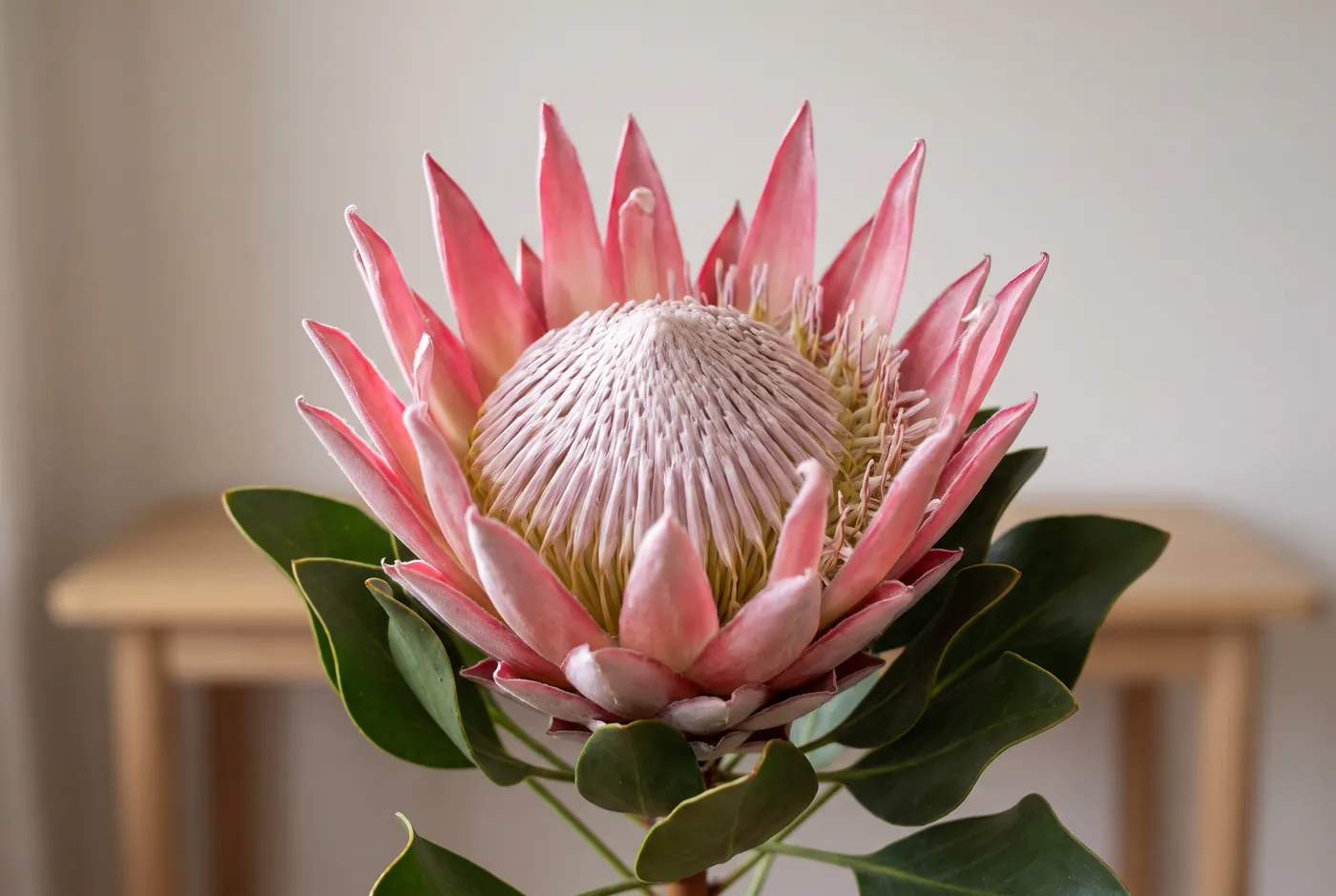
A king protea is the size of a side plate and looks like something from before flowers were invented, which is roughly right: the family goes back to Gondwana. A ring of stiff pointed bracts surrounds a dense fur-covered dome of hundreds of true flowers, and the whole thing sits on a woody stem with leathery leaves.
It is a florist's problem-solver. One stem carries an arrangement, it lasts two to three weeks fresh, and when it finally goes over it dries into a permanent object rather than dying. It is South Africa's national flower and there are more than 1,500 species in the family.
Primary Meanings
- Transformation: The family regenerates after wildfire
- Courage: From its hardiness in harsh ground
- Diversity: Named for Proteus, who could take any shape
- Daring: Given for boldness, fitting its appearance
Protea Colors and Their Meanings
Pink King Protea
The classic and the largest
Cream Protea
Understated; popular for modern weddings
Red Protea
Boldness; deep crimson forms
Orange Pincushion
Leucospermum, the spiky pincushion type
Silver Protea
Silvertree foliage, grey and felted
Popular Protea Types
King Protea
Protea cynaroides, the giant; one stem is a display
Pincushion
Leucospermum, spiky and bright orange or yellow
Blushing Bride
Serruria, small, delicate and pale pink
Banksia
Australian relative, dense cylindrical brush of flowers
Care Instructions
Cut on a Sharp Angle
Woody stems need a clean angled cut, recut weekly.
Strip Lower Leaves
Leaf blackening is the usual failure. Remove them early.
Clean Water
Change it often; they are sensitive to bacteria.
Let It Dry
Leave it in an empty vase and it becomes permanent.
Best Occasions for Protea
- Modern Weddings: The signature flower of the textural bouquet style
- Statement Arrangements: One stem does the work of a bunch
- Dried Displays: It dries into a lasting object rather than dying
- Masculine Gifting: Often chosen where a conventional bouquet would not suit
Interesting Protea Facts
- The king protea is South Africa's national flower
- The 'petals' are bracts; the true flowers are the furry dome inside
- The family is ancient enough to predate the breakup of Gondwana
- Many species need fire to release their seed
- Named after Proteus, the Greek god who could change shape at will
How to Buy Good Protea
Look at the leaves rather than the bloom. Leaf blackening is the characteristic protea failure, caused by the leaves using up sugars after cutting, and it starts at the tips. A stem with black-edged foliage in the shop will be worse in a week. The bracts should be firm and hold their shape when touched, and the furry center should look dense rather than shedding. Check the woody stem is not split or dried at the base, which is common on stems that have been shipped a long way dry.
Season, Availability and What Drives the Price
Most protea reaching the United States is grown in South Africa, and its flowering peak is the southern winter, so supply is strongest and best value from about May to September. Californian and Hawaiian growers fill much of the rest of the year. The price is high whatever the season and king protea is the highest of all, because it is a slow-growing shrub and each stem carries one enormous bloom. It has become steadily more expensive as the textural wedding style spread.
What to Use Instead
Banksia is the closest relative in feel, with the same brush-like density at a lower price. Pincushion protea gives the same family character in a smaller, brighter form and costs considerably less than a king. Globe thistle and echinops give a similar spiky architecture at a fraction of the price. Dahlias in the dinner-plate forms give comparable scale, though nothing like the texture. For a single stem that carries an entire arrangement, bird of paradise is the alternative.
Safety Around Pets and Skin
Protea is not listed as toxic to cats or dogs. It is not a flower most animals show any interest in, being woody and leathery. As with any plant material a pet eating a quantity may be sick, but there is no specific toxin and it does not appear on the ASPCA hazard list.
Florist Tips for Protea
Strip the lower leaves immediately
Leaf blackening is what ruins protea, and it starts because the leaves keep respiring after cutting. Removing the lower ones at once slows it considerably.
Do not throw it away when it fades
Take it out of the water and stand it somewhere dry. Protea dries into a permanent object with almost no loss of shape, which is why it turns up in dried arrangements years later.
Buy one, not three
A king protea is the size of a side plate. One stem with foliage is a complete arrangement, and buying several usually looks worse and costs a great deal more.
Common Questions About Protea
Why are the leaves on my protea turning black?
It is the classic protea problem, called leaf blackening. The leaves continue using sugars after the stem is cut and darken from the tips inward. Strip the lower leaves when you get it home, keep the water clean and out of strong light, and recut weekly.
Is the pink part the flower?
No. The pointed pink parts are bracts. The actual flowers are the hundreds of tiny structures making up the furry dome in the center, which is why it looks like a cushion rather than a bloom.
Can you dry protea?
Yes, better than almost any flower. Take it out of water when it starts to fade and leave it standing somewhere dry. It holds its shape and color for years, which is part of why the price is easier to justify.