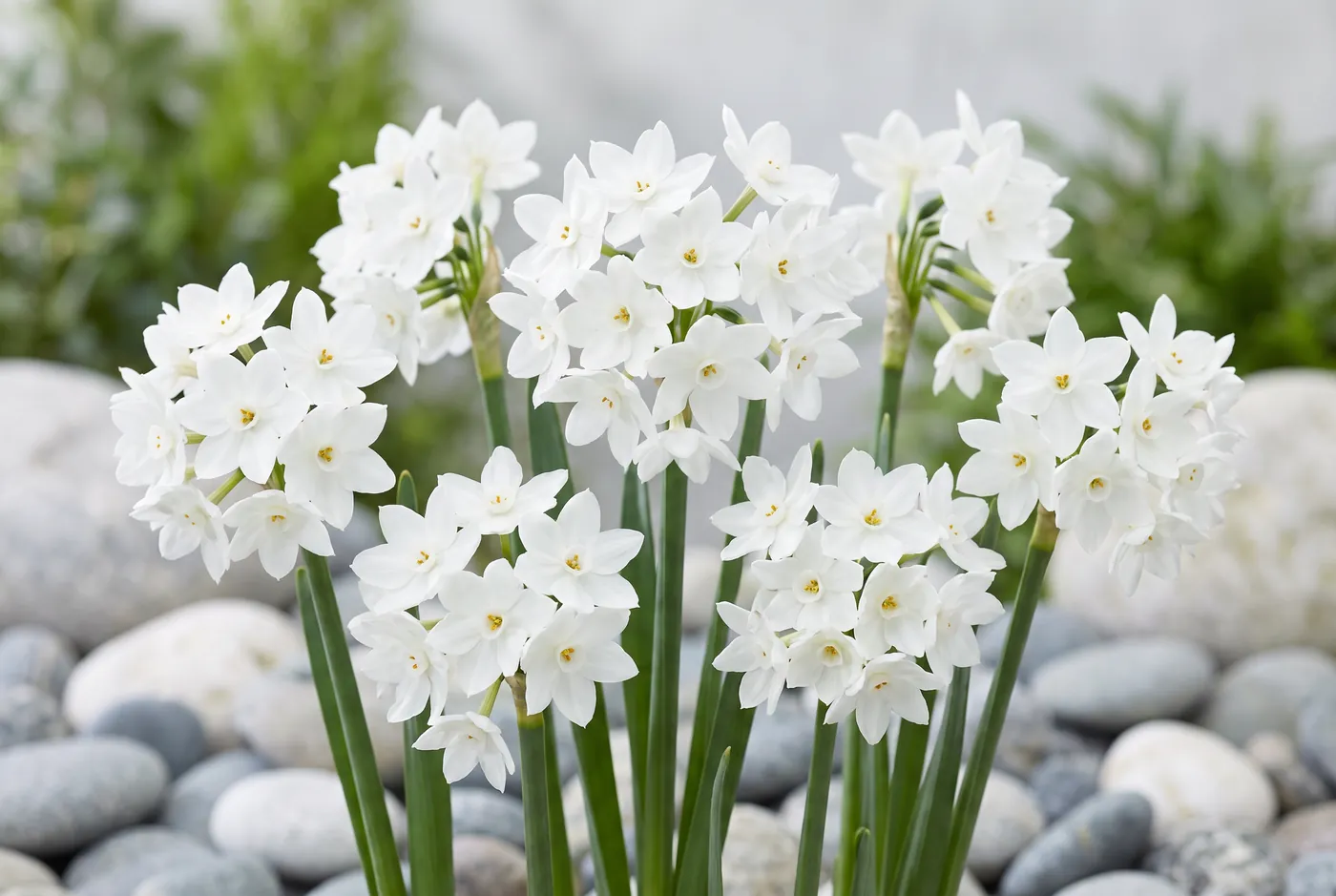
About Paperwhites
Paperwhites are the narcissus that flowers indoors at Christmas. Clusters of small pure white flowers on a green stem, forced from bulbs in a bowl of pebbles and water, from planting to flowering in three to five weeks with no cold period required. That last part is what separates them from every other bulb.
The scent divides people more sharply than any other flower. Some find it sweet and honeyed; others describe it as sour or faintly like cat urine, and both camps are describing the same compound. There is no middle ground and no point arguing about it.
Primary Meanings
- Rebirth: Shared with all narcissus
- Hope: Flowering indoors in midwinter
- New Beginnings: December birth flower in some traditions
- Respect: The traditional narcissus association
Paperwhites Colors and Their Meanings
Pure White Paperwhite
The classic; Ziva and similar
Cream Paperwhite
Softer varieties with warmer cups
Yellow-Cupped
Grand Soleil d'Or, a related forced narcissus
Popular Paperwhites Types
Ziva
The commercial standard; fastest and most strongly scented
Inbal
Milder scent, the choice for people who dislike Ziva
Nir
Shorter and sturdier, less prone to flopping
Grand Soleil d'Or
Yellow with an orange cup, a related forced type
Care Instructions
Pebbles and Water
No soil needed. Water just below the bulb base.
Cool and Bright
Warmth makes them stretch and fall over.
The Alcohol Trick
Dilute spirits stunt the stems and stop flopping.
Or Just Tie Them
Twine and a stake works as well and is easier.
Best Occasions for Paperwhites
- Christmas: The classic forced indoor bulb of the season
- Winter Gifting: A bowl of bulbs lasts far longer than a bouquet
- December Birthdays: Narcissus is a December birth flower
- Table Displays: Grown in shallow bowls as a centrepiece
Interesting Paperwhites Facts
- Unlike other narcissus they need no cold period, so they force in weeks
- Planting to flowering takes three to five weeks
- The scent is genuinely divisive; the compound responsible is indole
- Diluted alcohol in the water stunts stem growth and stops them flopping
- Bulbs are exhausted after forcing and cannot be reused
How to Buy Good Paperwhites
Buy bulbs that feel heavy and firm with no soft spots at the base and no mold between the papery layers. Size matters here as it does with amaryllis: a bigger bulb produces more stems. If you dislike the scent, ask for Inbal rather than Ziva, which is the standard and the most pungent. Buy them in stages a fortnight apart rather than all at once, and you get flowers through December and January instead of one week of everything.
Season, Availability and What Drives the Price
Bulbs appear from October and the forcing season runs to February. They are cheap, and unlike amaryllis they are genuinely disposable: the bulb exhausts itself in the process and cannot be kept for a second year, which is worth knowing before anyone tries. Prices are lowest early in the season when the bulbs first arrive, and stock thins out after Christmas.
What to Use Instead
Amaryllis is the other classic forced Christmas bulb, far larger, unscented and reusable for years. Hyacinth forces just as easily with a stronger but generally more popular scent. Grand Soleil d'Or is a paperwhite relative in yellow for anyone who wants the same effect with a different look. For scent-free winter flowers, cyclamen and Christmas cactus are the alternatives.
Safety Around Pets and Skin
Paperwhites are toxic to cats and dogs, as all narcissus are. The bulbs contain lycorine and are the most dangerous part, causing vomiting, drooling, diarrhoea and in larger amounts tremors and cardiac effects. Because paperwhites are grown in open bowls at table height with the bulbs fully exposed, they are considerably more accessible to a curious animal than a planted bulb would be. Keep bowls well out of reach.
Florist Tips for Paperwhites
The alcohol trick genuinely works
Once shoots are a few inches high, replace the water with a solution of roughly one part spirits to seven parts water. It stunts stem growth by about a third without affecting the flowers, so they stay upright. Cornell tested this properly. Do not use beer or wine, which have sugars that rot the bulbs.
Or just keep them cold and tie them
A cool bright room does most of the same job, and twine round a bowl of stems is less trouble than mixing solutions.
Do not try to keep the bulbs
They exhaust themselves forcing indoors and will not flower again. Compost them and buy new ones, which is what makes them cheap.
Common Questions About Paperwhites
Why do my paperwhites flop over?
They stretch in warmth and low light. Keep them cool and bright, or use the alcohol trick: once the shoots are a few inches tall, water them with about one part spirits to seven parts water. It shortens the stems by roughly a third without harming the flowers.
Why do paperwhites smell so strange?
The scent contains indole, a compound that reads as sweet and floral to some people and sour or unpleasant to others. It genuinely divides people. If you dislike it, the Inbal variety is much milder than the standard Ziva.
Can I keep paperwhite bulbs for next year?
No. Forcing exhausts them and they will not flower again, unlike amaryllis or hyacinths. Buy fresh bulbs each autumn; they are inexpensive.