About Agapanthus
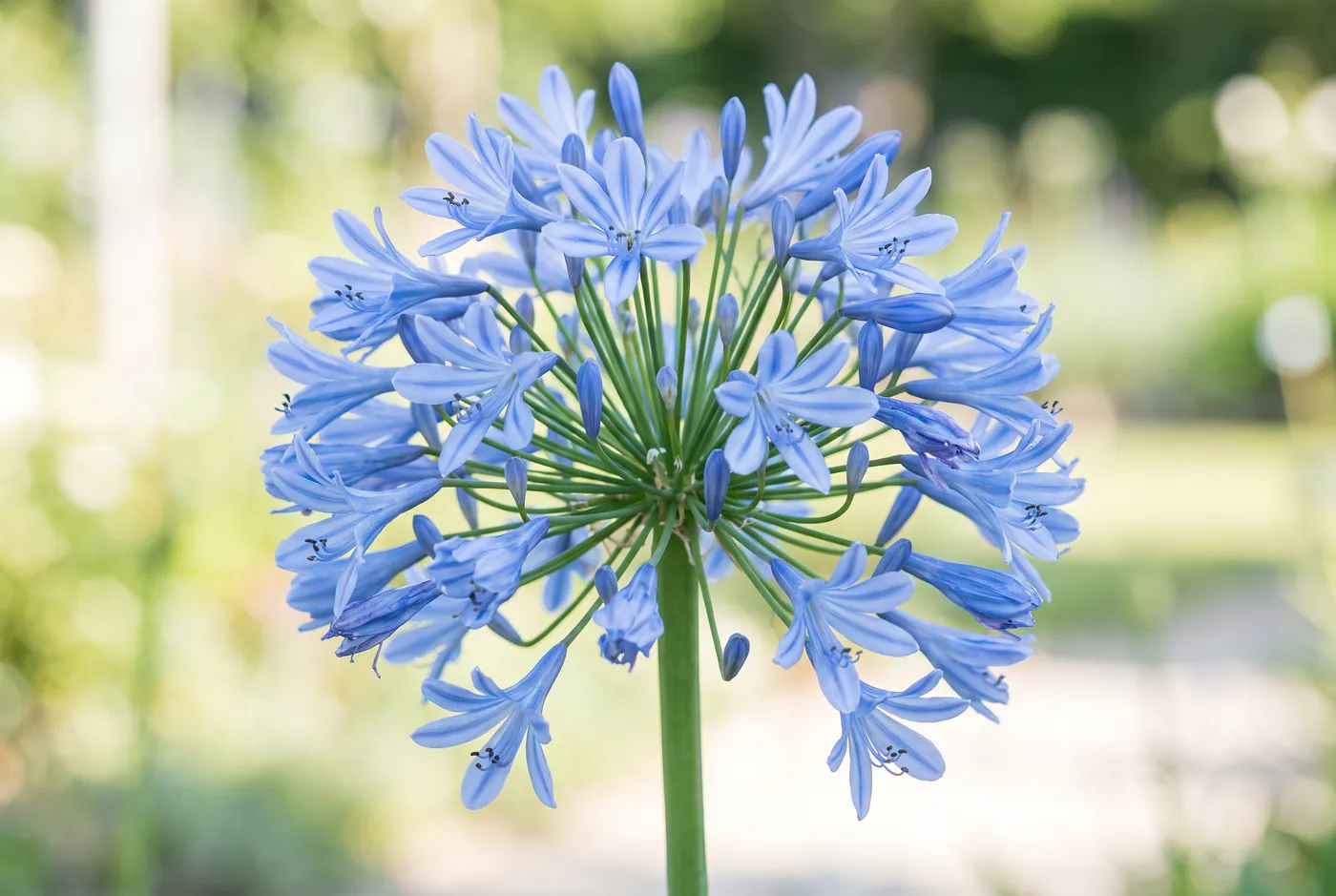
Agapanthus is a loose sphere of trumpet-shaped flowers, usually a clear mid-blue, held high on a bare stem with no foliage anywhere near it. It flowers in high summer, and a group of stems in a tall vase gives height and colour with almost no arranging required.
It is called African lily and lily of the Nile, and it is neither a lily nor from the Nile. It is South African, and it is more closely related to amaryllis and onions than to anything called a lily.
Primary Meanings
- Love Letters: The name means flower of love in Greek
- Fertility: The traditional South African association
- Beauty: The Victorian meaning
- Protection: Long planted at doorways in its native range
Agapanthus Colors and Their Meanings
Mid Blue Agapanthus
The classic and the reason to buy it
Deep Violet Agapanthus
Darker cultivars
White Agapanthus
Purity; widely used in weddings
Bicolour Agapanthus
White with blue stripes
Green Seed Heads
The structure after flowering, sold separately
Popular Agapanthus Types
Agapanthus africanus
Evergreen, deep blue, the classic
Agapanthus praecox
The most widely grown commercial cut variety
Deciduous Hybrids
Hardier types bred for cooler climates
Seed Heads
The green architectural structure after flowering
Care Instructions
Deep Water
Tall hollow stems drink heavily.
Recut
Trim mid-life; it lasts a fortnight or more.
Remove Spent Florets
The head opens in sequence over days.
Wash Your Hands
The sap irritates skin and it is toxic.
Best Occasions for Agapanthus
- Summer Arrangements: Height and blue when both are wanted
- Weddings: White forms in tall pedestal work
- Modern Design: The bare stem suits minimal arrangements
- Dried Work: The seed heads keep their structure
Interesting Agapanthus Facts
- The name means flower of love, from the Greek agape and anthos
- It is neither a lily nor from the Nile; it is South African
- The seed heads are sold as a separate architectural product
- The sap causes skin irritation and mouth ulceration if chewed
- It is one of relatively few genuinely blue flowers available in summer
How to Buy Good Agapanthus
Buy a head where roughly a third of the florets have opened and the rest are still in coloured bud, because it opens in sequence over about a week. The bare stem should be rigid its whole length; a soft stem cannot hold the weight of a full head and will bend permanently. Look for browning on the earliest-opened florets, which dates the stem, and check the cut end is not split, since these stems are hollow and crush easily in transit.
Season, Availability and What Drives the Price
High summer is the natural season and when it is best and cheapest, with Dutch and South African imports extending availability either side at higher prices. It is a moderate-priced flower for the height you get, which makes it useful for large summer arrangements where blue is wanted. Wedding demand for the white forms is what moves the price rather than any holiday.
What to Use Instead
Allium gives a tighter, more geometric sphere in late spring on the same kind of bare stem. Nerine covers autumn with a similar umbel structure. For blue specifically, delphinium and larkspur give height in a spike rather than a globe, and hydrangea gives mass. Scabiosa provides blue at a much smaller scale. Nothing else offers a loose blue sphere on a metre of bare stem in July.
Safety Around Pets and Skin
Agapanthus is toxic to cats and dogs. The sap contains saponins and other irritants, and chewing any part causes intense mouth irritation, drooling, vomiting and diarrhoea. The sap also causes skin irritation and, more seriously, ulceration if it gets into the mouth, which is a documented issue for gardeners as well as pets. Wear gloves when cutting quantities and keep stems away from animals.
Florist Tips for Agapanthus
Keep the seed heads
After the flowers go over, the green seed head is a sculptural object in its own right and is sold separately by some florists. Left to dry it holds its structure for months.
Wash your hands after cutting
The sap irritates skin and can cause ulceration if it reaches your mouth. It is not a flower to handle casually in quantity.
Use height deliberately
The bare stem is the whole point. In a tall vase with nothing else, three stems read as designed; buried in a mixed bouquet the effect is wasted.
Common Questions About Agapanthus
Is agapanthus a lily?
No. Despite African lily and lily of the Nile, it is not a lily and is not from the Nile. It is South African and sits in the Amaryllidaceae, closer to amaryllis and onions than to true lilies.
Is agapanthus poisonous?
Yes, to cats and dogs, and the sap irritates human skin. Chewing any part causes mouth irritation, drooling and vomiting, and the sap can cause ulceration if it gets into the mouth. Wear gloves when handling quantities.
What are the green globes sold after flowering?
Agapanthus seed heads. Once the flowers finish, the structure remains as a green architectural sphere that dries well and is sold as a cut product in its own right.