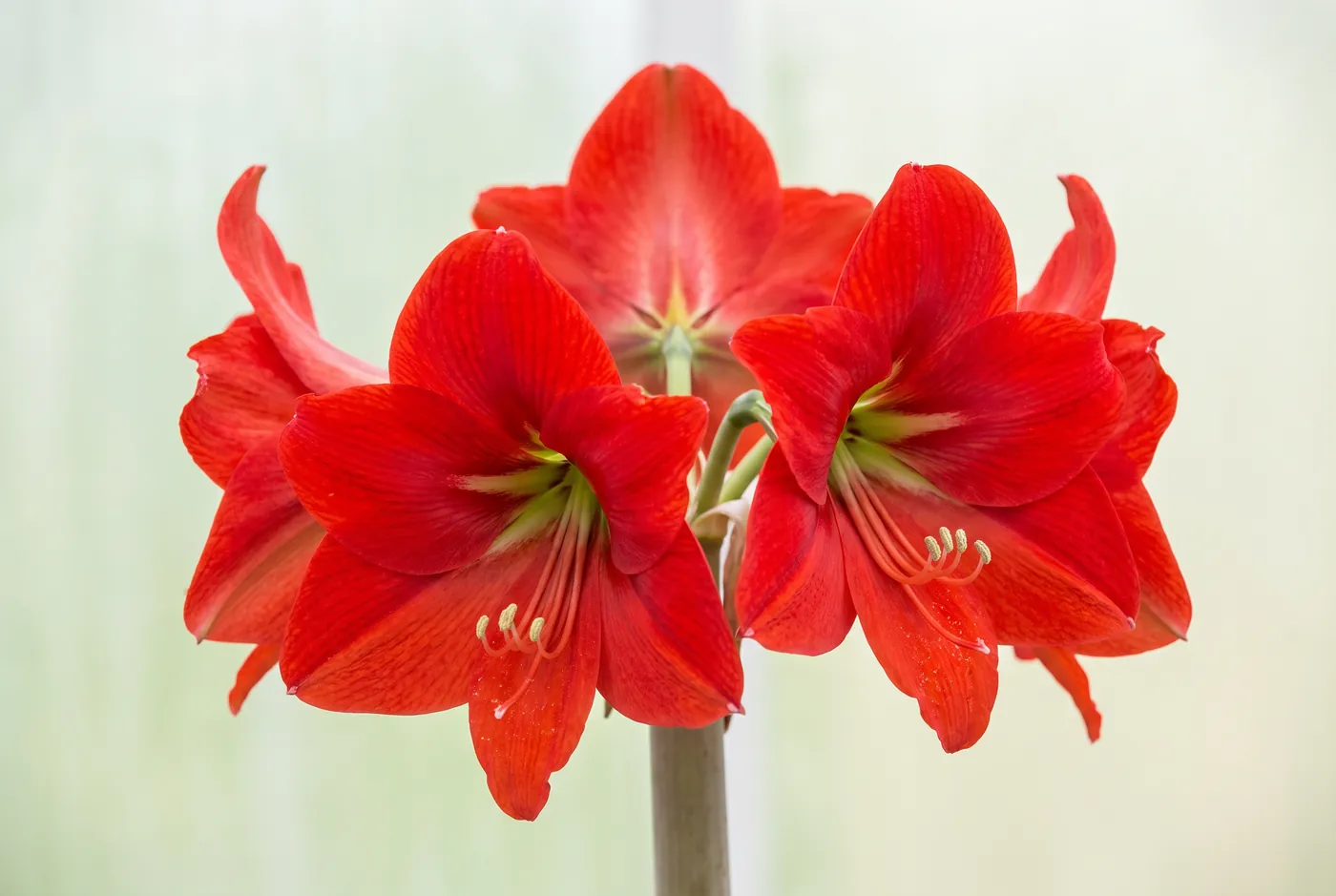
About Amaryllis
Amaryllis is the flower that makes midwinter look deliberate. A single thick hollow stem carries three or four trumpets the size of a hand, opening over a week or so, and the whole thing comes from a bulb the size of a fist with nothing else required. It is sold both as a bulb to grow and as a cut stem, and the two are quite different purchases.
Almost everything sold as amaryllis is really Hippeastrum, a South American genus. True Amaryllis is a South African plant that flowers outdoors in autumn. Nobody in the trade uses the correct names and it is far too late to fix.
Primary Meanings
- Pride: The traditional meaning, from its size and bearing
- Determination: It flowers in the dead of winter from a dormant bulb
- Radiant Beauty: The Victorian association
- Achievement: Commonly given to mark something completed
Amaryllis Colors and Their Meanings
Red Amaryllis
The Christmas classic and the biggest seller
White Amaryllis
Purity; the most elegant of the range
Pink Amaryllis
Affection, softer and increasingly popular
Striped Amaryllis
Red and white candy-striped varieties
Apricot Amaryllis
Warmth; the newest colour group
Popular Amaryllis Types
Single Large-Flowered
The standard: four huge open trumpets per stem
Double Amaryllis
Many-petalled, heavier heads, needs support
Cybister
Spidery narrow petals, nothing like the usual shape
Miniature
Smaller flowers, more stems per bulb, better on a table
Care Instructions
Support the Stem
Hollow stems collapse under the weight. Stake or use a narrow vase.
Shallow Water
Cut stems only need a few inches; deep water rots them.
Keep Cool
A cool room slows the flowers and adds days.
Bulbs Need Light
Growing bulbs want a bright windowsill and very little water until shoots appear.
Best Occasions for Amaryllis
- Christmas: Its main commercial season by a wide margin
- Winter Gifting: A bulb in a pot lasts far longer than a bouquet
- Congratulations: The achievement association fits milestones
- Modern Arrangements: Cut stems give scale that nothing else matches
Interesting Amaryllis Facts
- Nearly all amaryllis sold is actually Hippeastrum, a different genus
- The stems are hollow and will split or fold under the weight of the flowers
- A bulb can be kept and reflowered for decades with a proper rest period
- Larger bulbs produce more stems; bulb size is the single best quality indicator
- It flowers without soil, which is why waxed bulbs sitting on a shelf work at all
How to Buy Good Amaryllis
If you are buying a bulb, buy the biggest one you can. Bulb size is the single reliable predictor of how many stems you get, and a large bulb often gives two or even three where a small one gives one. It should feel heavy and firm with no soft patches at the base, and the roots underneath should look pale and alive rather than shrivelled. For cut stems, look for tight fat buds showing color at the tip and a stem that is firm all the way down; any softness low down means it is already collapsing internally.
Season, Availability and What Drives the Price
This is a Christmas crop and its season is roughly November to February. Bulbs are lifted, chilled and forced to flower in midwinter, which is the entire commercial point: it produces a huge flower at the time of year when nothing else does. Prices peak in early December and fall away sharply afterwards. Buying in January is genuinely good value if you want flowers rather than a gift, since a discounted large bulb will perform exactly the same.
What to Use Instead
For scale in winter at lower cost, oriental lilies give the same drama and a strong scent, which amaryllis lacks. Gladiolus offers height rather than size. If the point is a living gift that lasts, a phalaenopsis orchid flowers for months rather than weeks and costs about the same. Paperwhite narcissus is the cheap forced-bulb alternative and brings scent, though it is a fraction of the size and the smell divides people sharply.
Safety Around Pets and Skin
Amaryllis is toxic to cats and dogs, and the bulb is considerably more dangerous than the flower. It contains lycorine, and eating the bulb causes vomiting, drooling, diarrhoea, abdominal pain and lethargy. This matters more than with most cut flowers because the bulb sits at eye level on a windowsill for weeks and looks like something worth digging at. Keep potted bulbs off the floor and out of reach.
Florist Tips for Amaryllis
Fill the hollow stem with water and plug it
A florist's trick for cut amaryllis: turn the stem upside down, fill the hollow with water and plug the end with a small piece of cotton wool before putting it in the vase. It stops the stem collapsing and adds days.
Turn the pot every day
A growing bulb leans hard toward the light and will end up horizontal. A quarter turn daily keeps the stem upright without staking.
It will flower again if you let it rest
After flowering, keep the leaves going all summer, then withhold water for eight to ten weeks in autumn to force dormancy. Bring it back into warmth and it reflowers. Bulbs kept this way last decades.
Common Questions About Amaryllis
Why did my amaryllis stem flop over?
The stems are hollow and the flowers are extremely heavy for them. Either stake it, use a narrow-necked vase that holds it upright, or use the cotton wool trick: fill the hollow stem with water and plug the end before it goes in the vase.
Can I keep the bulb for next year?
Yes, and they last for decades. Keep the leaves growing and fed through summer, then stop watering for eight to ten weeks in autumn so it goes dormant. Bring it back into a warm bright spot and it will flower again.
Is amaryllis poisonous to cats?
Yes. All parts contain lycorine and the bulb is the worst of it, causing vomiting, drooling and lethargy. Because a potted bulb sits out for weeks it is more exposed than a cut flower, so keep it well out of reach.