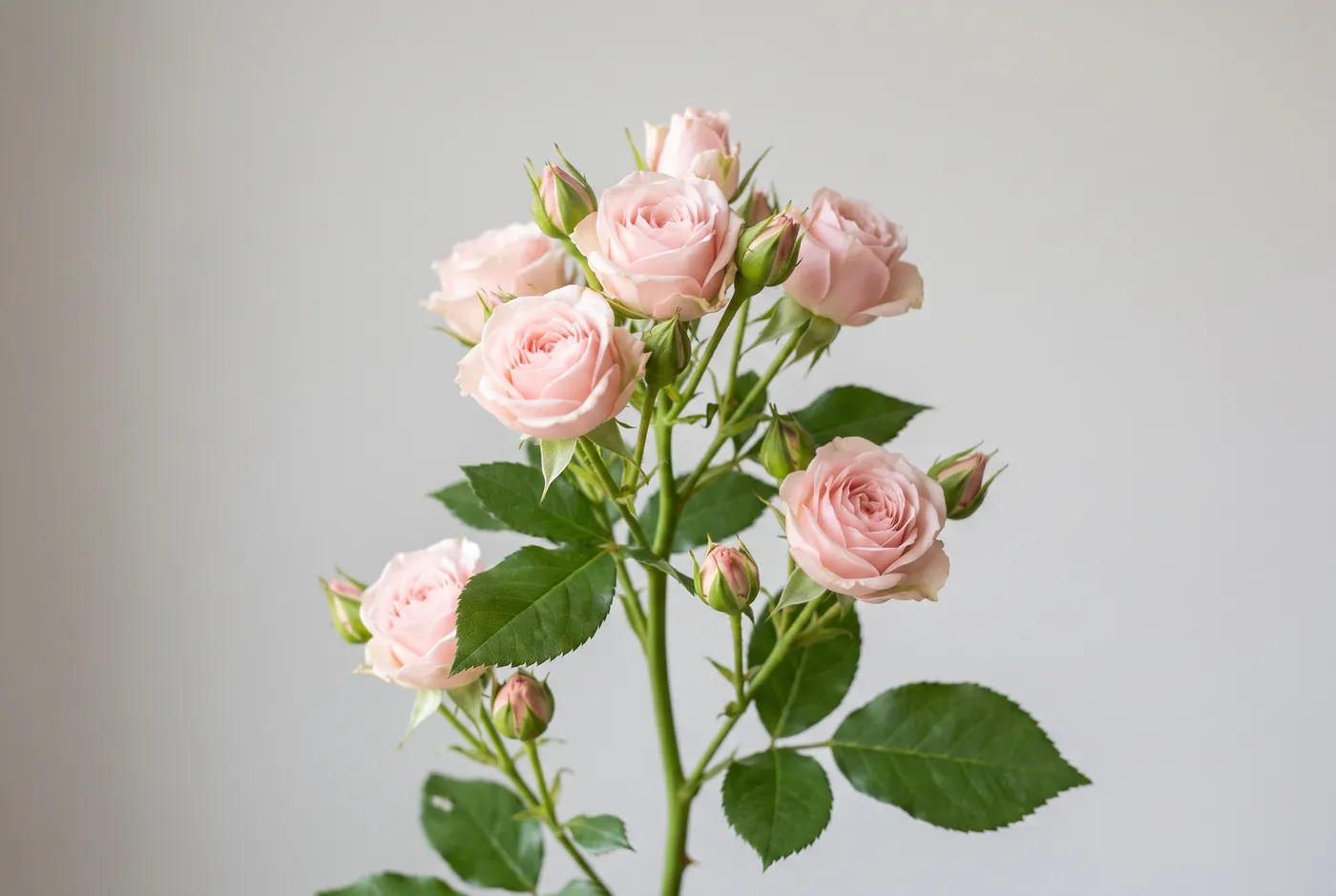
About Spray Roses
A spray rose is a rose stem carrying several small blooms instead of one large one, usually three to seven, opening in sequence. That single structural difference changes what it is useful for: it fills space faster, it costs less per flower, and because the blooms open over several days a stem stays interesting for longer than a standard rose does.
This page is about the form rather than about roses generally. How to judge a rose, what drives its price and how to condition one belongs on the main rose page, and the deeper cupped garden types have their own.
Primary Meanings
- Grace: The general spray rose association
- Gratitude: Commonly given as thanks
- Abundance: From several blooms on one stem
- Gentle Affection: The smaller bloom reads as less formal
Spray Roses Colors and Their Meanings
Blush Spray Rose
The wedding standard
White Spray Rose
Purity; heavy bridal use
Coral Spray Rose
Warmth; very widely grown
Deep Red Spray Rose
Love, at a smaller scale
Bicolour Spray Rose
Two-toned petals, common in sprays
Popular Spray Roses Types
Standard Spray Rose
Three to seven small blooms per stem
Sweetheart Rose
Small single-bloom roses, often confused with sprays
Spray Garden Rose
The ruffled garden form in spray habit
Micro Spray
Very small blooms, used in buttonholes and crowns
Care Instructions
Recut Under Water
Same air lock risk as any rose.
Remove Spent Blooms
The rest of the spray keeps going.
Clean Water
Change every couple of days.
Strip Low Foliage
Rose leaves rot fast below the waterline.
Best Occasions for Spray Roses
- Weddings: Bouquets, crowns and buttonholes
- Mixed Bouquets: Volume at lower cost than standard roses
- Buttonholes: The bloom size suits it exactly
- Everyday Gifting: More flowers per stem for the money
Interesting Spray Roses Facts
- One stem carries three to seven blooms that open in sequence
- Cost per bloom is usually well below a standard rose
- Sweetheart roses are single small roses, not sprays, despite the confusion
- They fill space faster than standard roses, which matters in large arrangements
- Removing spent blooms keeps the rest of the spray going
How to Buy Good Spray Roses
Judge the whole spray rather than one bloom. A good stem has one or two flowers just opening, several in colored bud and a couple still tight, which gives you a week of sequence. A spray where everything is open at once finishes together. Count the blooms, because that is what you are buying and stems vary considerably; five is typical and three is poor value. Check the junctions where each bloom meets the main stem, since those are the weak points.
Season, Availability and What Drives the Price
Grown under glass year-round in Colombia, Ecuador, Kenya and the Netherlands, exactly as standard roses are. The important commercial point is that Valentine's Day distorts red standard roses far more than it distorts sprays, so in early February a spray rose is often much better value than the equivalent standard stem. Outside that week the price gap narrows but sprays remain cheaper per bloom.
What to Use Instead
Standard roses give one large formal bloom where a spray gives several small ones. Garden roses give the ruffled scented form at roughly triple the price. Lisianthus is the closest non-rose substitute for the look and lasts longer. Ranunculus reads similarly in spring. Where a spray rose is genuinely the right answer is buttonholes and crowns, where a full-size rose is simply too big.
Safety Around Pets and Skin
Roses of every kind, sprays included, are non-toxic to cats and dogs. The only hazard is mechanical: thorns, and a pet cutting its mouth on a chewed stem. Spray roses are usually well de-thorned commercially, more so than garden roses, but check before a vase goes somewhere an animal can reach.
Florist Tips for Spray Roses
Count the blooms before you buy
You are buying flowers per stem, not stems. A spray with six blooms and one with three often cost the same, and the difference is entirely visible in the bucket.
Deadhead as they go
Pinch off each bloom as it finishes and the remaining buds open properly. A spray left with dead heads on it looks finished long before it is.
They beat standard roses at Valentine's
Red standard roses carry the whole Valentine's price distortion. Sprays barely move, so in February they are usually far better value for the same amount of color.
Common Questions About Spray Roses
What is the difference between a spray rose and a standard rose?
A standard rose has one large bloom on a stem. A spray rose carries several smaller blooms, usually three to seven, which open in sequence. The spray gives more flowers and more volume for the money; the standard gives one large formal bloom.
Are spray roses cheaper?
Per bloom, almost always, and the gap widens around Valentine's Day when red standard roses carry the whole price spike and sprays barely move.
Are sweetheart roses the same as spray roses?
No, though the terms get muddled. Sweetheart roses are small single-bloom roses on their own stems. Spray roses carry multiple blooms on one stem.