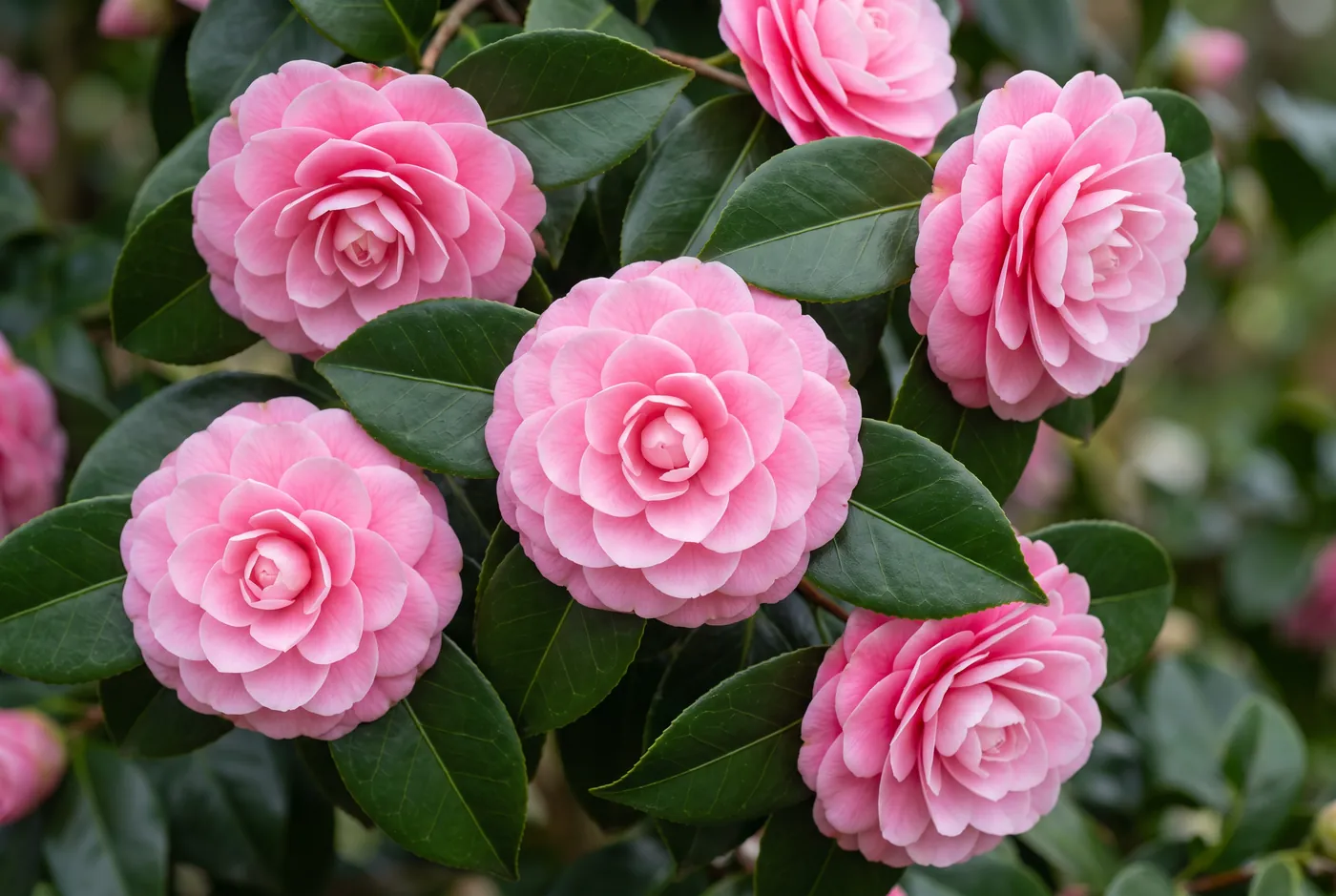
About Camellia
Camellia flowers look almost artificial: perfectly ordered rows of overlapping petals in white, pink or deep red, set against thick glossy evergreen leaves. They flower from late autumn through to spring, which is a strange time for something that looks so much like a summer rose.
The genus also gave the world tea. Camellia sinensis is the tea plant, the same genus as the ornamental japonica in gardens, though nobody makes a drink from the showy ones.
Primary Meanings
- Devotion: The classic meaning, from long-lived evergreen plants
- Longing: The Victorian association, particularly the pink forms
- Perfection: From the geometric formality of the bloom
- Steadfastness: It flowers reliably through winter
Camellia Colors and Their Meanings
Pink Camellia
Longing; the most common ornamental
White Camellia
Purity and adoration
Deep Red Camellia
Devotion and passion
Variegated Camellia
Streaked and flecked forms
Glossy Foliage
The leaves, cut and sold as greenery
Popular Camellia Types
Camellia japonica
The formal double garden classic
Camellia sasanqua
Earlier, looser, lightly scented
Camellia sinensis
The tea plant; small white flowers
Williamsii Hybrids
Bred to drop spent flowers cleanly
Care Instructions
Split the Stem
Woody evergreen wood; split the end.
Handle Gently
Petals mark brown at a touch, like magnolia.
Cool Water
It prefers cold; heat drops the flowers.
Float Short Blooms
Short stems float beautifully in a bowl.
Best Occasions for Camellia
- Winter Arrangements: One of few things flowering in the cold
- Weddings: The foliage as much as the flower
- Chinese New Year: Traditional in late winter displays
- Sympathy: White forms, for their formality
Interesting Camellia Facts
- Camellia sinensis is the tea plant, the same genus as the garden ornamentals
- Ornamental camellias have almost no scent, unusual for such a showy flower
- Whole flowers drop intact rather than shedding petals
- The Williamsii hybrids were bred specifically to shed cleanly
- It is the state flower of Alabama
How to Buy Good Camellia
Camellia is not a mainstream cut flower, so you will usually be cutting it from a garden or buying from a specialist. Choose flowers that have just opened fully, with petals still crisp and no brown edging, since browning starts at the margins and spreads fast. Handle by the stem alone. Check the foliage as carefully as the flower, because glossy undamaged leaves are half of what makes a camellia stem worth having, and scale insect leaves black sooty patches on them.
Season, Availability and What Drives the Price
Sasanqua types start in late autumn, japonica through winter into early spring. That unusual timing is exactly why florists value them: they flower when almost nothing else on woody stems does. There is very little commercial trade, so supply is mostly local and seasonal. The foliage, however, is cut year-round and sold as glossy dark greenery, and that is how most people encounter camellia in a shop without realizing.
What to Use Instead
Gardenia gives a similar waxy formality with an enormous scent, which camellia lacks. Ranunculus reproduces the layered geometry at a much smaller scale and far lower cost. Roses cover the same formal shape year-round. For winter woody stems, hellebores and early magnolia are the realistic alternatives. For the glossy dark foliage, ruscus and salal do the same job and last longer.
Safety Around Pets and Skin
Camellia is not toxic to cats or dogs and is not on the ASPCA hazard list. It is safe around animals, which is worth noting given that its close relative is the tea plant and people often assume caffeine content. Ornamental camellias are not a source of caffeine and the flowers are harmless.
Florist Tips for Camellia
Float the short ones
Camellia stems are often too short to arrange. A single bloom floated face-up in a shallow bowl of water is the traditional way to display them and shows the geometry far better than a vase.
Expect whole flowers to drop
Camellias shed the entire bloom intact rather than losing petals one by one. It looks alarming and is completely normal.
The leaves are worth as much as the flowers
Glossy dark camellia foliage is excellent cut greenery and lasts for weeks after the flowers have gone. Do not bin the stem.
Common Questions About Camellia
Is camellia the same plant as tea?
Same genus. Tea comes from Camellia sinensis; the showy garden and cut varieties are usually Camellia japonica. They are relatives, but nobody makes tea from the ornamental ones and those flowers contain no caffeine.
Why do camellia flowers fall off whole?
That is how the plant sheds. Rather than dropping petals individually, the entire bloom detaches intact. Some hybrids, particularly the Williamsii group, were bred specifically so this happens cleanly rather than leaving brown flowers on the plant.
Why don't camellias smell of anything?
Most ornamental camellias have little or no fragrance, which is unusual for a flower that showy. Sasanqua types carry a light scent; japonica generally has none at all.