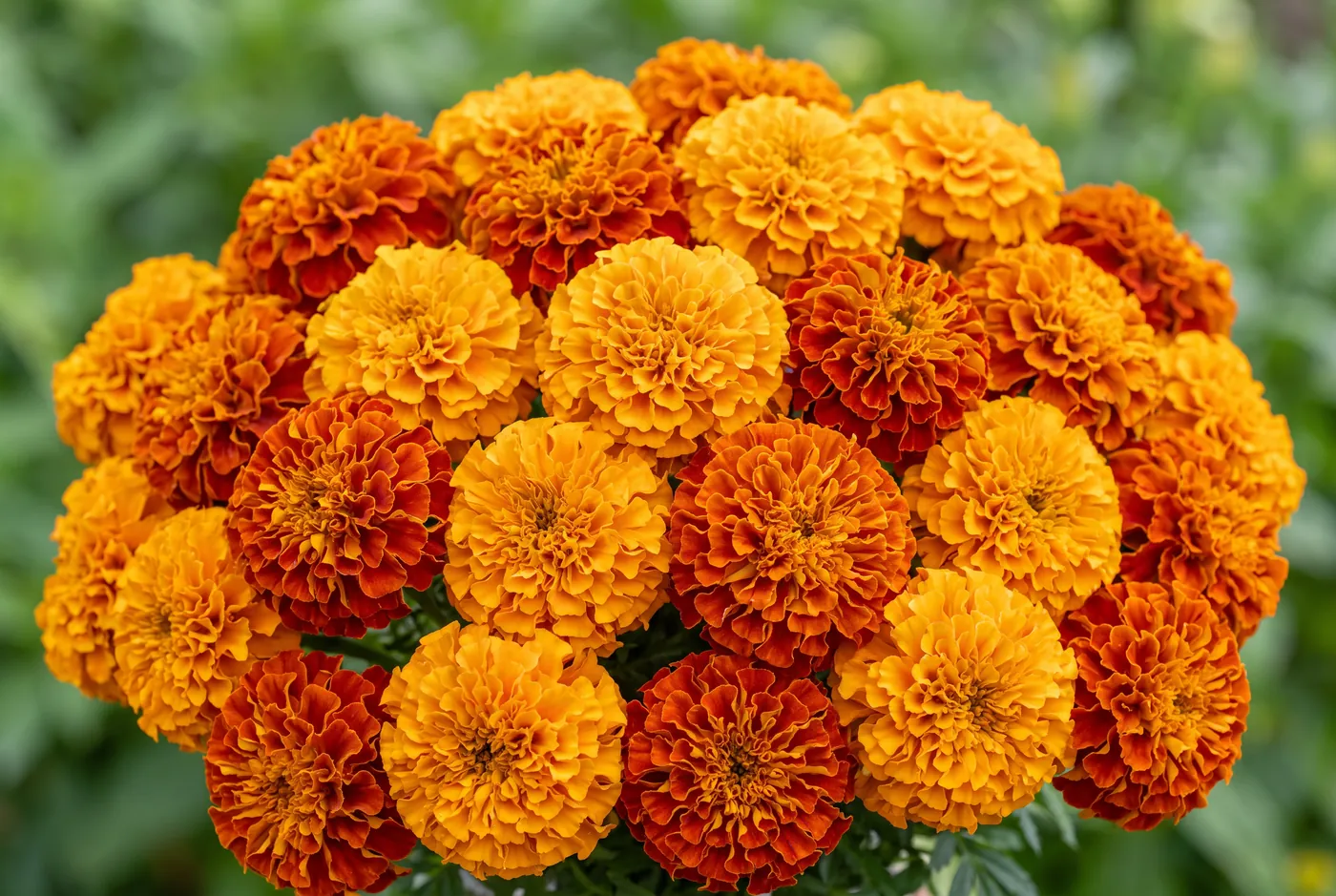
About Marigolds
Marigolds carry more cultural weight in the United States than almost any other flower, and most florists still treat them as a bedding plant. For Día de los Muertos they are cempasúchil, the flower of the dead: grown by the million, sold by the armful in late October, and used to make the scented path that guides the dead home. That is a serious annual market and it is nothing to do with garden borders.
They are also October's birth flower, they last extremely well cut, and the scent is genuinely divisive. Almost nobody is neutral about it.
Primary Meanings
- Remembrance of the Dead: The central meaning in Mexican tradition
- Warmth of the Sun: From the colour, and the Aztec association with the sun
- Grief: The Victorian meaning, quite separate from the Mexican one
- Devotion: Used in Hindu garlands and temple offerings
Marigolds Colors and Their Meanings
Deep Orange Marigold
The cempasúchil colour; the one that matters
Golden Yellow Marigold
Sunlight and warmth
Rust Marigold
Autumnal depth, French marigold types
Cream Marigold
A modern bred colour, rare in tradition
Popular Marigolds Types
African Marigold
Tagetes erecta, tall with large pompom heads; the cempasúchil
French Marigold
Tagetes patula, smaller and bushier, often bicoloured
Signet Marigold
Tiny single flowers, citrus-scented, edible
Calendula
Pot marigold, a different genus entirely despite the name
Care Instructions
Strip Foliage
The leaves are the source of the smell and rot fast.
Change Water
Every other day, or the water turns quickly.
Trim
Cut on an angle; the stems are hollow and crush easily.
Cool and Bright
They hold well but dislike a hot windowsill.
Best Occasions for Marigolds
- Día de los Muertos: Late October and 1-2 November; the biggest use by far
- October Birthdays: The birth flower for the month
- Diwali and Hindu Festivals: Strung into garlands for temples and doorways
- Autumn Arrangements: The strongest orange available in the season
Interesting Marigolds Facts
- Cempasúchil comes from Nahuatl and means roughly twenty-flower
- Petals are scattered to make a scented path guiding the dead home
- It is the birth flower for October
- Signet marigolds are edible and taste of citrus, unlike the large types
- Calendula, sold as pot marigold, is an unrelated genus
How to Buy Good Marigolds
Look for heads that are fully open and dense right through, because marigolds do not open much further once cut. Squeeze one gently: it should feel firm and packed, not hollow. The petals at the back of the head brown first, so turn a few over. Stems should be sturdy and pale green; hollow crushed stems mean rough handling and will collapse. If you are buying for an ofrenda, buy far more than seems reasonable, because loose petals for the path use up several times what the arrangement does.
Season, Availability and What Drives the Price
Marigolds flower from summer until the first frost, and the commercial peak is unmistakable: the fortnight before Día de los Muertos, when growers across Mexico and the southwestern United States harvest cempasúchil in enormous quantity. Prices in that window are set by that demand rather than by the general flower trade. Outside late October they are one of the cheapest flowers you can buy, and they hold remarkably well for something usually thought of as a bedding plant.
What to Use Instead
For the same intense orange in autumn, spray chrysanthemums are the closest and last even longer. Sunflowers give scale rather than density. Celosia in the cockscomb forms brings a similar depth of color with completely different texture. Zinnias cover the same season in a wider color range. For Día de los Muertos specifically nothing substitutes: the flower is the tradition, and the color and scent are the point of it.
Safety Around Pets and Skin
Marigolds are mildly toxic to cats and dogs. Eating them causes stomach upset, and the sap can irritate skin on contact, which is worth knowing if you are stripping large quantities for garlands. They are not dangerous in the way lilies are. Signet marigolds and calendula are edible and used in cooking, but the large African marigolds sold as cut flowers are not pleasant to eat and should not be treated as a garnish.
Florist Tips for Marigolds
Strip every leaf
The foliage carries most of the smell and rots fast in water. Taking it all off makes them last longer and tones the scent down considerably.
Buy loose petals separately for an ofrenda
Many suppliers sell petals by weight in the run-up to Día de los Muertos. Pulling them off whole stems yourself is slow and much more expensive.
The smell fades, the color does not
The pungency drops sharply after the first day or two in water, while the color holds for well over a week. If the scent puts you off, it is a short problem.
Common Questions About Marigolds
Why are marigolds used for Día de los Muertos?
They are cempasúchil, the flower of the dead. The color and the strong scent are believed to guide spirits home, and petals are scattered to make a path from the door to the ofrenda. The tradition predates the Spanish and the flower is native to Mexico, so it is genuinely the original plant rather than a substitute.
Do marigolds really smell that bad?
They have a strong pungent scent that people either dislike immediately or stop noticing. Most of it is in the foliage rather than the flowers, so stripping the leaves reduces it a great deal, and it fades after a day or two in water.
Is calendula the same as a marigold?
No, though it is sold as pot marigold. Calendula is a different genus with flatter, daisy-like flowers and a much milder scent, and its petals are commonly eaten. True marigolds are Tagetes.